
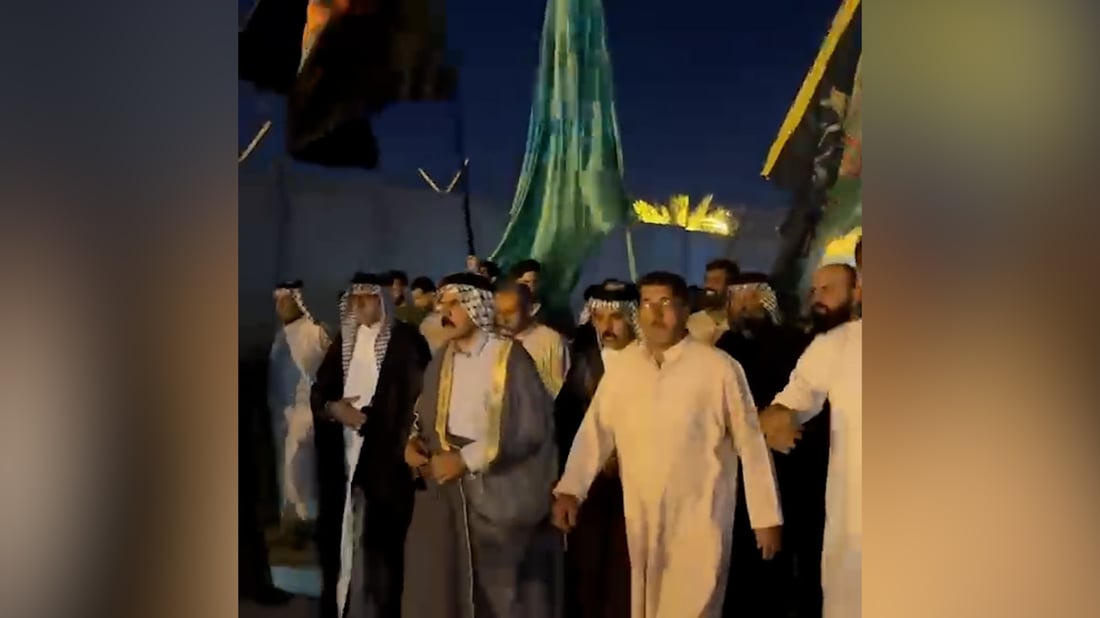
FILES: Residents of Basra’s Shuaiba area march toward a local electricity station in June to protest recurring power outages and demand improved electricity supply during the summer season.
Media Monitor
Nearly 60% of Iraq’s power lost before reaching consumers, ex-official says
BAGHDAD — Nearly 60% of the electricity Iraq generates never reaches consumers because of losses in its transmission and distribution networks, former Electricity Ministry spokesperson Ahmed Mousa al-Abadi said, arguing that repairing the distribution system should be the government’s first priority in tackling the decades-old power crisis.
Iraq needs about 62,000 megawatts in summer to supply round-the-clock power to households, businesses and factories, Abadi said in a televised interview, against current production of about 21,000 MW, according to the Electricity Ministry’s National Control Center. Demand peaks in summer, when temperatures frequently exceed 50°C, and many households rely on private neighborhood generators to fill the gaps.
Abadi served as the ministry’s spokesperson from 2016 until 2026 under five successive electricity ministers: Qasim al-Fahdawi, Luay al-Khatteeb, Majid Hantoush, Adel Karim and Ziad Ali Fadel. “I never got anything from this state except insults,” he said. “I am known for speaking frankly, and that honesty cost me a lot.” He said he had repeatedly warned of summer shortages because ministry data already pointed to insufficient generating capacity.
Ministry figures show that 55% to 59% of generated electricity is lost in distribution, Abadi said, meaning more than 11,000 MW of current output never reaches consumers. Building enough capacity to generate 1,000 MW costs about $1 billion under international standards, he said, a figure that covers generation alone and excludes transmission and distribution. “The state spends money to produce this 21,000 megawatts but does not receive its full benefit,” he said. “If management had been successful, Iraq would not have remained for more than 20 years without a fundamental solution.”
The crisis extends beyond generation and gas shortages to poor management, corruption, deteriorating infrastructure, missing meters, widespread illegal connections and aging overhead networks vulnerable to theft, he said. Comparisons with countries such as Britain, Egypt or Algeria are misleading, he added, because they do not face distribution losses approaching 59% or large areas without meters. “As long as the networks remain overhead, violations will continue until they are placed underground,” he said.
Abadi said the current minister had launched campaigns against illegal connections and begun introducing smart technologies but warned that reform would take time, and that successive governments had failed to draw on the expertise of senior engineers and specialists in choosing leadership. He said all government institutions except hospitals, prisons, water projects and heavy sewage pumping facilities had shifted to solar power.
He criticized pricing policy, saying the government sells electricity below production cost while subsidizing fuel for power stations, and said responsibility ultimately rests with the minister, who sets policy and oversees implementation. “If we want to begin reform, we start with the distribution network to eliminate losses and distribute electricity fairly,” he said.
Referring to Prime Minister Ali al-Zaidi’s visit to Washington, Abadi said the government’s emphasis on partnerships over conventional contracting was the right approach. “The prime minister said he wanted partnerships, not contractors,” he said. “Companies have shown their willingness.”
Abadi said Iraq should develop and process its own natural gas rather than rely on imported Iranian gas, which he said Iranian officials had repeatedly warned could not be guaranteed. “Iranians came to Iraq around 20 times and told us their gas reserves were declining and they would not always be able to supply us,” he said. They proposed extracting and processing Iraqi gas, he said, but the idea stalled because it fell under the Oil Ministry rather than the Electricity Ministry. Iraq relies on Iran for roughly one-third to 40% of the gas it uses to generate electricity; after attacks on Iran’s South Pars field earlier this year, deliveries fell sharply, forcing some stations onto alternative fuels. In May, the ministry said supply hours had declined across several governorates as imports fell and domestic output dropped.
The sitting electricity minister, Ali Saadi Waheeb, said Monday he had asked to brief Parliament on the power system and the measures being taken, after lawmakers moved to summon him at the direction of Speaker Haibat al-Halbousi. A day earlier the ministry apologized over declining supply hours, citing “exceptional circumstances” from reduced gas supplies linked to the regional conflict, rising demand, illegal connections, aging infrastructure and insufficient funding.
Solutions are achievable but require sustained investment, Abadi said. “We begin by reorganizing the distribution network, converting it underground and installing smart meters,” he said. “That requires investors, but without effective bill collection there is no funding. The budget covers only operating expenses.”
In the Kurdistan Region, generation fell by 2,500 MW on Thursday after the operator of the Khor Mor gas field halted production, citing “credible security threats.” Dana Gas said it had shut down primary facilities and was coordinating with the Kurdistan Regional Government and Baghdad. Production had resumed on April 13 after a suspension that began with the outbreak of the U.S.-Israeli war with Iran.