
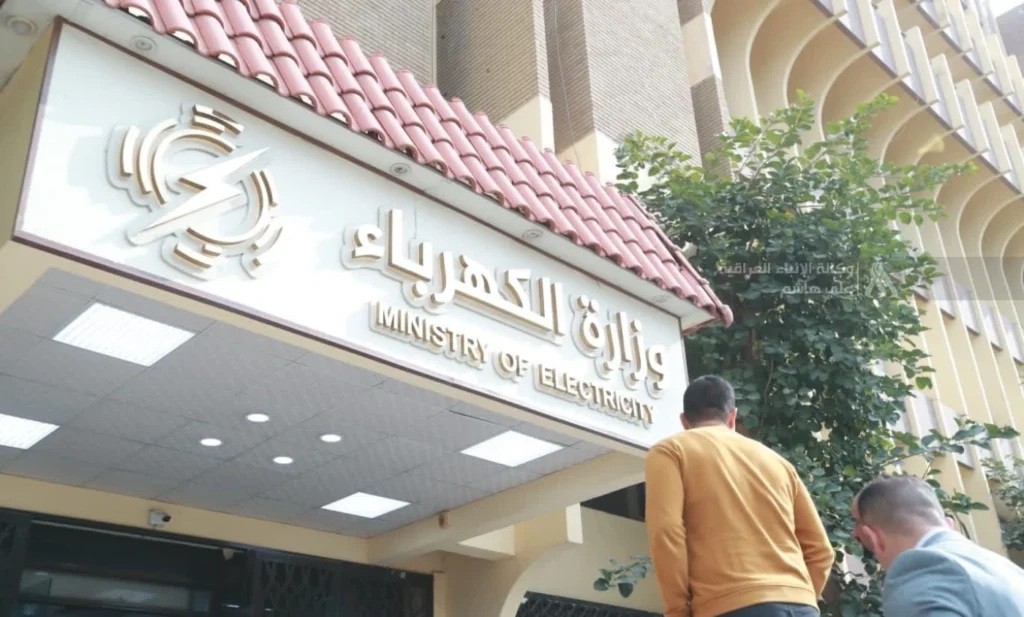
The entrance of Iraq’s Ministry of Electricity headquarters in Baghdad
Electricity cuts worsen across Iraq as summer heat arrives
BAGHDAD — Electricity supply hours declined across several Iraqi governorates Monday as the country entered the summer season amid reduced Iranian gas imports, lower domestic production and disruptions linked to the regional conflict.
In Baghdad, residents in privatized electricity service areas reported repeated outages during both day and night. A 964media correspondent in the Yarmouk area said supply had declined sharply over the past two weeks, compounded by the removal of neighborhood generators five years ago. In Sadr City, the scheduled supply held at two hours on and two hours off, though a source in the Tariq neighborhood electricity department said levels could decline next week as temperatures and demand rise. In Husayniyah district northeast of Baghdad, residents reported unstable supply despite an official schedule of two hours on and two hours off, with some cuts lasting up to four hours.
In Hilla, supply shifted over the past two weeks from two hours on and two hours off to one hour on and three hours off. Basra’s city center and commercial areas were running on five hours on and one hour off throughout the day, with Abu al-Khasib district reporting similar conditions and Shatt al-Arab district on a four-hours-on, one-hour-off pattern.
Najaf saw the sharpest deterioration, with supply falling over ten days from two hours on and two hours off to two hours on and six hours off. Demonstrators were preparing Monday to protest outside the local government building, with participants expected from several districts. Abbas Dohan, head of operations for Najaf Electricity, said the governorate required around 3,000 megawatts in 2025 but received only about 1,400, and that demand in 2026 is expected to exceed 3,200 megawatts.
The shortfalls are driven by a confluence of crises. Iraq relies on Iranian gas for more than 30% of its electricity generation, but imports collapsed after U.S. and Israeli strikes on Iran’s South Pars gas field in March. Oil production fell from around 4.3 million barrels per day before the regional conflict to as low as 800,000 to 1.3 million bpd as the closure of the Strait of Hormuz cut off southern export routes, reducing associated gas output. Planned energy imports through Gulf interconnections have also faced delays amid regional security tensions.
Iraq’s electricity grid faces its greatest strain during summer months, when temperatures regularly exceed 50 degrees Celsius. Public protests over power cuts have repeatedly broken out in southern governorates during previous summers.