
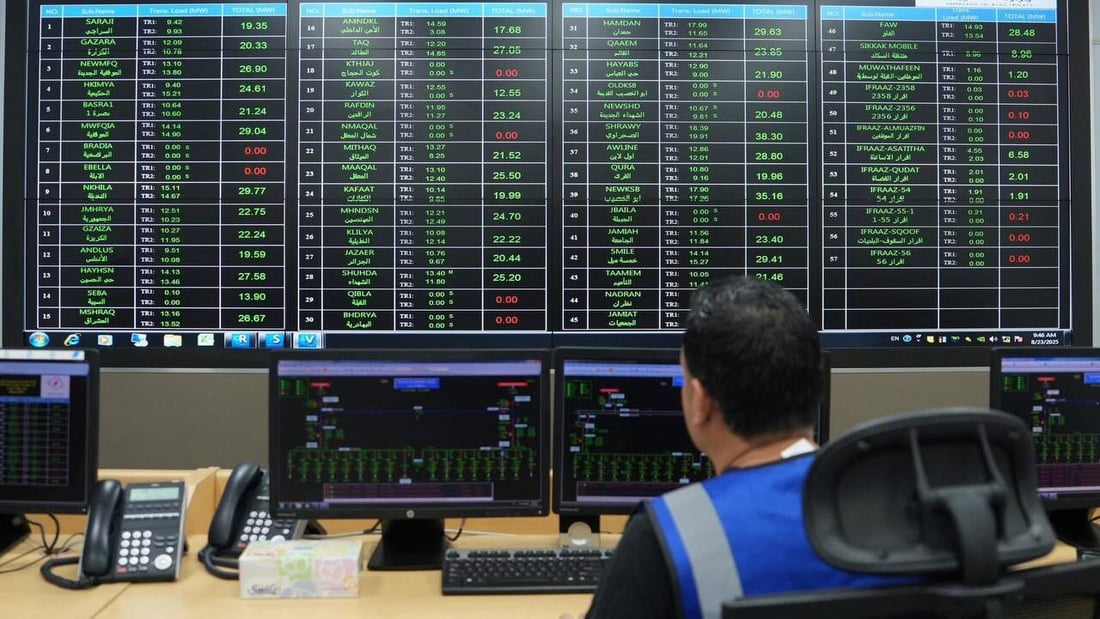
FILES: An operator monitors electricity distribution and transmission data at a control center
Iraq power cuts deepen as ministry cites regional war and lawmakers demand answers
BAGHDAD — Iraq’s Ministry of Electricity apologized to the public on Sunday as electricity supply hours fell across the country, blaming reduced gas supplies linked to regional conflict, rising summer demand, aging infrastructure and insufficient funding, while lawmakers moved to summon the electricity and oil ministers for a briefing on the crisis.
The ministry said it understood the hardship caused by the decline, particularly as temperatures climb and demand rises. “The national electricity system is currently facing exceptional circumstances imposed by a combination of simultaneous challenges,” it said, citing lower gas supplies from the regional war, higher loads, illegal grid connections, aging infrastructure and the need for larger allocations to speed rehabilitation. It said technical teams were working around the clock to improve unit readiness and accelerate transmission and distribution projects, and called on the public to cut consumption and report illegal connections.
Iraq has faced chronic electricity shortages for decades, with demand peaking in summer as temperatures frequently exceed 50°C. Many households rely on private neighborhood generators to fill the gaps.
A group of lawmakers on Sunday submitted a request to summon the electricity and oil ministers, seeking to review the state of the grid and the government’s response. They also urged expanded investment in Iraq’s associated natural gas, still widely flared at oil fields, to fuel power stations domestically, arguing that more local production would strengthen energy security and reduce exposure to regional developments. The parliament presidency later approved the request to host the electricity minister.
Iraq relies on Iran for roughly one-third to 40% of the natural gas it uses to generate electricity. After attacks on Iran’s South Pars gas field earlier this year, deliveries to Iraq fell sharply, forcing some stations onto alternative fuels. In May, the ministry said supply hours had declined across several governorates as gas imports fell and domestic output dropped. In April, officials said they aimed to produce about 30,000 megawatts over the summer while peak demand was expected to reach 55,000 to 60,000 megawatts, guaranteeing continued scheduled outages even if all available units ran as planned.
In the Kurdistan Region, generation fell by 2,500 megawatts on Thursday after the operator of the Khor Mor gas field halted production, citing “credible security threats.” Dana Gas said it had shut down primary production facilities and was coordinating with the Kurdistan Regional Government and the federal government. Production at the field had resumed on April 13 after a suspension that began following the outbreak of the U.S.-Israeli war with Iran.