
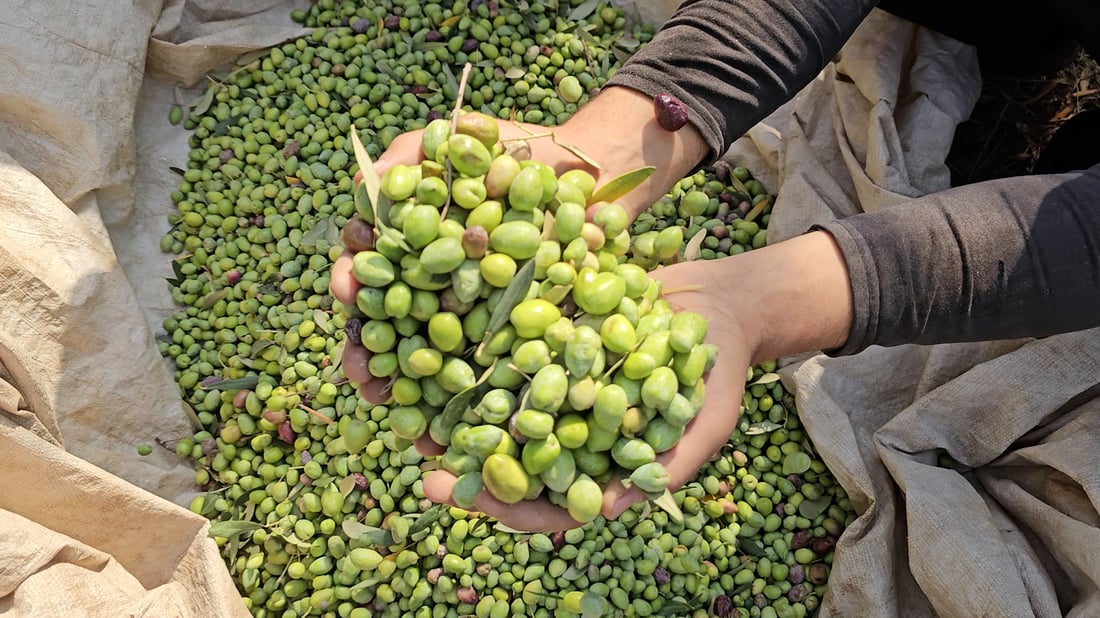
Freshly harvested green olives are displayed in a farmer’s hands during the olive harvest in Bashiqa, Nineveh governorate. Photo: 964media.
Bumper olive crop in Bashiqa fails to lift farmer earnings as prices plummet
NINEVEH — Olive farmers in Omar Qabaji, a village on the outskirts of Bashiqa in the Nineveh Plain, are bringing in a bumper crop this year, but low prices are eating into their returns.
Single trees are producing 50 to 100 kilograms of fruit this season, farmers said. With prices starting at 550 dinars a kilogram (about 33 cents at the street rate), some farmers and traders are storing olives to preserve and pack later, as is done with dates, rather than sell the fresh crop cheaply.
Nader Musab, a local olive trader, told 964media that the large harvest had not brought farmers better earnings.
“This year’s production is good and quantities are abundant, but prices are low, starting at 550 dinars per kilogram and increasing according to variety and quality,” Musab said. “This decline has harmed farmers despite the abundant harvest.”
In Hit, in Anbar governorate, a farmer told 964media in August 2025 that Khastawi olives sold for 1,250 dinars a kilogram (about 89 cents at the time).
Musab said Bashiqi, the local Iraqi variety named for the town, was in harvest and remains one of the most widely grown olives in Bashiqa and the nearby villages of Fadhiliya and Omar Qabaji. Farmers also grow Khastawi and Dagal, a variety known for its large fruit, and are trying out trees from Afrin in Syria and from Spain.
Bashiqa, a town in Hamdaniya district northeast of Mosul, has long been known for its olives, olive oil and soap. The Islamic State group held it from 2014 until late 2016. In 2021, the UN World Food Programme and local partners opened a new olive press in Bashiqa to help restore production to its level before the conflict.
Sameh Ghanem, who owns an olive farm, told 964media that farmers usually sell their crop while it is still on the trees, leaving traders to pick, transport and market it.
“When the olives ripen, traders come to the farms to buy the crop, and we sell the olives while they are still on the trees,” Ghanem said. “The price is determined by supply and demand and the agreement between the farm owner and the trader.”
Once a deal is struck, traders organize the harvest and take the olives to processing plants and pickle shops, which prepare them and supply markets across Iraq’s governorates.
The trees need care all year, Ghanem said. Farmers fertilize them in February to prepare for the growing season, and in March, as spring begins, they dig irrigation basins around them.
Watering usually starts in May and June and continues as the fruit develops. By August the olives reach the green stage and can be picked and sold.
Ghanem said his farm grows the traditional Iraqi variety Bashiqa is known for. He described this year’s crop as plentiful and said the farm was still picking green olives.
The groves have faced other pressure. In August 2025, a Bashiqa farmer drew public anger for cutting down 200 olive trees and selling them as firewood to a fish restaurant.
The harvest starts in August or early September, depending on the variety, how ripe the fruit is and each owner’s choice, and runs in stages until February, Musab said. Green olives are usually picked from August to the end of October, before the fruit ripens and changes color.
Black olives, left on the tree to ripen fully, are harvested from December through February.