
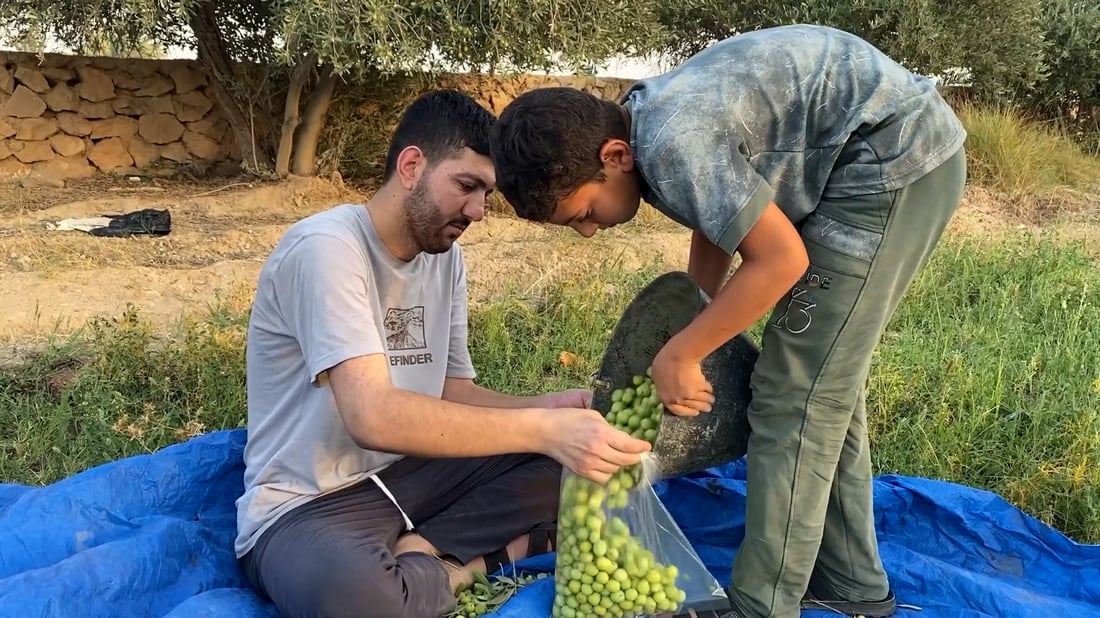
Farmers in Hit, Anbar, collect freshly harvested olives during the early days of the season. — Photo by 964media
Anbar olive harvest expected to exceed 2,400 tons this season
ANBAR — Farmers in Anbar say this year’s olive harvest is expected to surpass previous seasons, with production projected to reach more than 2,400 tons, according to agricultural officials.
Olive cultivation in Iraq totals about 2 million trees, with Anbar accounting for more than 120,000 of them. The largest concentrations are in Qaem with 30,000 trees and Hit with 23,000.
“In the spring we start planting olive seedlings, and when the tree reaches five to seven years it begins producing. The olives gradually mature and ripen in the fall, so we start harvesting from late August until mid-September,” farmer Mazhar Kazem told 964media.
“Last season I produced one ton, but this year I expect one and a half tons. In the future, our trees will grow bigger and production will increase, so we call on the authorities to open a pressing facility to handle local output,” he said.
Kazem explained that different varieties are grown in Hit. “We have three types of olives: Khastawi, priced at 1,250 dinars (about $0.89) per kilogram; Khiyara, at 1,000 dinars (about $0.71) per kilogram; and high-oil varieties designated for pressing. The first two are used for pickling, while the high-oil type is preferred for producing oil,” he said.
Farmers noted that while dust storms are one of the most common problems affecting yield, this season has been free from major issues. They called on the Ministry of Agriculture to study the slower growth of some male trees, which they say affects production.
The Agriculture Media Office in Hit said: “In Hit we have 23,530 olive trees, planted across all areas of the governorate, whether under palm trees or among other crops. Any problem faced by farmers should be reported to our office, and we will send a specialized committee to determine the disease and treatment.”
Safaa Zidan, head of the horticulture and desertification department, told 964media: “The area of olive cultivation in Anbar is estimated at 3,015 dunams (about 745 acres), with around 120,600 trees. The total expected annual yield is 2,414 tons, with an average of 20 kilograms per tree. The varieties include high-oil, Ashrasi, Khastawi, Baashiqa, Nepali, and Concord, spread across the governorate, with Qaem ranked first at 30,006 trees.”