
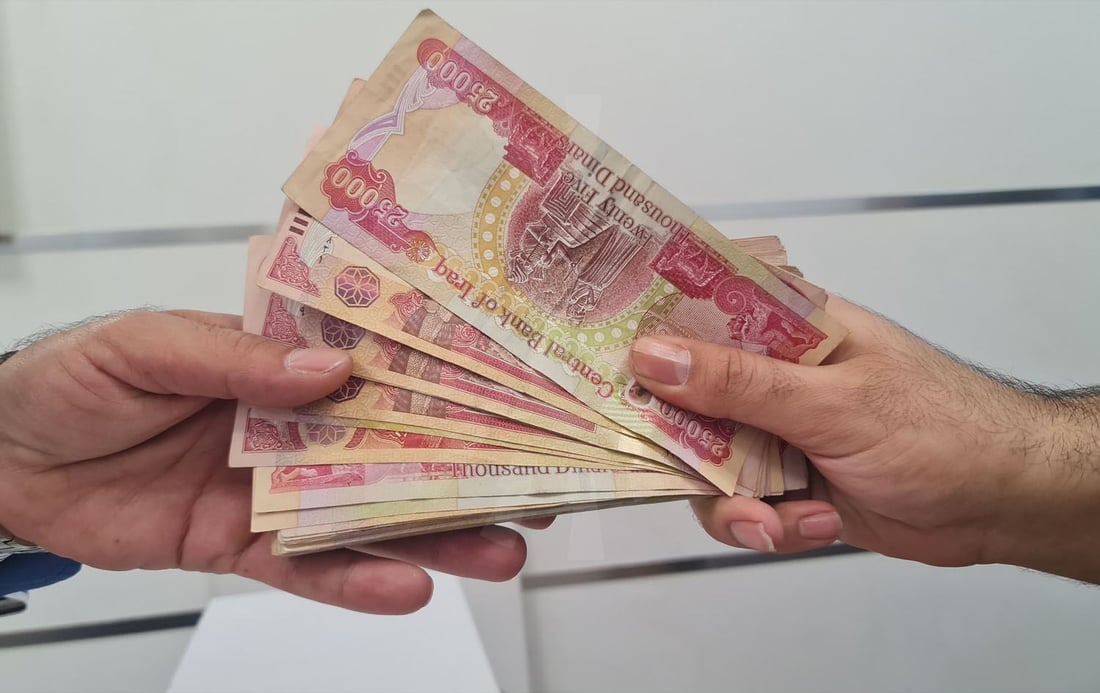
A person handing over a stack of Iraqi dinars, representing cash transactions or financial exchanges in Iraq. Photo by Blind T. Abdullah
Markets seek clarity
Iraq says no decision yet on removing zeros from dinar
BAGHDAD — Iraq has not approved a plan or timetable to remove zeros from the dinar, a government source said Wednesday, seeking to calm speculation as authorities consider measures to revive slowing markets, support private businesses and protect purchasing power.
“Putting forward any proposal for study or discussion does not mean approving it or beginning its implementation immediately, and circulating expectations cannot be treated as effective decisions or fixed dates for implementation,” the source told the state-run Iraqi News Agency.
Any redenomination would require detailed technical, legal and operational preparations, along with mechanisms to protect citizens’ financial rights, before it could be implemented, the source said.
“Removing zeros, in principle, means re-expressing monetary values in a new unit, with prices, salaries, savings and obligations converted at the same ratio, and does not in itself mean reducing the real value of citizens’ money,” the source said.
The proposal remains at an initial stage, with officials assessing its economic feasibility and technical and legal requirements and examining other countries’ experiences, since redenomination alone does not guarantee broader economic improvement, the source said.
The comments follow weeks of speculation over the dinar. The Central Bank of Iraq said in August that reports of new banknotes with zeros removed already being printed were unfounded, adding that any future redenomination would require an official decision and multiple legal, regulatory and technical stages.
The talk has already shifted currency-market expectations. Economist Amr Hisham said in September that it had prompted some Iraqis to buy dollars as a hedge. At the time, Baghdad exchange shops were selling $100 for about 160,250 dinars, against the official rate of 132,000 dinars.
The source said officials were also examining ways to stimulate commercial and productive activity, ease financing for productive projects and support the private sector.
“The government recognizes the slowdown in buying and selling in the markets and the effect this has on citizens, traders and business owners,” the source said, adding that authorities were looking for practical measures to sustain businesses and jobs while preserving fiscal and monetary stability.
The source linked part of the pressure to regional tensions and disruption to trade and supply routes through the Strait of Hormuz, which have raised transportation, shipping and insurance costs.
Iraq’s oil exports averaged about 2.6 million barrels per day in September, according to the latest official figures, down from roughly 3.3 million to 3.5 million barrels per day before shipping through Hormuz was disrupted.
The Central Bank has said its foreign-currency reserves remain sufficient to meet demand and has blamed recent pressure on the parallel exchange rate on speculation, expectations and the exploitation of regional conditions.
The source urged citizens, traders and business owners to rely on official information, saying details of any economic initiatives would be announced once studies and discussions are complete.