
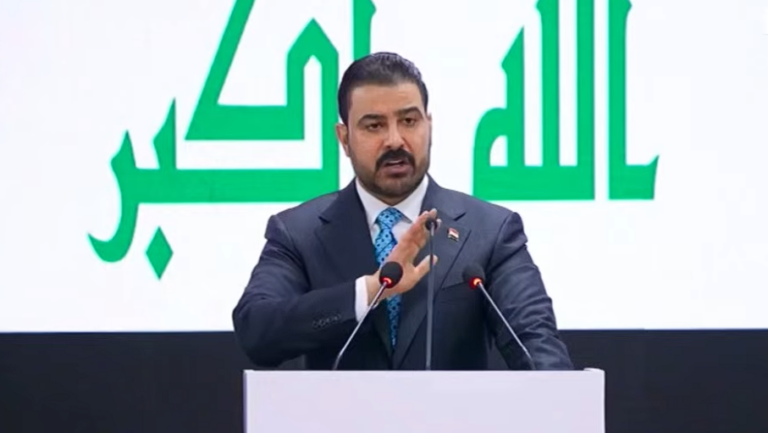
Zaidi says no weapons or forces will remain outside Iraqi state authority
BAGHDAD — Prime Minister Ali al-Zaidi said Wednesday that Iraq would not allow weapons outside the law or armed forces outside state institutions, putting the weapons policy at the centre of the security transition as the U.S.-led coalition mission formally ended.
“There will be no weapons outside the umbrella of the law, and no force outside state institutions, in accordance with the constitution, what our wise religious authority has called for and what our people want,” Zaidi said at a National Sovereignty Day ceremony in Baghdad. Parliament Speaker Haibat al-Halbousi used almost the same words in his own statement for the day, declaring that “there are no weapons outside the framework of the law, no force outside state institutions.”
Zaidi formally declared the end of the coalition’s mission against the Islamic State group. “The conclusion of the International Coalition’s mission does not mean the end of our battle against terrorism,” he said. “Rather, it marks Iraq’s transition to a phase in which it assumes full responsibility for its security and stability.” Security cooperation with coalition countries would continue in a more focused form, with greater use of technology and digital capabilities, he said, calling it the start of “a new phase whose title is Iraq’s sovereignty, the strength of its institutions, the readiness of its forces, the unity of its decision and balanced partnerships with its friends.”
The coalition’s departure also starts the clock on Zaidi’s timetable for the armed factions: a 90-day halt to attacks from Sept. 30, followed by a gradual six-month handover ending on June 30, 2027. Muqtada al-Sadr dissolved his Promised Day Brigade on Wednesday and called for weapons to be placed exclusively under state authority, after moving his larger Saraya al-Salam under the commander-in-chief in May. Ashab al-Kahf threatened a military response to any foreign presence from Wednesday night, and a Kataib Hezbollah security official said the group would monitor Iraqi airspace and try to shoot down aircraft it considers hostile.
U.S. Central Command said the last U.S. and coalition forces had left Erbil Air Base, completing the withdrawal. The anti-ISIS task force is now headquartered in Jordan, and U.S.-Iraqi security cooperation is moving to a bilateral relationship.