
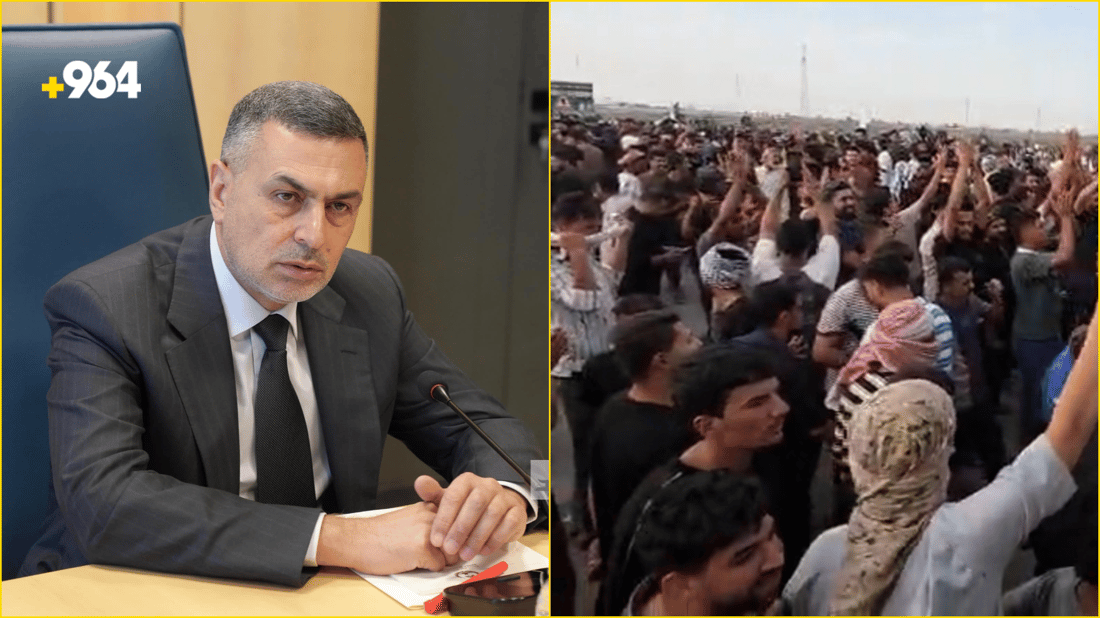
Composite photo showing Basra Governor Asaad al-Eidani (left) and protesters demanding public services in Basra. (Photo: 964media)
Basra governor warns oil field protesters could face terrorism charges
BASRA — Basra Governor Asaad al-Eidani on Wednesday warned that protesters who enter oil fields could face arrest warrants and even terrorism charges, a day after demonstrators shut a station at the West Qurna 1 field.
In a voice message, Eidani said his earlier warning to protesters against entering the fields was not meant to restrict them or limit their demands. He said it was meant to keep them safe and spare them the legal and security consequences.
“Entering the oil fields may expose some protesters to arrest warrants, and the matter could go as far as charges under Article 4 of the Anti-Terrorism Law,” Eidani said.
Article 4 of Iraq’s 2005 Anti-Terrorism Law sets the death penalty for anyone who commits the terrorist acts it lists. Eidani said he had no power to intervene in such proceedings, and he warned that the fallout could hurt service projects in the areas involved.
He said he wanted to avoid a repeat of the 2018 protests in the governorate, in which people were killed, and recalled the killing of a man he named only as Saad.
“The loss of any life is a loss for his family and for society as a whole,” Eidani said.
He said he had apologized to residents of the protest areas in case his remarks had been misunderstood. He said the apology did not mean he was withdrawing his warnings and was made out of respect for the governorate’s people.
“The demands the protesters have raised have been repeated for years,” Eidani said, adding that protesting and demanding services was a legitimate right of citizens.
He said the local government had finished several service projects in Sadiq district and other areas, including treatment plants and infrastructure, and was still working on projects in Qurna district despite the financial crisis. Federal projects had stopped because the money for them had not been allocated, he said.
Eidani urged parties, political forces and public figures to back the local government in claiming Basra’s border-crossing revenue and petrodollar funds, the per-barrel share of oil revenue that federal law sets aside for oil-producing governorates.
“Border-crossing dues have not been paid to the governorate for about a year and a half, while petrodollar dues stopped in September 2024,” he said.
On Sunday, after meeting the committee organizing the Sadiq sit-in, Eidani had said the local government paid for its service projects in Sadiq from border-crossing revenue.
He asked where those who had declared their support for the protests stood on the unpaid funds, and invited them to join the demand. He said the local government was ready to work with everyone, take responsibility and be held to account for any failings.
Eidani said the protesters were in the right. He urged Basra residents to hold on to their demands and not let anyone exploit their protests, and said the local government saw all the governorate’s people as partners in responsibility.
On Tuesday, protesters from tribes and communities in Basra’s northern Qurna and Sadiq districts shut Station 8 at West Qurna 1. They gave the federal and local governments three days to meet their demands for services and jobs, and threatened to shut all the oil fields in the area if the deadline passed.
Residents of Sadiq have held a sit-in near the entrance to West Qurna 1 since Friday. Their demands include work on a bridge to Ezz al-Din Salim district, jobs for unemployed young people and the rebuilding of the Qurna-Basra road. On Tuesday, Basra lawmaker Uday Awad, who leads the Sadiqoun parliamentary bloc, urged Prime Minister Ali al-Zaidi to visit Basra and meet the protest leaders.
Basra’s 2018 protests over jobs and services turned deadly on July 8 that year, when a protester was shot dead outside West Qurna 1. More protesters were killed in the city that September.
West Qurna 1, one of Iraq’s largest oil fields, has been operated by China’s PetroChina since ExxonMobil left in early 2024.
This article has been updated