
Kataib Hezbollah says leader met Iran’s Qaani over Jurf al-Sakhar
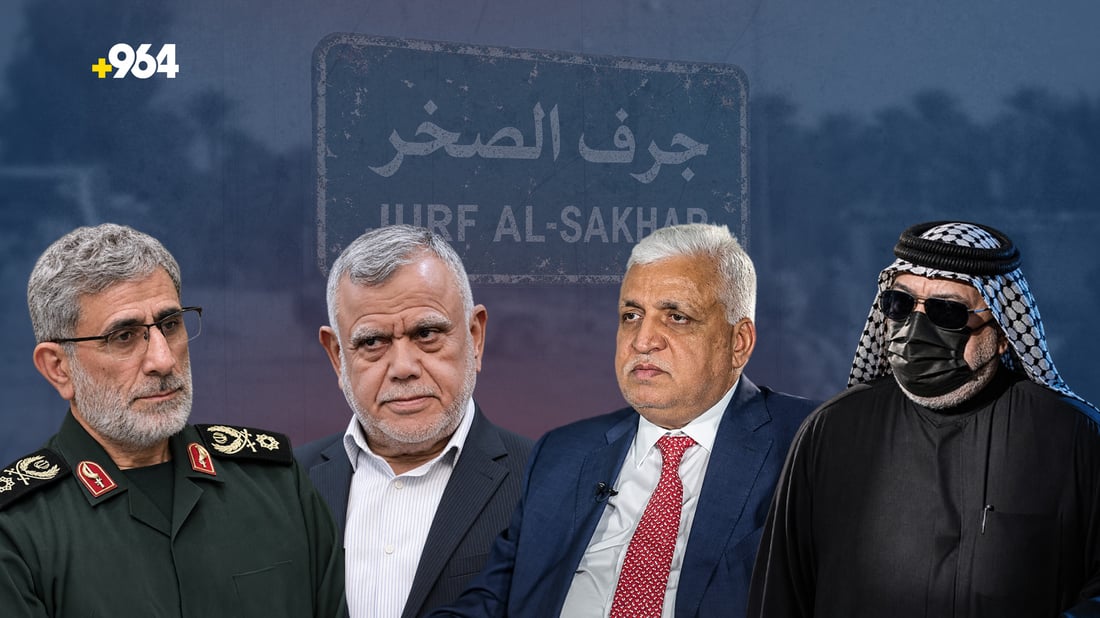
BAGHDAD — Kataib Hezbollah’s leader met Iran’s Quds Force commander and the heads of the Badr Organization and Iraq’s Popular Mobilization Commission to consult on “the crisis,” the faction said Thursday, an apparent reference to the standoff over Jurf al-Sakhar.
The faction’s secretary-general, Ahmed al-Hamidawi, known as Abu Hussein al-Hamidawi, met Esmail Qaani, commander of the Quds Force, the external arm of Iran’s Islamic Revolutionary Guard Corps, the Iran-aligned faction said in a statement on its official channel. Badr leader Hadi al-Amiri and Falih al-Fayyadh, chairman of the Popular Mobilization Commission, the state body that runs the Popular Mobilization Forces, were also at the meeting.
Hamidawi “described the results as good,” the statement said. It gave no details of any agreement, and it did not say whether Kataib Hezbollah would meet the government’s demand that it leave the area. It also did not say when or where the meeting took place.
The statement came a day after Prime Minister Ali al-Zaidi’s media office said the force holding Jurf al-Sakhar would be replaced by one Zaidi names as commander-in-chief. The Energy Police, the Interior Ministry force that guards oil and power sites, will take over guarding the pipelines that cross the area, the office said after the first meeting of a higher committee for security sector reform.
Documents obtained by 964media on Wednesday show Zaidi approved a plan dividing the area among the army’s 38th Brigade, the Federal Police’s 17th Brigade and the PMF’s 72nd and 79th brigades. He set aside Fayyadh’s proposal to give security across the whole area to PMF units. The media office did not confirm the plan.
Kataib Hezbollah responded the same day with a video of first-person-view drones, which an operator flies through a live camera feed. The video ends with a hosa, a traditional Iraqi chant: “You’ll only hear their buzz beside you, faster than Solomon’s jinn,” an allusion to the jinn the Quran says served King Solomon.
Leaders of the Coordination Framework, the ruling alliance of Shiite parties, turned down Zaidi’s push for combat troops at a meeting Monday, a source in the alliance told 964media. They agreed instead to replace the force in the area with other PMF units to avoid a confrontation, the source said.
Earlier Monday, government spokesperson Haider al-Aboudi said Zaidi had ordered the armed forces into Jurf al-Sakhar and given the faction there a short deadline to leave. The government has named Kataib Hezbollah as the force that holds the area. It has not said when the deadline expires.
Kataib Hezbollah denies smuggling oil and has accused Zaidi’s office of spreading “fabricated reports.” At a news conference inside Jurf al-Sakhar on Tuesday, senior faction figure Abu Talib al-Saeedi accused the investigators of distorting the facts and said the faction did not intend to clash with security forces. He told AFP the same day that the faction would not leave the area “even over our bodies.”
The standoff has exposed a rift within Kataib Hezbollah, a source told 964media on Monday. PMF Chief of Staff Abdul Aziz al-Muhammadawi, known as Abu Fadak, favored a deal that would let federal forces take over parts of the area, while Hamidawi opposed further security concessions, the source said.
Hamidawi’s wing has proposed putting off any handover until June 30, 2027, the government’s deadline for bringing all weapons under state control, according to the source. Thursday’s statement did not mention Muhammadawi, whom the U.S. State Department has described as a former Kataib Hezbollah secretary-general.
The standoff began after a report by the Federal Intelligence and Investigations Agency, an Interior Ministry body, began circulating Nov. 9. It alleges that crude was drawn from pipelines in Jurf al-Sakhar and carried away in tanker trucks. On Saturday, Zaidi relieved nine security and oil officials of their duties after his investigating committee found tampering with the pipelines and two refineries in the area, Aboudi said.
The United States designated Kataib Hezbollah in 2009 and placed Hamidawi under sanctions in 2020. The faction has brigades in the PMF, the state-sanctioned umbrella of mostly Shiite armed groups formed in 2014 to fight the Islamic State group.
Jurf al-Sakhar, officially renamed Jurf al-Nasr in 2014, was recaptured from the Islamic State group that year by Iraqi forces and allied armed groups. It has been closed since, and many of its displaced residents still cannot return.