
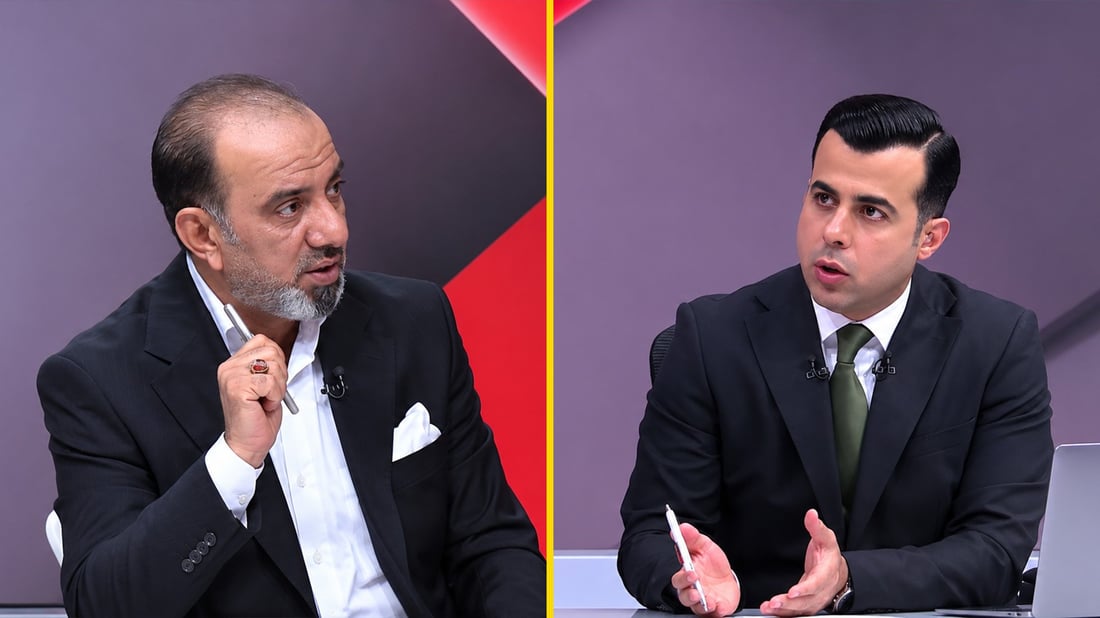
Iraqi lawmaker Dhiaa al-Zaidi speaks during an interview on Dijlah TV about oil smuggling in Jurf al-Sakhar, Babil.
Aerial footage shows covered trucks on Jurf al-Sakhar farms, MP says
BAGHDAD — Aerial footage taken days ago showed covered trucks on farms in Jurf al-Sakhar, and tanker trucks are still inside the area although smuggling traffic has stopped, a lawmaker investigating oil smuggling there said Wednesday.
Diaa al-Zaidi, a lawmaker from the Reconstruction and Development Coalition and a member of the parliamentary committees investigating Jurf al-Sakhar, spoke in an interview with presenter Hussam al-Hajj on Dijlah TV. The footage proved that oil was being smuggled from the area, so there was no reason to doubt the findings of Prime Minister Ali al-Zaidi’s investigating committee, which went into Jurf al-Sakhar on Friday, Nov. 13, he said.
The parliamentary committee that heard from Oil Minister Basim al-Abadi on Sunday holds secret information on Jurf al-Sakhar that “cannot be disclosed,” Diaa al-Zaidi said. Everything it has found on oil smuggling is documented in photographs and video, and the smuggling has gone on since 2021, he said.
He was the second lawmaker this week to say some of the findings should be kept from the public. Ali Nuhair al-Saadi, a member of parliament’s Security and Defense Committee, said late Tuesday that the government committee’s technical report was due to reach parliament Thursday and would probably be discussed in a closed session.
“There are some things we do not want the people to see for now, until we reach the truth that everyone hopes for,” Saadi said.
The smuggling from Jurf al-Sakhar was run with “high professionalism” for six years, with tanker trucks leaving the area and reaching Afghanistan, Diaa al-Zaidi said. It was run by “foreign experts,” not Iraqis, he said. Parliament Speaker Haibat al-Halbousi has also asked the lawmakers’ inquiry to examine intelligence on oil smuggled from the Kirkuk fields and the Kurdistan Region through Iran to Afghanistan.
Smuggled tankers got through security checkpoints because “influential figures” called the checkpoints and orders were given not to stop them, Diaa al-Zaidi said. The Oil Ministry and the security agencies bear part of the responsibility, but the smuggling grew out of political interference and the state’s failure to impose its authority in the past, he said. He also did not rule out that money was being smuggled out of the area.
“The Jurf al-Nasr issue is not open to discussion,” Diaa al-Zaidi said, using the area’s official name. Kataib Hezbollah, the Iran-aligned faction the government says holds the area, would face legal penalties if it defied the decisions to impose state control there, he said.
He dismissed talk of a “Shiite-Shiite war” as long outdated. “Are the factions that joined the state’s umbrella not Shiite?” he said. The argument was meant to protect personal and factional interests that live off smuggling through Jurf al-Sakhar and other areas, he said.
The prime minister is determined to expose oil smuggling cases “from Zakho to Basra” and from Iraq’s east to its west, and is not targeting any individual, the lawmaker said. The forces moving toward Jurf al-Sakhar are Iraqi forces that want to impose state control, he said.
Diaa al-Zaidi also said the latest attack on the Khor Mor gas field in Sulaymaniyah governorate was meant to disrupt and halt oil exports and to tamper with Iraq’s wealth. Armed groups benefit from strikes on the field, but it has not been established whether the latest one was launched from inside or outside Iraq, he said.
A suspected drone attack on Khor Mor late Sunday, Nov. 8, knocked nearly 3,000 megawatts off the Kurdistan Region’s grid. No group has claimed it. Sabah al-Numan, spokesperson for the commander-in-chief of the armed forces, said Nov. 10 that authorities had identified where the attack was launched from and who was involved. He gave no details.
Also on Wednesday, the prime minister referred the government’s investigations into violations on the Jurf al-Sakhar oil pipeline to the judiciary and said the force holding the area would be replaced, with the Interior Ministry’s Energy Police guarding the pipeline, his media office said.
Documents obtained by 964media show Zaidi has approved a plan dividing the area among the army, the Federal Police and the Popular Mobilization Forces. It sets aside a proposal by Falih al-Fayyadh, chairman of the Popular Mobilization Commission, the state body that runs the PMF, to give security across Jurf al-Sakhar to PMF units. The media office’s statement did not confirm the plan.
Leaders of the Coordination Framework, Iraq’s ruling alliance of Shiite parties, turned down Zaidi’s push for combat troops at a meeting Monday and agreed instead to replace the force holding the area with other PMF units, a source in the alliance told 964media.
Kataib Hezbollah denies smuggling oil and has accused Zaidi’s office of spreading fabricated reports. The faction has brigades in the PMF, the state-sanctioned umbrella of mostly Shiite armed groups formed in 2014 to fight the Islamic State group, and the United States designated it a terrorist organization in 2009.
The standoff began after a report by the Federal Intelligence and Investigations Agency, an Interior Ministry body, began circulating Nov. 9. It alleges that crude was drawn from pipelines in Jurf al-Sakhar and carried away in tanker trucks.
Jurf al-Sakhar, in northern Babil, was officially renamed Jurf al-Nasr in 2014, when Iraqi forces and allied armed groups recaptured it from Isis. It has been closed since then, and many of its displaced residents still cannot return.