
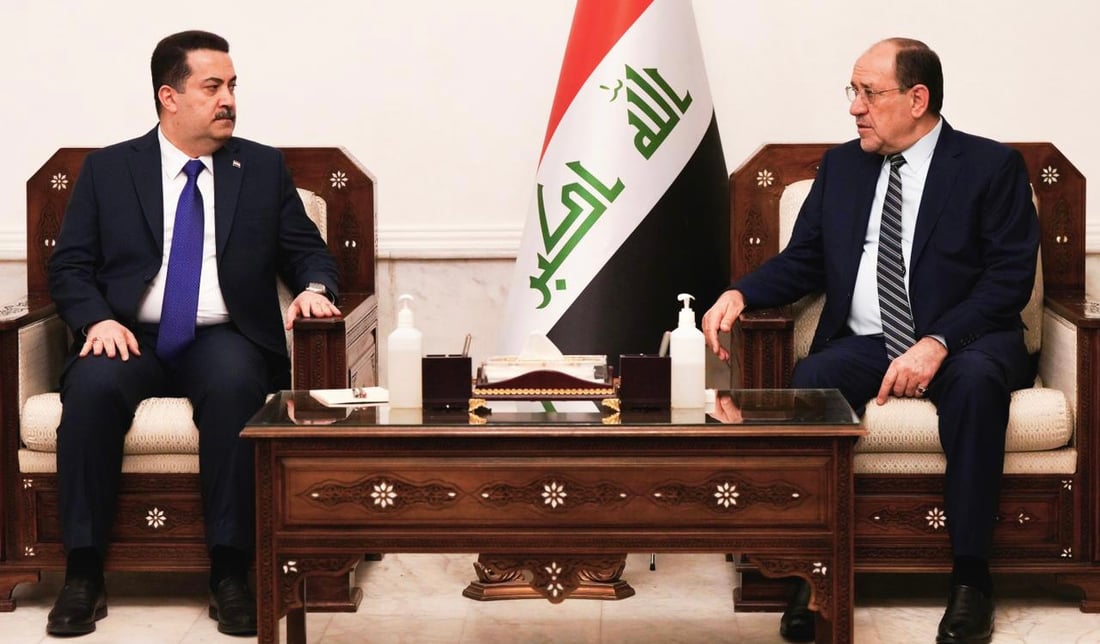
Former Iraqi Prime Minister Mohammed Shia al-Sudani (left) meets his predecessor Nouri al-Maliki (right), leader of the State of Law Coalition.
Maliki ally rejects calls to prosecute former Iraqi PM over fall of governorates
BAGHDAD — The head of Nouri al-Maliki’s media office on Saturday rejected a rival camp’s call to put the former prime minister on trial over the fall of governorates to the Islamic State group in 2014.
Khalid Walid al-Marsoumi, a member of former Prime Minister Mohammed Shia al-Sudani’s Reconstruction and Development Coalition, made the call in a post on X late Saturday.
“Put Maliki on trial, and do not forget the blood of your sons in the days of the fall of the governorates and the bitter strife,” Khalid Walid wrote. “Try him, so that he is a lesson to whoever destroyed society and spread strife.”
He ended the post by asking what had become of the state’s final accounts for 2012 to 2016, the audited year-end statements of government spending, which parliament passes as laws.
The accounts are already disputed in parliament, where lawmakers gave a first reading in July to bills approving those for 2013, 2014 and 2015. On July 26, Bahaa al-Araji, who heads Sudani’s parliamentary bloc, said on X that the bloc rejected moving to a second reading unless 2012 was examined too. He cited Federal Board of Supreme Audit reports of violations in the management of state finances from 2012 to 2015.
“Enough hypocrisy and point-scoring over the blood of Iraqis,” Hisham al-Rikabi, who heads Maliki’s media office, wrote on X in reply. “Whoever speaks today about the fall of the governorates and strife must stop exploiting Iraqis’ tragedies in their political rivalries.”
History could not be reduced to a tweet, Rikabi added, and facts did not change when positions and interests shifted.
Khalid Walid answered early Sunday in a post addressed “to someone,” without naming Rikabi. “Although what we said did not point to a name, a specific person or a government, your insistence on linking the matter to your leader and talking about political rivalry and a string of accusations puts you in a position no one would envy,” he wrote.
His first post had named Maliki and opened with the hashtag #TryMaliki.
“Our demands are clear: to try everyone without exception,” Khalid Walid wrote in the reply. He and his allies were not angels and could be wrong or right, he said, but tying any criticism to a rivalry was far from their intentions.
The exchange is the latest in a week of clashes between the two former prime ministers’ camps. Parliament on Tuesday referred State of Law lawmaker Yousif al-Kilabi to its conduct committee over remarks about Sudani, after Kilabi called for Sudani to be held accountable for Iraq’s debt. Sudani’s parliamentary bloc said Monday it would boycott sessions until action was taken against a lawmaker it did not name.
Maliki, who leads the State of Law Coalition, served as prime minister from 2006 to 2014. His second term was marked by protests in Sunni-majority governorates over arrests and the use of anti-terrorism laws, and Sunni leaders accused his government of exclusionary policies that deepened sectarian tensions.
In June 2014, Isis captured Mosul, Iraq’s second-largest city, and went on to seize large areas of northern and western Iraq as Iraqi security forces collapsed. Maliki stepped down later that year under domestic and international pressure.
A parliamentary committee in August 2015 named Maliki among 36 officials it held responsible for the fall of Mosul and recommended that they stand trial.
The Coordination Framework, the dominant Shiite alliance in parliament, nominated Maliki for a return as prime minister in January 2026. The bid drew objections from Sunni parties and a warning from U.S. President Donald Trump that the United States would “no longer help” Iraq if Maliki returned. The Framework settled instead on Prime Minister Ali al-Zaidi, who took office in May.