
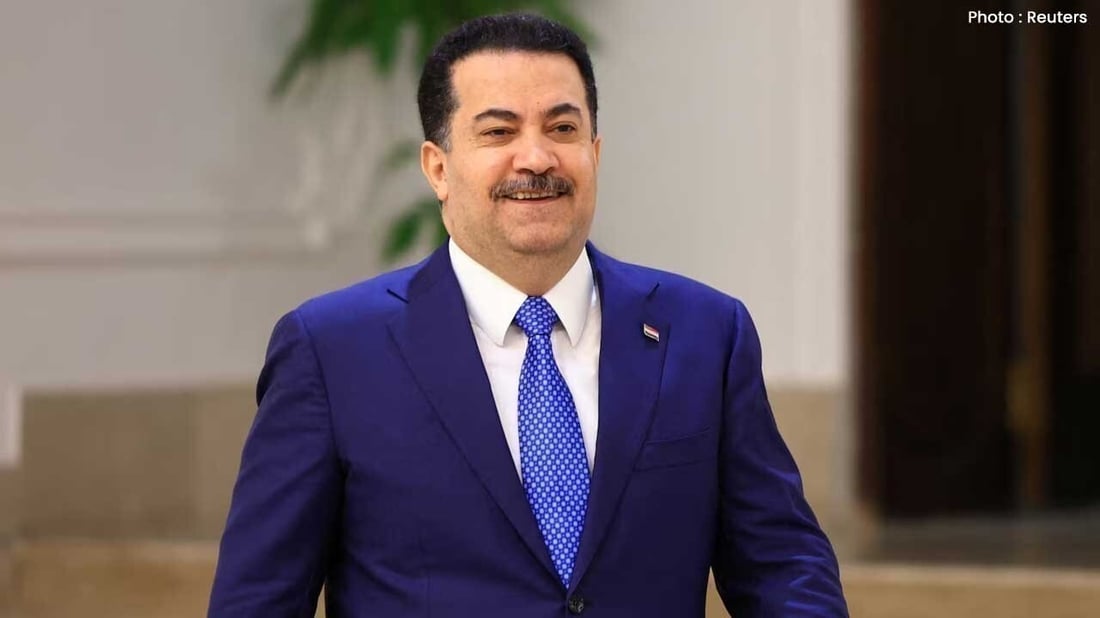
Reconstruction and Development Coalition leader Mohammed Shia Al-Sudani
Conduct Committee
MP referred over Sudani remarks wants him questioned on Iraq’s debt
BAGHDAD — State of Law lawmaker Yousif al-Kilabi said Tuesday he would seek a public session of parliament to question former Prime Minister Mohammed Shia al-Sudani over Iraq’s debt, hours after he was referred to the Parliamentary Conduct Committee.
Kilabi, a member of former Prime Minister Nouri al-Maliki’s State of Law Coalition and of parliament’s Finance Committee, said Sudani’s government left Iraq with 208 trillion dinars (about $160 billion at the time) in debt. That was nearly half of the 450 trillion dinars (about $340 billion at the time) allocated under the three-year federal budget approved during Sudani’s term, he said.
“All I said was: Hold the former prime minister accountable because he plunged Iraq into debt,” Kilabi said in a video statement. Lawmakers were being prevented from carrying out their constitutional oversight role, he said.
Parliament referred Kilabi to the committee on Tuesday after a formal complaint from Bahaa al-Araji, head of the Reconstruction and Development parliamentary bloc. The complaint accused Kilabi of insults and of making false statements about Sudani, who leads the Reconstruction and Development Coalition.
Kilabi said his criticism was aimed at Sudani, not at the bloc or its members. “I did not say a single word about the Reconstruction and Development bloc or its lawmakers. They all have my respect and appreciation. I spoke exclusively about the former prime minister,” he said.
The bloc said Monday it would suspend its attendance at parliament’s sessions until legal measures were taken under parliament’s rules of procedure against a lawmaker it did not name. Kilabi questioned the boycott and suggested that political pressure had influenced Speaker Haibat al-Halbousi’s decision to refer him. He said he would file a formal objection, arguing that the complaint broke parliament’s rules and legal procedures.
Kilabi said he would also request a public session attended by Sudani to examine the debt, investment decisions, government exemptions and what he called the electoral exploitation of state resources. “He is no longer a member of parliament. He is an ordinary citizen who previously served as prime minister,” he said.
He said he would raise the issues at parliament’s next session on Thursday. He also asked how Iraq had built up the debt despite a three-year budget meant to fund government spending and development projects.
Prime Minister Ali al-Zaidi’s government struggles each month to find 9 trillion to 9.5 trillion dinars (about $5.9 billion to $6.3 billion at the official rate) for salaries and emergency spending, Kilabi said. The 208 trillion dinars includes money owed to citizens, companies and the electricity sector, he said.
Zaidi, who succeeded Sudani in May, told lawmakers this month that he inherited the debt. “We began our duties with public debt exceeding 208 trillion dinars, while the government was required to provide 10 trillion dinars each month. Despite the crisis, we secured salary payments,” he said.
Iraq’s domestic debt has reached 117 trillion dinars (about $77 billion at the official rate) after budget deficits from 2023 through 2025, and its external debt stands at $8 billion to $10 billion, Mahmoud Dagher, an adviser to the Central Bank governor and the bank’s spokesperson, said Oct. 21.
Iraq has had no 2026 budget since the 2023-2025 budget law expired, so spending runs on the one-twelfth rule, under which monthly spending is capped at one-twelfth of the previous year’s actual current spending while there is no budget law.
Sudani’s coalition won 46 seats in the November 2025 election, more than any other list, though Sudani declined to take up his seat. In March, Halbousi barred lawmaker Mustafa Sanad from parliament and referred him to the conduct committee after a physical altercation with Araji during a closed session. Sanad has since become communications minister.