
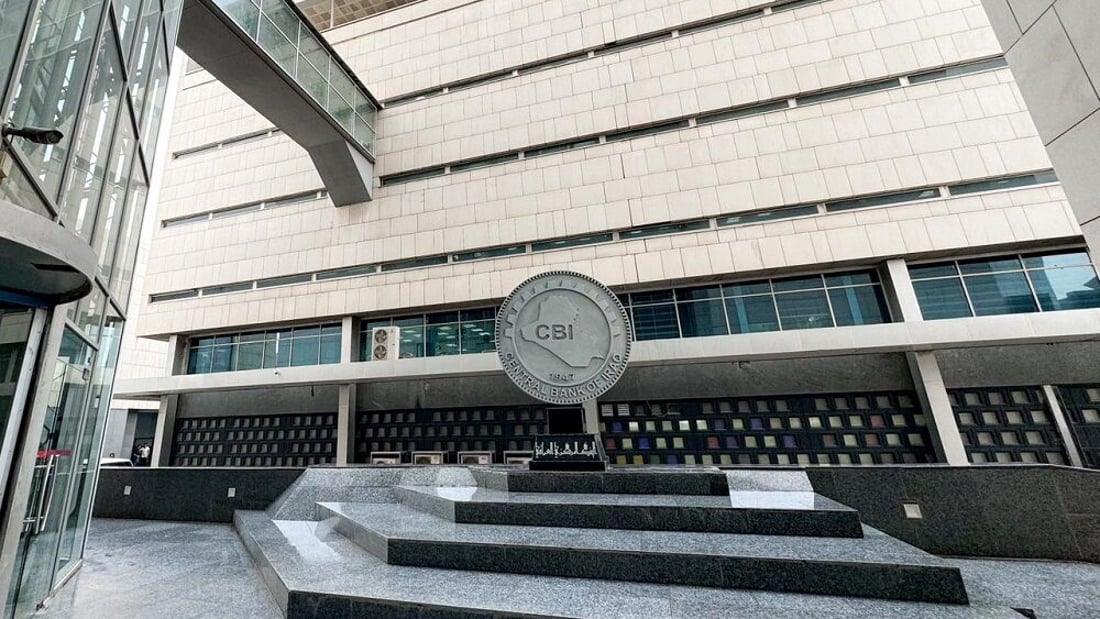
The Central Bank of Iraq (CBI) headquarters in Baghdad
Customs exemptions will cut budget funds, Finance Committee chair warns
BAGHDAD — Parliament’s Finance Committee will invite the Central Bank governor and the finance minister to appear this week to discuss how to fund the budget, its chair said Tuesday, warning that customs exemptions would cut revenue.
Committee chair Uday Awad told the state-run Iraqi News Agency that the committee had decided to invite Governor Nizar Nasser Hussein and Finance Minister Falih al-Sari. Lawmakers had already discussed the exemptions, expected losses in non-oil revenue and their effect on the exchange rate with the director general of the General Customs Authority, he said.
“The customs exemption on some goods will reduce budget financing, so a mechanism to fund the budget has to be found,” Awad said. He did not say how much revenue the exemptions would cost.
The customs chief appeared on Sunday. Committee member Nasser Turki told the agency that day that the meeting covered the cabinet’s exemption of imported food and medicine from customs duties and its expected effect on customs revenue in the draft 2027 budget. Members also discussed how to make sure the exemption is passed on to consumers in lower prices, he said.
The cabinet exempted all imported food and medicine from customs duties on Oct. 13, backdated to Oct. 7, the day the dinar was devalued, to protect food security and public health, the government said. It did not say how long the exemption would last.
On Oct. 7 the official selling price of the dollar rose from 1,320 to 1,520 dinars, the first change since 2023, raising the cost of dollars bought at the official rate to pay for imports. On the parallel market, the dollar sold for about 168,500 dinars per $100 in Baghdad on Tuesday morning.
The draft 2027 budget has been delayed and will reach parliament on Nov. 15, a month after its legal deadline, Awad said Monday. Committee member Abbas Ahyal said on Oct. 7 that the draft assumes oil at $58 a barrel and an exchange rate of 1,500 dinars to the dollar, the rate at which the Central Bank now buys dollars from the Finance Ministry.
Awad also said Monday that his committee backs Prime Minister Ali al-Zaidi’s order on Saturday to move contract employees and daily wage workers onto the permanent payroll. The order covers more than 500,000 people, according to a Finance Ministry count cited by government spokesperson Haider al-Aboudi. Neither the government nor the ministry has given a cost.
The state already spends about 7.7 trillion dinars a month on salaries (about $5.9 billion at the time) and other payments to about 10 million employees, pensioners and welfare recipients, according to the prime minister’s financial adviser, Mazhar Mohammed Salih, who gave the figure in August.
The Ministerial Council for Economy approved the draft budget on Sept. 27 and sent it to the cabinet. Iraq has had no budget this year, with parliament skipping 2026 to concentrate on 2027. Spending has been governed by the one-twelfth rule, which caps monthly spending at one-twelfth of the previous year’s actual current spending, since the three-year law covering 2023 to 2025 expired.
Oil provides more than 90% of federal revenue. Exports have risen to more than 3.4 million barrels a day since the start of October, back to prewar levels, from an average of 3 million in September, Oil Minister Basim Mohammed Khudair al-Abadi said on Oct. 19.