
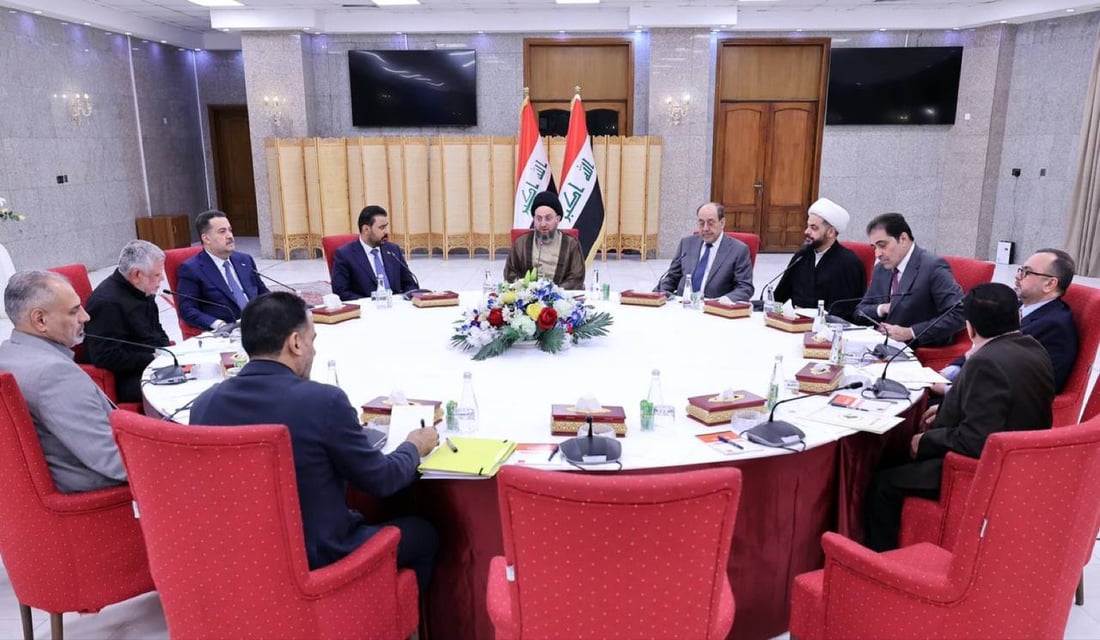
FILES: Iraq’s Coordination Framework during a regular meeting in Baghdad
Media Monitor
Shabandar says Coordination Framework has ‘no agenda’ beyond sharing power
BAGHDAD — Former MP Izzat al-Shabandar said the Coordination Framework was formed as a reaction rather than a project, has no binding voting mechanism and no agenda beyond sharing power, and that Prime Minister Ali al-Zaidi has more opponents than allies inside the alliance that put him in office.
“The institutionalization of the Framework has become a subject of discussion among its leaders, but institutionalization cannot happen when every leader in the Framework feels that he is the sole and highest leader,” he told Dijlah TV. “There is no binding voting mechanism within the Framework, and there is no agenda in the Framework other than sharing power.” He said several figures including Nouri al-Maliki oppose institutionalising it, and that pressing ahead would end it.
He singled out Humam Hammoudi, head of the Islamic Supreme Council and a senior Framework figure, saying he “is trying to give the Framework a status larger than its size and makes many statements on his own,” and describes the prime minister as an employee managed by the alliance.
“The Framework brought Zaidi, but it is not in harmony with Zaidi,” Shabandar said. “Zaidi has more opponents than allies within the Framework.” Framework parties do not in fact back the anti-corruption campaign, he said, calling claims that they do hypocrisy and lies, and said Sunni groups behave the same way, encouraging Zaidi publicly while seeking limits on who investigations can reach.
On the system itself, he said any move from a parliamentary to a presidential model would first require dismantling politics organised around sect and ethnicity. “We have to get rid of Sunni, Shiite and Kurdish alliances and move toward two alliances, each of which includes Sunnis, Shiites and Kurds,” he said, proposing that the largest winning alliance nominate a president who would then appoint a prime minister. “I hope the failure of the political forces in managing the parliamentary system will push [them] toward thinking in another way.”
The idea is not new. Protest leaders from the Tishreen movement in October 2019 pressed for a shift to a presidential or semi-presidential system, frustrated with the lack of accountability under consensus government, and then-President Barham Salih formed a committee to propose constitutional amendments during those protests. Salih called for what amounted to a presidential system in an article after leaving office.
The Coordination Framework is the coalition of Shia parties that forms Iraq’s main governing bloc. It took power after lawmakers loyal to Muqtada al-Sadr resigned from parliament in 2022, backed Mohammed Shia al-Sudani’s government from that October, and now backs Zaidi, who replaced Sudani in May. Maliki said in early July that the Framework remains a successful national project with no reason to break it up.
The anti-corruption campaign accelerated after the arrest of former Deputy Oil Minister Adnan al-Jumaili in May, whose interrogation state media cited as the basis for the June 28 Green Zone operation, in which it said 47 lawmakers and officials were detained and published 15 names. A sitting MP from that list was sentenced to seven years for illicit enrichment on Wednesday.