
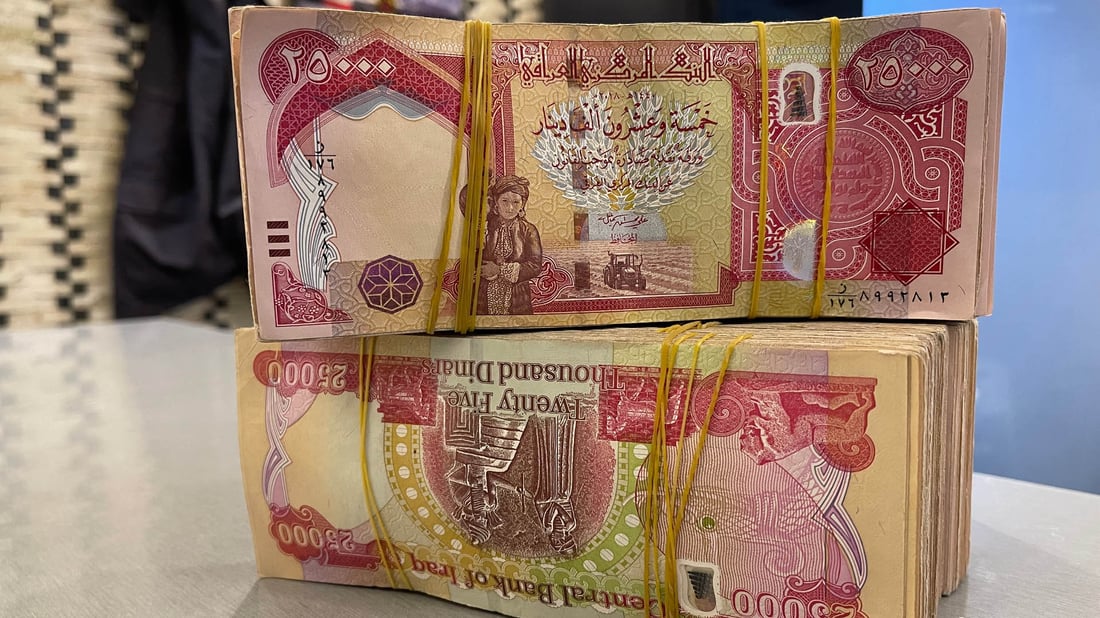
Bundles of 25,000 Iraqi dinar notes sit on a counter. Photo by 964media
Oil revenues strengthen
Iraq denies plan to borrow 16 trillion dinars from 5 countries
BAGHDAD — The Iraqi government on Friday denied reports that it plans to borrow 16 trillion dinars (about $11 billion at the official rate) from Saudi Arabia, Kuwait, China, Germany and France to cover its budget deficit. It said higher oil exports had made such borrowing unnecessary.
Reports that Iraq intends to borrow 16 trillion dinars from a number of countries to cover the deficit “are not true, and there is no need for such borrowing given the oil export indicator,” government spokesperson Haider al-Aboudi told the state-run Iraqi News Agency.
Aboudi said the government’s economic policy rests on careful use of Iraq’s revenues to fund public spending and meet the state’s financial needs, and that raising the ceiling on oil exports had boosted revenue. He did not say how else the deficit in the draft 2027 budget would be financed.
The figures in the denial match those economist Nabil al-Marsoumi gave on Thursday, when he said Iraq would borrow 16 trillion dinars from 18 Arab and foreign lenders, including the five countries. Marsoumi, who said he had read the draft, put the draft budget’s deficit at 43 trillion dinars (about $28 billion) in an interview.
Marsoumi said 5 trillion dinars from the account of Iraq’s oil-for-infrastructure agreement with China appears in the draft both as investment spending and as a source of deficit financing, which could make the deficit look like 38 trillion. That amount, he said, would be covered by 16 trillion dinars in foreign loans and 22 trillion (about $14 billion) in domestic borrowing, most of it from the Central Bank.
The government has not published the draft’s figures. Parliament’s Finance Committee on Thursday questioned the director general of the Finance Ministry’s Public Debt Department about the domestic and foreign loans included in the draft, parliament’s media office said. It gave no amounts.
Oil provides more than 90% of federal revenue. Exports collapsed after the U.S.-Israeli war with Iran disrupted shipping through the Strait of Hormuz, Iraq’s main export route, from Feb. 28, and the government acknowledged a fiscal crisis in late July, when salaries went out in stages.
Oil Minister Basim Mohammed Khudair al-Abadi said on Oct. 19 that exports had recovered to more than 3.4 million barrels a day in October, against 3.3 million to 3.5 million before the war.
In May, Ali al-Allaq, then governor of the Central Bank, warned that the deficit was now real rather than only on paper, and that the danger lay in it becoming “chronic and structural” because of the state’s dependence on oil. He said Iraq might need foreign loans, adding that “the lending capacity of government banks has reached high limits.”
The draft was due in parliament by Oct. 15 under the Financial Management Law. Finance Committee chair Uday Awad said Monday that it would reach lawmakers on Nov. 15, a month late.
Earlier this month, Marsoumi and economist Abdulrahman al-Mashhadani put the draft’s spending at about 217 trillion dinars (about $140 billion) and its deficit at about 45 trillion.
Iraq has had no budget this year. Since the three-year law covering 2023 to 2025 expired, spending has been governed by the one-twelfth rule, under which monthly spending is capped at one-twelfth of the previous year’s actual current spending while there is no budget law.