
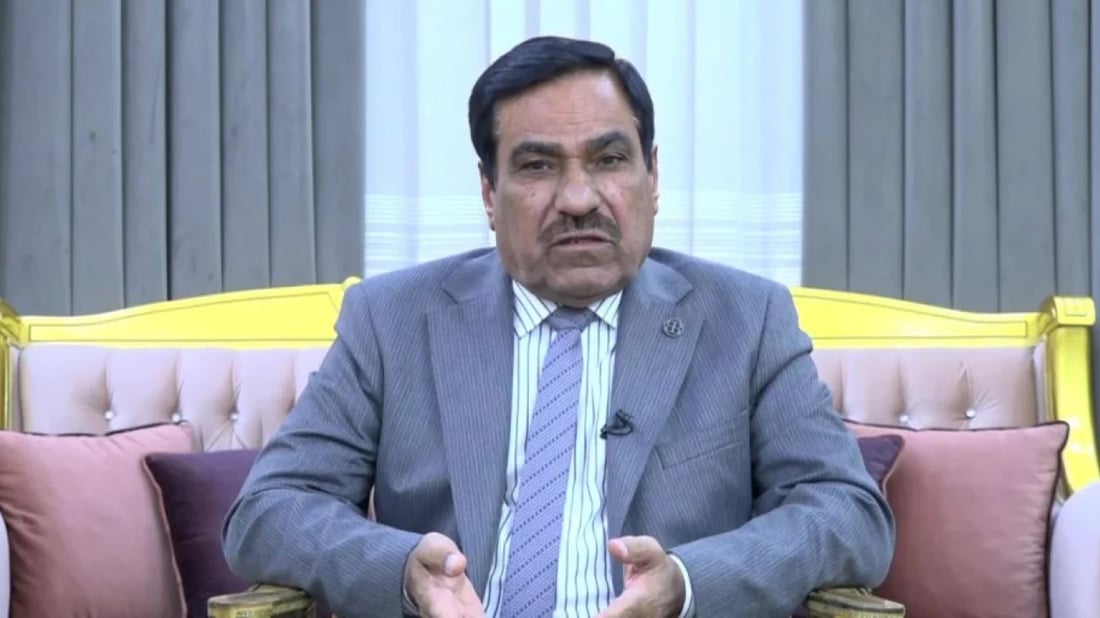
Economic expert Nabil al-Marsoumi
Iraq economist calls IMF borrowing a ‘trap,’ warns of risks to salaries and subsidies
BAGHDAD — Iraqi economist Nabil Al-Marsoumi warned Thursday that the federal draft budget carries a deficit of 43 trillion dinars, while potential borrowing from the International Monetary Fund could require spending cuts affecting public sector salaries and government subsidies for low-income households.
Speaking in an interview with journalist Sajad Al-Jubouri, Al-Marsoumi questioned the accounting of 5 trillion dinars linked to the Iraq-China agreement, saying the amount appears in the draft budget both as investment expenditure and as a source of deficit financing. “What is strange about the draft budget I reviewed is that 5 trillion dinars are covered through the Iraq-China agreement account, while the same amount is also listed under investment expenditures,” Al-Marsoumi said.
He suggested the accounting treatment could be intended to make the deficit appear smaller. “Perhaps the purpose is to give the impression that the budget deficit is not 43 trillion dinars, but 38 trillion,” he said.
According to Al-Marsoumi, financing for the 38 trillion dinar deficit includes 16 trillion dinars in external borrowing and 22 trillion dinars in domestic borrowing. The domestic portion comprises 15 trillion dinars from the Central Bank of Iraq, 5 trillion dinars through bonds and 2 trillion dinars from state-owned banks.
Al-Marsoumi also warned that increasing domestic debt could restrict banks’ ability to lend to private businesses. “Domestic debt in Iraq has begun to grow at a worrying rate and could affect banks’ ability to lend to the private sector,” he said.
He added that the government has borrowed 20 trillion dinars since the closure of the Strait of Hormuz, while external debt remains within what he described as safe limits, at approximately $13 billion. Al-Marsoumi said Iraq plans to borrow 16 trillion dinars from 18 Arab and foreign lenders, including Saudi Arabia, Kuwait, China, Germany and France.
Addressing borrowing from the IMF and other international financial institutions, he warned that loans could come with conditions requiring changes to government spending. “Borrowing from the IMF and other institutions and organizations is a trap, despite the low interest rate of 1.25%,” he said.
He explained that the IMF generally lends to address budget deficits rather than finance development projects, requiring borrowing countries to adopt measures aimed at increasing revenues, covering expenditures and meeting debt repayments.
“Sometimes this prescription can be harsh and painful, affecting the poor through reductions in government support for them. It could even interfere with the salary bill,” Al-Marsoumi said.
Iraq’s domestic debt has reached 117 trillion dinars following accumulated budget deficits from 2023 through 2025, while external debt stands at between $8 billion and $10 billion, according to Central Bank adviser Mahmoud Dagher on Oct. 21.
In a televised interview, Dagher said Iraq has the right to seek loans from the International Monetary Fund as a contributing member, with interest rates not exceeding 1%. However, he explained that IMF lending requires an agreement with Iraq’s political and economic leadership to reform macroeconomic policies, including measures to address government spending, operating expenditures and public-sector salaries.
Prime Minister Ali al-Zaidi said this month that his government took office in May with public debt of more than 208 trillion dinars. “We began our duties with public debt exceeding 208 trillion dinars, while the government was required to provide 10 trillion dinars each month. Despite the crisis, we secured salary payments,” said Zaidi.
State of Law lawmaker Yousif al-Kilabi said Tuesday he would seek a public session of parliament to question former Prime Minister Mohammed Shia al-Sudani over Iraq’s debt, hours after he was referred to the Parliamentary Conduct Committee. Kilabi, a member of former Prime Minister Nouri al-Maliki’s State of Law Coalition and of parliament’s Finance Committee, said Sudani’s government left Iraq with 208 trillion dinars (about $160 billion at the time) in debt. That was nearly half of the 450 trillion dinars (about $340 billion at the time) allocated under the three-year federal budget approved during Sudani’s term, he said.
Iraq has had no 2026 budget since the 2023-2025 budget law expired, so spending runs on the one-twelfth rule, under which monthly spending is capped at one-twelfth of the previous year’s actual current spending while there is no budget law.