
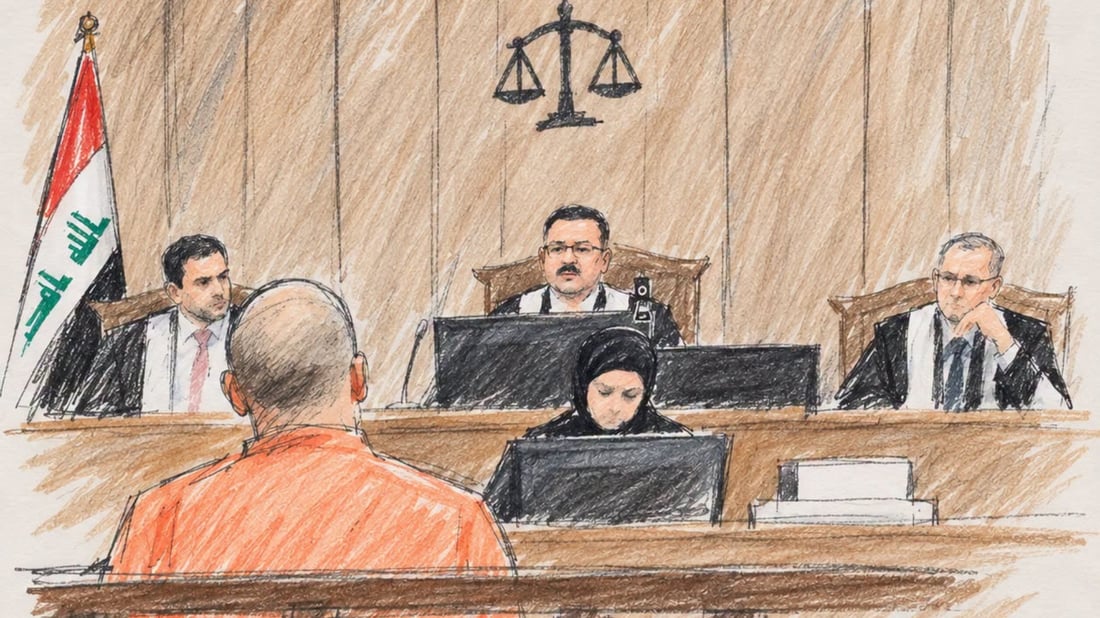
An illustration depicting a defendant appearing before a panel of judges in an Iraqi courtroom.
Syria cases advance
Baghdad court jails 3 more French Isis members for life
BAGHDAD — A Baghdad court on Thursday sentenced three French nationals to life in prison for membership in the Islamic State group, the Supreme Judicial Council said, two days after the same court sentenced seven other French defendants.
The Karkh Criminal Court handed down the sentences in the presence of the defendants’ lawyers and representatives of the French Embassy in Iraq, the council said in a statement. Life imprisonment under Iraqi law is 20 years. The statement did not name the three.
The court convicted them under Article 4 of Iraq’s Anti-Terrorism Law of 2005, which carries the death penalty for carrying out or taking part in terrorist acts. It also cited Article 132 of the Penal Code, which allows a court to replace a death sentence with imprisonment when it finds grounds for leniency.
The three were among 47 French defendants whom Iraqi authorities received from northeast Syria, the council said. The First Karkh Investigation Court, which handles terrorism cases, questioned them and referred them for trial.
On Tuesday, the court sentenced six French nationals to life and a seventh to 15 years for Isis membership, according to an earlier council statement. Thursday’s verdicts bring to 10 the number of the 47 sentenced this week.
Iraq began receiving Isis suspects from prisons in northeast Syria guarded by the Kurdish-led Syrian Democratic Forces in January, after instability raised concerns over the facilities’ security, and had taken in 5,703 by mid-February. The transfers were coordinated with the U.S.-led coalition against Isis. On Jan. 23, Mohammed Shia al-Sudani, then prime minister, discussed the transfers with French President Emmanuel Macron and urged European countries to take back and prosecute their nationals.
Iraqi judicial authorities finished initial investigations into all 5,704 suspects in September. They said 466 would be released for lack of evidence and that the remaining cases would go to trial according to the evidence against each defendant.