
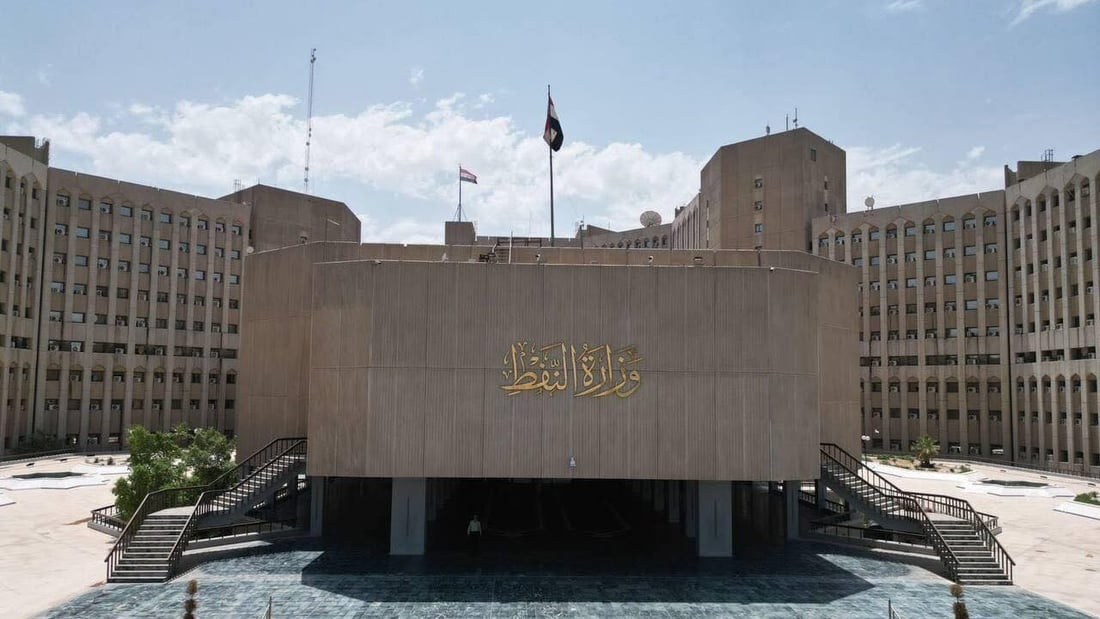
Iraq's Ministry of Oil headquarters
Media Monitor
Iraqi MP urges pipelines to Jordan, Syria, says export planning failures are ‘deliberate’
BAGHDAD — Iraqi lawmaker Jassim Al-Attiyah said Thursday that parliament plans to host officials from the Oil Ministry’s planning department for questioning, accusing ministry personnel of deliberately obstructing efforts to expand Iraq’s oil export capacity and suggesting that external interests could be behind the alleged mismanagement.
Speaking in an interview with journalist Samer Jawad on Iraq 24 TV, Al-Attiyah warned that Iraq would remain vulnerable to security and regional disruptions unless it develops additional oil export routes with capacity exceeding current export volumes. “If the government does not consider diversified oil export outlets with capacity exceeding current export volumes, so that we have reserves in case of a disruption or something similar, we will remain in trouble,” he said.
Al-Attiyah urged authorities to move forward with pipeline projects connecting Iraq to neighboring countries, including Jordan and Syria, despite opposition to such plans. “We are always concerned about populism in the streets calling for no pipelines to Jordan, Syria and other neighboring countries,” he said. “We must deal with matters realistically, overcoming populism and those who threaten to blow up one pipeline or another.”
Prime Minister Ali al-Zaidi and Syrian interim President Ahmed al-Sharaa on Wednesday discussed exporting up to 2 million barrels a day of Iraqi oil through a pipeline to Syria’s Mediterranean port of Baniyas, Zaidi’s office said. Two million barrels a day would be more than half of Iraq’s current oil exports.
The lawmaker said parliament had already raised concerns about the ministry’s planning, “When we hosted the oil minister, around 90% of members of parliament identified shortcomings in the Oil Ministry’s strategic planning,” Al-Attiyah said. “I believe this failure is deliberate, and there are personnel within the ministry working against it.”
In July, Iraq signed a memorandum of understanding with Syria to develop a crude export pipeline to Baniyas, to be carried out by a consortium of U.S. companies Chevron and TI and Qatar’s UCC, the Oil Ministry said at the time. A memorandum sets out an intention to cooperate and is not a construction contract.
He said lawmakers intend to question the ministry’s planning department, “It makes no sense for production to have increased over the past years without the ministry considering how to export it,” he said, adding that “I say this frankly: There is deliberate mismanagement in the Oil Ministry, and there may be an external agenda behind it or an attempt to obstruct Mr. Al-Zaidi’s progress,” he said. He added that the oil minister was not cooperating with parliament and described the official responsible for planning at the ministry as “asleep.”
Al-Attiyah did not identify the ministry personnel he accused of deliberate mismanagement or provide evidence of foreign involvement in the alleged obstruction.
Iraq’s oil exports have risen to more than 3.4 million barrels a day since the start of October, back to prewar levels, from an average of 3 million in September, Oil Minister Basim Mohammed Khudair al-Abadi said on October 19. Iraq is exporting through three routes, the Strait of Hormuz, Turkey’s Ceyhan port and tanker trucks through Syria, Abadi told the state-run Iraqi News Agency, and its crude is going to Europe, Asia and the Americas. The ministry was working to expand export capacity to raise revenue and fund state spending, he said.
Exports fell from more than 99 million barrels in February to 18.6 million in March, cutting monthly revenue from more than $6.8 billion to about $1.95 billion, Oil Ministry figures show, and Abadi said in July that monthly revenue had dropped to about $1.5 billion, against $7 billion to $8 billion before the war. Oil provides more than 90% of government revenue. Foreign Minister Fuad Hussein said this month that the war had cost Iraq an estimated $60 billion.
Iraq has kept Kirkuk crude flowing through Ceyhan while supplies to Jordan have been suspended since the start of the year, a suspension the ministry attributes to a shortage of Kirkuk light crude.
There is also the Basra-Aqaba oil pipeline. The pipeline, first agreed in a 2012 framework deal and never built, would carry Basra crude about 1,700 kilometers to Jordan’s port of Aqaba, bypassing the Strait of Hormuz, where shipping has been disrupted by the U.S.-Israeli war with Iran. King Abdullah and Iraqi President Nizar Amedi stressed the need to build it in a phone call on Oct. 19.
Iraq and Jordan on Monday signed nine memorandums of understanding and cooperation programs, from higher education to consumer protection, as al-Zaidi called for a joint free zone during talks in Amman. None of the statements on Monday’s talks mentioned the pipeline, and none of the nine documents signed covers energy.