
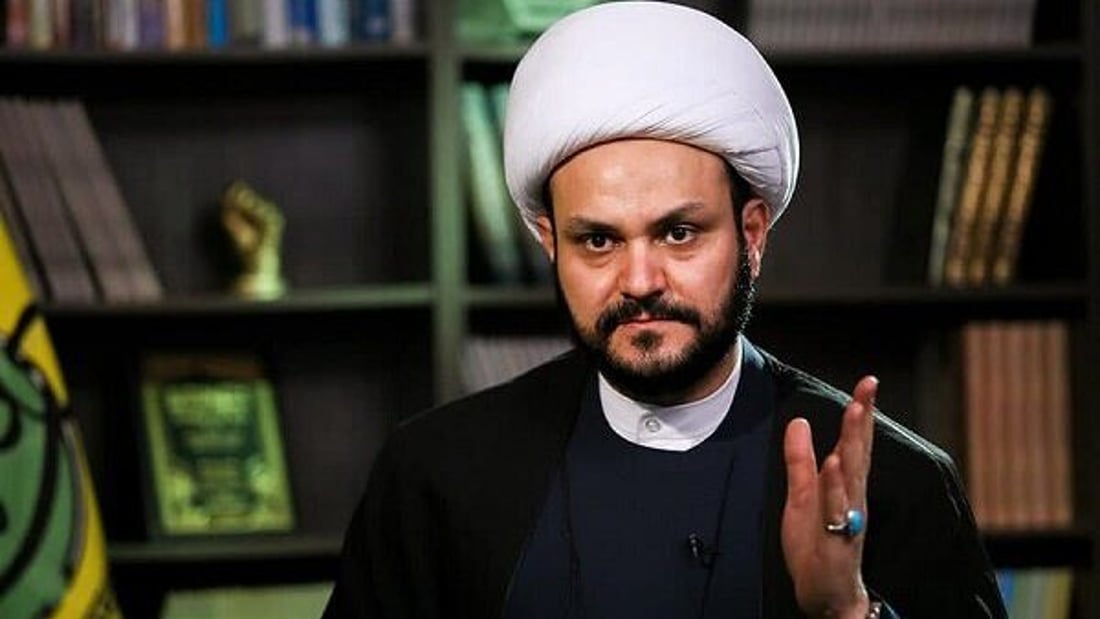
Akram al-Kaabi, secretary-general of Harakat al-Nujaba
Iraqi militia leader unleashes tirade at Saudi Arabia and calls for military strikes
BAGHDAD — The head of Harakat al-Nujaba called Saturday for “an appropriate military response” to last month’s U.S.-Saudi airstrikes and rejected diplomacy with Riyadh, a day after Iran-aligned factions called off an attack at the request of a senior Iraqi politician.
“All brothers will realize that the option of diplomacy with the vile Wahhabi Al Saud entity is futile, because it is a regime of deviant creed,” Akram al-Kaabi said in a statement, accusing the kingdom of standing “behind many of the conspiracies that targeted Iraq and its people.”
Saudi Arabia is “a rabid dog toward Muslims, while at the same time you find it a cowardly milch cow before the Zionists and the enemies of Islam, submissive and abject,” Kaabi said, and “the professional and correct way to discipline it is only through humiliating it, as is its habit and as its Zionist masters have accustomed it.” That, he said, could only be achieved through military action that would “fulfill the debt owed to the blood of our righteous martyrs among the sons of the Popular Mobilization Forces, struck by its treachery.”
He dismissed compensation: “What compensation are you talking about that equals their sacred blood? What money can restore joy to their orphans, their bereaved mothers and their widowed wives?” He closed: “Missiles are answered only with missiles, and fire is met only with fire.”
Kaabi is the second faction leader in a day to push back on the stand-down. Abu Alaa al-Walaei of Kataib Sayyid al-Shuhada said earlier Saturday that a response “remains on the table” and that the delay had come at the request of Coordination Framework leaders. Both lead factions that have refused to join the government’s plan to bring weapons under state control by Sept. 30, and both are the subject of U.S. rewards of up to $10 million — Kaabi’s announced in May over what the State Department called a long history of targeting American troops and diplomatic facilities in Iraq.
The Islamic Resistance in Iraq said Friday it had postponed an attack on Saudi Arabia and U.S. military bases planned for that day, following an appeal by Badr Organization leader Hadi al-Amiri and the positions of several political leaders, while saying it had not abandoned the rights of those killed and wounded.
U.S. and Saudi aircraft struck Popular Mobilization Forces sites in Baghdad, Wasit, Nineveh, Basra, Kirkuk, Karbala and Diyala in late July, killing at least 20 members and wounding 32, according to the force. U.S. Central Command said the strikes hit weapons-storage and logistics sites linked to Iran-backed groups after more than 30 drone attacks it attributed to Iran’s Revolutionary Guard.