
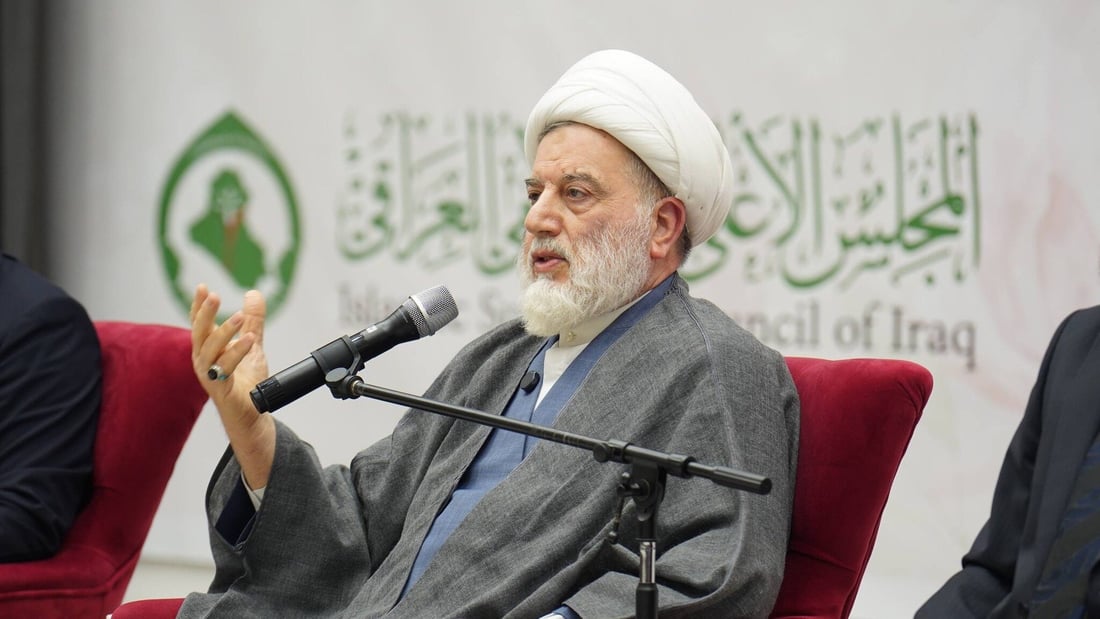
FILES: Hummam Hamoudi, head of Iraq’s Islamic Supreme Council, speaks during a political forum in Baghdad.
Anti-corruption drive must cover everyone without exception, Hammoudi says
BAGHDAD — Hummam Hammoudi, head of the Islamic Supreme Council of Iraq, said Saturday the government’s anti-corruption campaign should continue only under a transparent framework applying to everyone without exception, and that armed groups will cease to be necessary once the state can protect its own sovereignty by land, air and sea.
“There is a will to confront corruption,” Hammoudi said in a speech in Baghdad. “There must also be a clear and transparent vision for how this will be carried out, covering everyone without exception.” He said political reform and removing corruption from state institutions should form part of a comprehensive strategy.
The campaign, launched in late June, has led to the arrest of dozens of current and former lawmakers, officials and political figures, according to state media, which has described the arrests as the first phase of a broader operation against corruption networks. State media said they followed confessions by detained former Deputy Oil Minister Adnan al-Jumaili, who was dismissed in late May and arrested in Salah al-Din governorate over alleged commissions and misuse of public funds through oil refining contracts. Investigators have continued seizing cash and gold in the case, most recently 13 billion dinars (about $9.8 million at the official rate), $400,000 and 40 gold bars, announced Wednesday by the Supreme Judicial Council.
Hammoudi has pressed the campaign before. Earlier this month he asked why Iraq’s integrity, financial oversight and parliamentary watchdogs had failed to detect the cases now emerging, arguing accountability should address systemic failures rather than individual arrests alone.
On the armed factions, Hammoudi said the “resistance was born from circumstances in which the state needed those who would support it,” and had helped build and protect Iraq’s post-2003 political system. “But once the state becomes capable of protecting sovereignty by land, air and sea, there will no longer be a need for it,” he said. In May he said restricting weapons to state authority was “a demand of the religious authority, not one imposed from abroad,” and called for a constitutional and legal framework to achieve it.
Prime Minister Ali al-Zaidi’s government is pursuing that plan, and it has split the Iran-aligned factions. Asaib Ahl al-Haq, Saraya al-Salam and the Imam Ali Battalions have moved to comply. Kataib Hezbollah, Harakat al-Nujaba and Kataib Sayyid al-Shuhada have refused, arguing their weapons remain necessary while U.S. forces are in Iraq.
At his White House meeting with U.S. President Donald Trump on July 14, Zaidi said the government intended to bring weapons under state control once the coalition mission ends. “Whoever surrenders their weapons will turn into a political and civil entity,” he said. “After Sept. 30, there is no need for any faction. Factions are a need, not a profession. There is no justification for their existence after Sept. 30.” Sept. 30 is the end date of the anti-ISIS coalition’s mission and the withdrawal of American troops.
Hammoudi also said Iraq would not become “an axis against another axis,” that future investment agreements would require parliamentary approval and oversight, and that lawmakers should exercise that role independently of party competition. “Partisanship is linked to public affairs, but we reject its interference in the administrative affairs of state institutions,” he said.
The Islamic Supreme Council is one of Iraq’s longstanding Shia political movements and part of the Coordination Framework, the coalition of Shia parties central to Iraqi politics since the 2021 elections.