
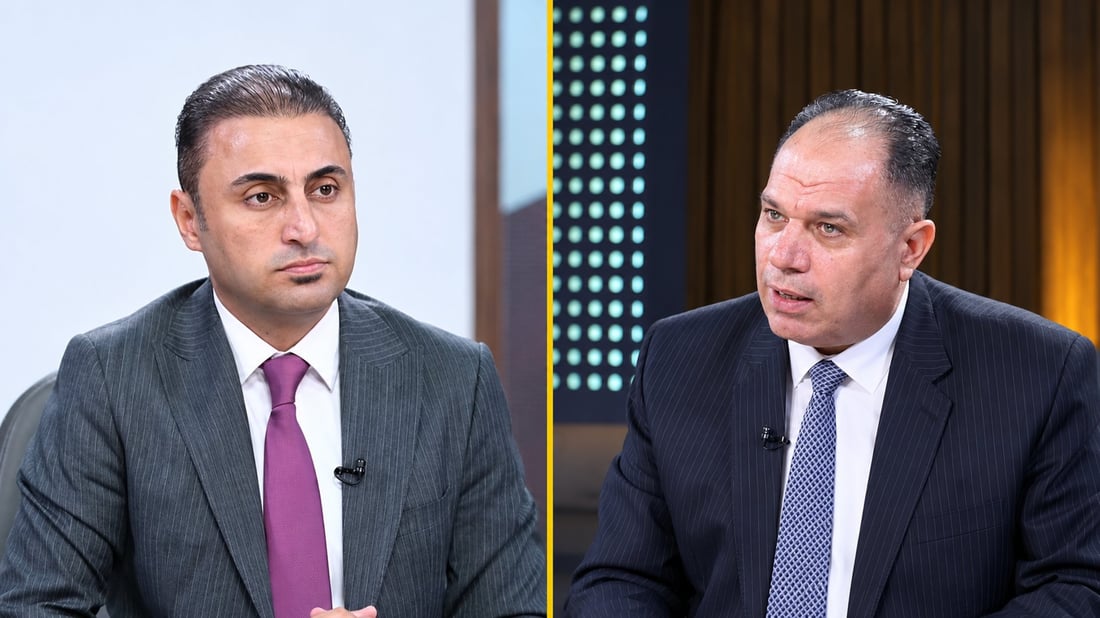
State of Law Coalition lawmaker Falah al-Khafaji, right, during an interview on Al-Rasheed TV.
State of Law MP urges Zaidi to give Jurf al-Sakhar talks up to a month
BAGHDAD — A State of Law Coalition lawmaker on Tuesday urged Prime Minister Ali al-Zaidi to extend Kataib Hezbollah’s deadline to leave Jurf al-Sakhar, in northern Babil, by 10 days to a month to give negotiations more time.
Falah al-Khafaji, whose coalition is led by former Prime Minister Nouri al-Maliki, also proposed that the shrine units take the Iran-aligned faction’s place. The units are armed brigades linked to the Shiite shrines in Karbala and Najaf, which a 2020 decree placed directly under the commander-in-chief. Khafaji spoke to presenter Ahmed al-Tayeb on Al-Rasheed TV.
The Coordination Framework, Iraq’s ruling alliance of Shiite parties, on Monday turned down Zaidi’s insistence on sending combat forces into the area, a source in the alliance told 964media. Its leaders agreed instead to replace the armed force that holds Jurf al-Sakhar with other units of the Popular Mobilization Forces, the state-sanctioned umbrella of mostly Shiite armed groups, the source said.
“Prime minister, you are a father to all Iraqis, to the factions and the security agencies,” Khafaji said. “You gave four days, and there is no harm if we give another 10 days for more negotiations.”
The government said Monday that Zaidi had ordered the armed forces into Jurf al-Sakhar and given the faction a short deadline to leave. It has not said publicly when the deadline expires.
Zaidi is a leader and the head of a family, and it makes no sense for him to throw himself into a confrontation, Khafaji said. “Can he not give 15 days or even a month for negotiations? We may find a way through,” he said.
He said he had information that Framework politicians were leading efforts to ease the dispute, and that new figures had joined the mediation on Tuesday “to ward off strife and infighting.”
Khafaji backed the state’s authority over the area. “The commander-in-chief of the armed forces is number one in Iraq, and the state’s authority must extend over every inch of Iraq,” he said.
But Zaidi must treat everyone by “one yardstick,” he said, and the government should not take on one group while leaving others alone. No religion or sect permits anyone to smuggle oil, he added.
He rejected Kataib Hezbollah’s statements that it would not leave. “The Kataib’s talk of not leaving Jurf al-Sakhar is unacceptable, because they have been in this area for 14 years,” he said. Iraqi forces and allied armed groups retook Jurf al-Sakhar from the Islamic State group in 2014.
The issue should not be made bigger than it is, Khafaji said, adding that without the media hype the faction would have left Jurf al-Sakhar “with complete ease.”
“Our message to the Kataib: You are brothers, and we hold you in the highest regard, but we do not accept a clash with the security agencies,” he said. “There is no harm in the shrine units replacing the Kataib in Jurf al-Sakhar.”
Razzaq al-Haidari, a former lawmaker for Babil from the Badr parliamentary bloc, urged Kataib Hezbollah on Tuesday to hand Jurf al-Sakhar to government forces and move to Mosul or the area around Karbala. That way the faction would give no grounds for talk that it was hiding something there, he told Tayeb on Al-Rasheed TV.
“I personally have no problem with replacing the forces in the Jurf with other forces,” Haidari said. There would be no harm in the faction moving and another force taking over the area, he said.
He rejected the vow by Abu Talib al-Saeedi, a senior Kataib Hezbollah figure, that the faction would not leave “even over our bodies.” Saeedi told AFP earlier Tuesday that the faction would stay despite the deadline, though he said there would be no fighting with the troops Zaidi has ordered in.
Haidari also registered his “strong objection” to what he said was government spokesperson Haider al-Aboudi’s description of the faction as reckless. “The problem with Jurf al-Sakhar is that if weapons are used there, it may start and never end,” he said.
Fighters in a holy cause cannot also be traders and smugglers, Haidari said. “If my own son were smuggling oil or encroaching on Iraq’s public money, I would take him by the hand to the courts,” he said.
He said he had heard that Badr Organization leader Hadi al-Amiri opposed the government’s handling of the issue, particularly the statements by Zaidi and Aboudi. Such crises are not solved “with harshness and orders,” Haidari said, but need the intervention of Framework leaders such as Amiri, Maliki, Hikma Movement leader Ammar al-Hakim and Asaib Ahl al-Haq leader Qais al-Khazali.
Speaking of Amiri, he said: “I am optimistic about him and about Maliki, and 99% of the issue will be resolved peacefully.” He said his view was based on information he had.
Abdul Amir Taiban, an adviser to Zaidi, told Dijlah TV on Monday that there would be no retreat from the decision to take control of the area.
Also on Tuesday, a PMF commander said Kataib Hezbollah was ready to let the Energy Police guard the oil pipelines that cross Jurf al-Sakhar.
The standoff began with a Federal Intelligence and Investigations Agency report that started circulating Nov. 9. The report alleges that oil was drawn from a pipeline in Jurf al-Sakhar through an unauthorized opening and carried away in tanker trucks holding 36,000 liters each. The agency is part of the Interior Ministry. Kataib Hezbollah has denied smuggling oil.
Kataib Hezbollah has brigades in the PMF. Jurf al-Sakhar was officially renamed Jurf al-Nasr in 2014 after its recapture. It has been closed since then, and many of its displaced residents still cannot return.