
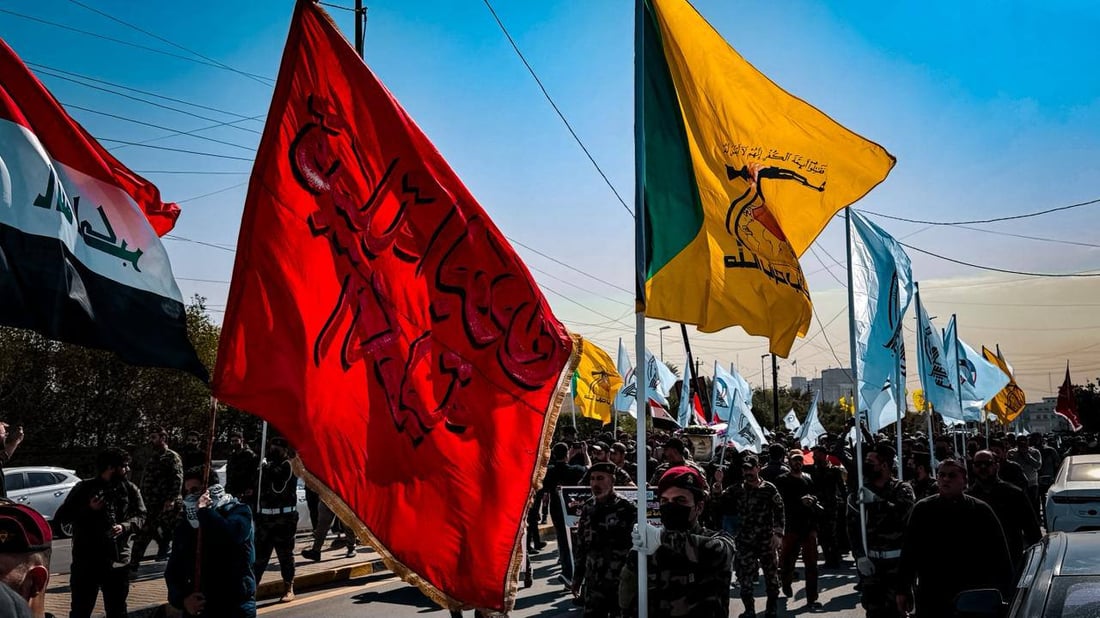
FILES: Supporters of Kataib Hezbollah carry the group's flags alongside the Iraqi national flag during a procession.
Kataib Hezbollah says Iraq’s ruling blocs approved Iran blockade role
BAGHDAD — Kataib Hezbollah’s security official said Tuesday that Iraq’s ruling alliances had approved the country’s part in a blockade of Iran. He compared anyone who takes part to an early enemy of the Prophet Mohammed.
Abu Mujahid al-Assaf said in a statement posted on X that the Framework’s “managing director” had told Iranian officials that the State Administration Coalition and the Coordination Framework had approved Iraq’s part in the blockade. The phrase appeared to refer to Prime Minister Ali al-Zaidi. The State Administration Coalition is the governing coalition behind Zaidi’s government, and the Coordination Framework is the ruling alliance of Shiite parties. Assaf gave no evidence for the claim.
“Anyone who contributes to the blockade of the brotherly Iranian people is no less evil than Abu Lahab and a handful of Quraysh infidels,” Assaf said. Abu Lahab, an uncle of the Prophet, sided with Mecca’s Quraysh tribe when it boycotted the Prophet’s clan in the early years of Islam.
Kataib Hezbollah is an Iran-aligned armed faction that the United States designated a terrorist organization in 2009. The government and the Framework did not respond to the statement right away. Zaidi, a former banker, headed the National Holding Company before he became prime minister.
Assaf did not say what Iraq’s part in the blockade involved. The al-Sheib border crossing with Iran in Maysan governorate closed to goods and travelers on Oct. 21 on Zaidi’s instructions, until further notice. Government spokesperson Haider al-Aboudi said the crossing’s technical and logistical facilities were not ready for continued operation. Government adviser Abdul Amir Taiban said the closure was meant to keep drugs and counterfeit currency out of Iraq and denied that it was part of a blockade of Iran.
Assaf also said Kataib Hezbollah was still waiting for a copy of an agreement signed between the Islamic Resistance in Iraq, the umbrella name Iran-aligned factions use, and a Framework committee. “Will the managing director keep it in his pocket?” he asked. The resistance was still keeping its pledge, he said.
A Kataib Hezbollah-linked lawmaker said earlier this week that a Framework committee had agreed with the armed factions on regulating their weapons, but Zaidi had not signed the deal for fear of U.S. pressure. “Who says there are understandings between the government and the factions? In fact, a committee from the Coordination Framework reached understandings with the factions and agreed on a number of issues and provisions,” Saud al-Saadi, head of the Huqooq bloc in parliament, said in an interview on Al-Rabiaa TV.
Assaf said the government “has produced nothing but unfulfilled promises.” He asked Framework leaders whether they knew what was happening behind the scenes, or whether they would find out only after the prime minister fell.
He said the group had nothing to do with an incident over Baghdad’s Green Zone last week. He described the incident as the targeting of an aircraft friendly to the United States by U.S. allies, and suggested the government ask its Emirati friends. On Oct. 27, Iraqi security forces engaged an unidentified drone near the heavily fortified Green Zone, causing a loud noise heard across the capital, the head of the Security Media Cell told the state-run Iraqi News Agency. The cell reported no casualties or damage.
The Islamic Resistance had halted all military operations inside Iraq to date and would announce any operation as soon as it carried it out, Assaf said. The government’s plan for the factions calls for a 90-day halt to attacks from Sept. 30, followed by a six-month handover of weapons ending June 30, 2027.
The statement also questioned the activity of what it called Emirati-Syrian drones named Shaheen in Iraqi airspace. It said one had crashed on a farm in Karbala and raised an earlier incident in Samawah. 964media could not verify either incident.
Assaf accused Zaidi and his office of tampering with the bill governing the Popular Mobilization Forces before it was sent to parliament. He asked whether PMF members and the bill’s defenders knew how far the changes went.
Asaib Ahl al-Haq’s Sadiqoun parliamentary bloc wrote to Speaker Haibat al-Halbousi last month asking why the PMF bill had not reached parliament nearly four weeks after the cabinet approved it. The cabinet voted on the bill on Sept. 29, according to the bloc’s letter.
Assaf also denied that Kataib Hezbollah had joined or would join the government or had sought any post in it. Anyone who said so was lying, he said.
Mansour al-Buaiji, a lawmaker from former Prime Minister Mohammed Shia al-Sudani’s Reconstruction and Development Coalition, said last month that Zaidi was working to replace officials in 50 government posts and might extend the changes to the PMF. Buaiji also said every armed faction had joined the government and agreed to hand its weapons to the state on a set timetable, and that even Kataib Hezbollah might take part. Kataib Hezbollah said on Sept. 30 that it was not bound by any timetable for handing over weapons.