
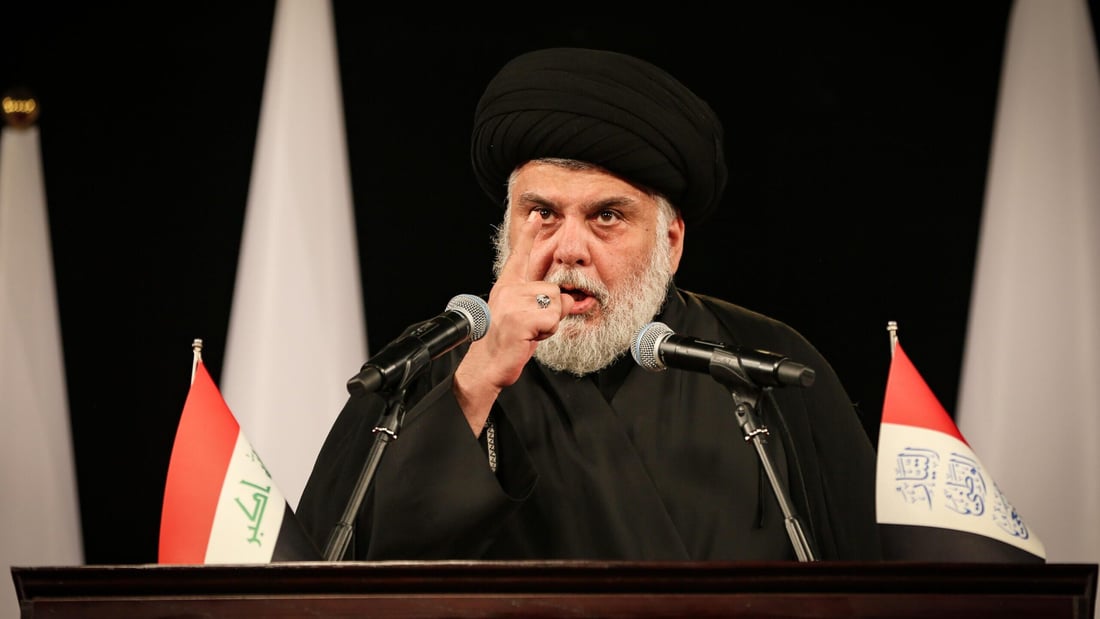
Sadrist movement leader Muqtada Al-Sadr
Blame for PMF deaths lies with ‘brazen actions of the militias’, Sadr says
BAGHDAD — Muqtada al-Sadr blamed Iraqi armed factions rather than the United States or Saudi Arabia for the deaths of Popular Mobilization Forces personnel in Wednesday’s airstrikes, and renewed his call for weapons to be held only by the state.
“The brazen actions of the militias and the failure to restrict weapons to state control have continued to cause the martyrdom of the mujahideen in the Popular Mobilization Forces and the security forces without justification,” Sadr said in a statement Thursday. He accused faction leaders of escaping the consequences borne by their fighters: “Their senior figures enjoy security, comfort and commerce. Enough of your individual and irrational actions.”
Offering condolences, he said: “Mercy and divine acceptance for our martyrs, and patience and consolation for their honorable families. There are no condolences for those whose actions caused their loss.”
U.S. and Saudi aircraft struck PMF headquarters and facilities on Wednesday in Baghdad, Wasit, Nineveh, Basra, Kirkuk, Karbala and Diyala, and the PMF reported a preliminary toll of 20 killed and 32 wounded. U.S. Central Command said the joint operation targeted weapons and logistics sites belonging to Iran-aligned groups, following more than 30 drone attacks on U.S. forces and Saudi energy infrastructure over the previous 72 hours.
Sadr had already condemned the attacks on Iraqi territory on Wednesday while accusing armed factions of trying to drag Iraq into a war, and calling on Iran’s Revolutionary Guard not to strike Iraqi soil.
He led the Mahdi Army, which fought U.S. and Iraqi government forces after 2003 and was implicated in the 2006-08 civil war, and disbanded it in 2008. Saraya al-Salam, the armed wing he formed in 2014 to fight the Islamic State group, operates within the PMF and is among the factions complying with the weapons-control plan. On May 27 he announced Saraya al-Salam would sever its organizational link to his movement and come under state authority, and urged other factions to do the same.
Asaib Ahl al-Haq and the Imam Ali Battalions have also announced steps to place their weapons under state control. Kataib Hezbollah and Harakat al-Nujaba have resisted while foreign forces remain in Iraq. The command structure for compliant factions has not been made public, with official statements using terms such as integration and restructuring without saying whether fighters would be absorbed individually into army units or remain as formations.
Prime Minister Ali al-Zaidi’s government says it will continue the process as the international coalition prepares to leave, with the withdrawal scheduled for Sept. 30.