
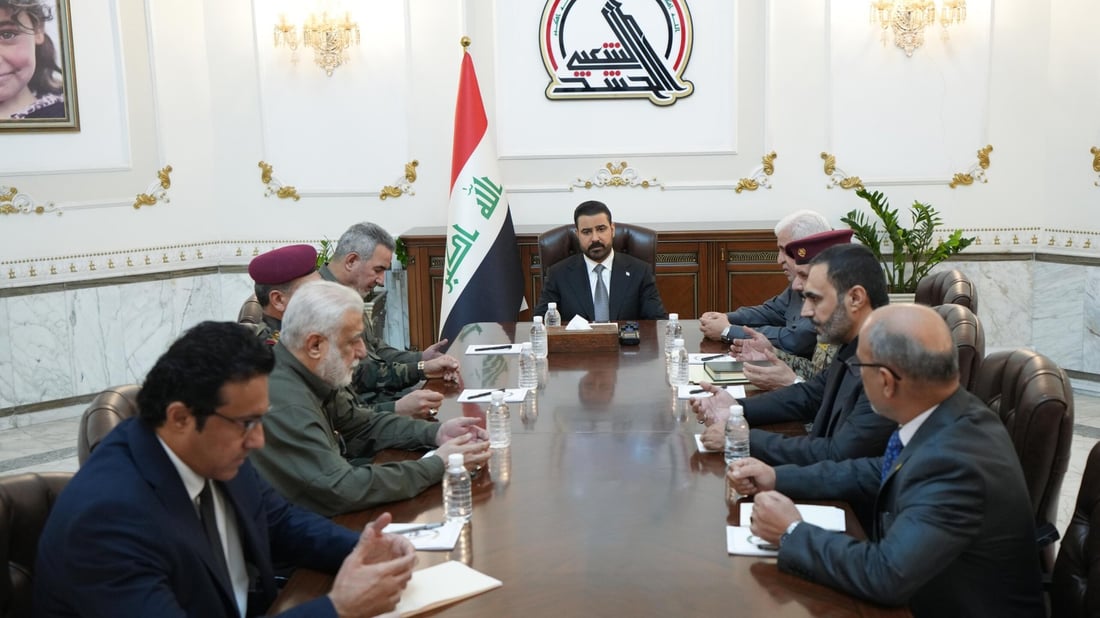
(Photo: Iraqi Prime Minister’s Media Office)
PMF chair pledges to follow all orders from the prime minister
BAGHDAD — Popular Mobilization Commission Chair Faleh al-Fayyadh told Prime Minister Ali al-Zaidi the force is ready to carry out “all directives of the Commander-in-Chief of the Armed Forces,” as Zaidi visited its headquarters Wednesday hours after U.S. and Saudi aircraft struck PMF sites across seven governorates.
Fayyadh said the commission would act to “protect the lives of PMF fighters, strengthen the country’s security, safeguard its sovereignty, and raise the level of readiness to confront any attacks targeting Iraq and its security institutions,” according to a PMF statement.
Zaidi received a detailed briefing on the strikes and directed officials to “honor the families of the martyrs, provide comprehensive healthcare to the wounded, and take all necessary measures to ensure they receive the required medical treatment,” including transfer abroad “if their medical condition so requires.” Fayyadh also briefed him on the security missions PMF units carry out and their role in supporting the security system, the statement said.
The PMF said the strikes hit its headquarters in Baghdad, Wasit, Nineveh, Basra, Kirkuk, Karbala and Diyala, killing at least 20 members and wounding 32 in a preliminary toll.
The pledge of obedience came on a day when the government’s authority over armed groups was directly challenged. The Ministerial Council for National Security, chaired by Zaidi, said responding to the strikes was “the exclusive responsibility of the Iraqi government”. Hours later the Islamic Resistance in Iraq, an umbrella name used by Iran-aligned factions, said it would respond itself after the Arbaeen pilgrimage and gave the government a deadline to prove it can ‘defend’ Iraqi sovereignty without them.
The PMF was formed in 2014 after Grand Ayatollah Ali al-Sistani called on volunteers to fight the Islamic State group following its capture of Mosul, and was incorporated into the state under a 2016 law recognizing it as part of Iraq’s security apparatus. It comprises dozens of brigades, some with close ties to Iran and the Revolutionary Guard, among them Kataib Hezbollah, Harakat al-Nujaba, Kataib Sayyid al-Shuhada and the Badr Organization.
U.S. Central Command said it and Saudi forces struck weapons-storage and logistical sites linked to Iran-backed groups after more than 30 drone attacks it attributed to Iran’s Revolutionary Guard. Saudi Arabia said the targets were connected to attacks on its energy facilities, and its Defense Ministry said earlier this week that air defenses had intercepted drones targeting petroleum facilities in the Eastern Province and Riyadh which it said were launched from Iraqi territory by Iran-backed militias. It did not name a faction.