
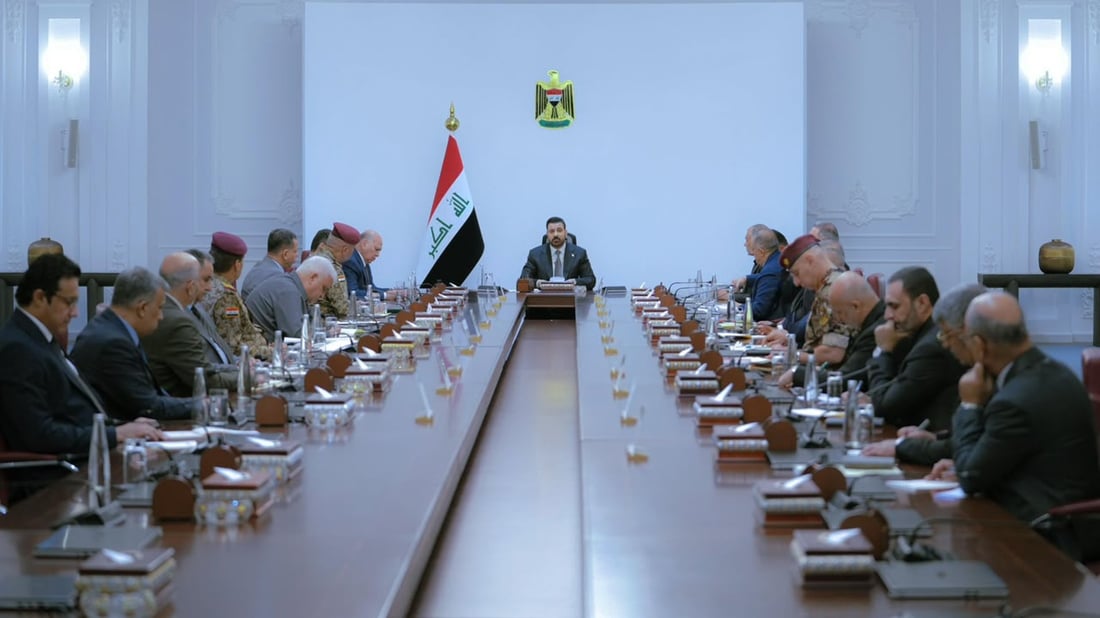
(Photo: Iraqi Prime Minister’s Media Office)
Ministerial security council condemns strikes and says only the state may respond
BAGHDAD — Iraq’s Ministerial Council for National Security condemned Wednesday’s U.S.-Saudi airstrikes but reserved any response to the government alone, and reaffirmed both its plan to bring weapons under state control and the September deadline for the U.S.-led coalition’s withdrawal.
The council, chaired by Prime Minister Ali al-Zaidi, said responding to such attacks “is the exclusive responsibility of the Iraqi government and its constitutional state institutions,” and that it rejects “all acts of aggression, regardless of the party responsible or the justifications presented.” It called on all parties to avoid actions that could increase instability.
It adopted what it called a comprehensive security plan to strengthen control across Iraq, prevent violations of sovereignty and ensure Iraqi territory is not used to threaten neighboring states, and directed the Foreign Ministry to act “in accordance with international law and the Charter of the United Nations to document the incident and safeguard Iraq’s legitimate rights.”
The council said the strikes came while the government was “actively engaging with the relevant parties to verify and address the concerns raised by both the Saudi and U.S. sides regarding the targeting of Saudi territory.” It said Iraq remains committed to reducing regional tensions through dialogue and good neighborliness and to keeping the country out of regional conflicts, and rejected “these unjustified unilateral actions.”
The statement made no mention of a complaint to the U.N. Security Council, of summoning the U.S. or Saudi envoys, or of reviewing any agreement with Washington — steps demanded earlier in the day by senior figures across Iraqi politics. First Deputy Speaker Adnan Faihan al-Dulaimi called for a Security Council complaint. Badr Organization Secretary-General Hadi al-Amiri called for a review of all agreements with the United States, foremost the security agreement. Harakat al-Nujaba, one of the factions refusing to disarm, demanded the government expel U.S. forces and acquire air defenses.
The PMF said the strikes hit its headquarters in Baghdad, Wasit, Nineveh, Basra, Kirkuk, Karbala and Diyala, killing at least 20 members and wounding 32 in a preliminary toll. U.S. Central Command said it and Saudi forces struck weapons-storage and logistical sites linked to Iran-backed groups after more than 30 drone attacks it attributed to Iran’s Revolutionary Guard. Saudi Arabia said the targets were connected to attacks on its energy facilities, and its Defense Ministry said earlier this week that air defenses had intercepted drones launched, it said, from Iraqi territory by Iran-backed militias. It did not name a faction.
Asaib Ahl al-Haq, Saraya al-Salam and the Imam Ali Battalions have moved to comply with the weapons plan; Kataib Hezbollah, Harakat al-Nujaba and Kataib Sayyid al-Shuhada have refused while U.S. forces remain in Iraq. At the White House on July 14, Zaidi said the government intended to bring all weapons under state control once the coalition mission ends. “After Sept. 30, there is no need for any faction,” he said. “Factions are a need, not a profession. There is no justification for their existence after Sept. 30.”