
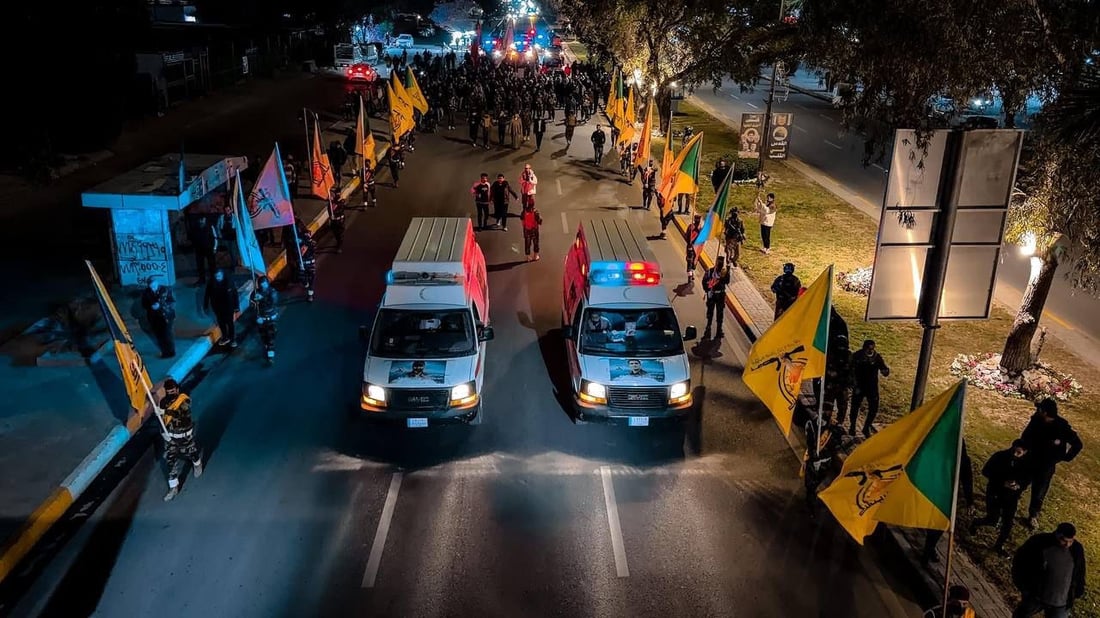
FILES: Supporters of Kataib Hezbollah carry flags and march during a funeral procession in Baghdad for two fighters killed in airstrikes on Jurf al-Sakher, Feb. 28, 2026.
Iran-aligned umbrella group warns Saudi Arabia after drone launch accusations
BAGHDAD — The Islamic Resistance in Iraq, an umbrella name used by Iran-aligned armed groups, warned Saudi Arabia against military action after the kingdom said drones that tried to strike its oil facilities were launched from Iraqi territory.
In a statement, the group said the Saudi claims “only reinforce our conviction that hostility toward Iraq and its people is an inseparable characteristic of this regime,” and described them as “nothing more than an attempt to justify the inability to respond to the painful Yemeni strikes that reached deep into their infrastructure.” It called on Riyadh to lift its blockade on Yemen and added: “We direct a clear warning to the Saudi regime. Any foolish Saudi action will be met with a harsh response that will make them bite their fingers in regret.”
Saudi Arabia’s Defense Ministry said Monday its forces intercepted and destroyed several drones that had tried to hit petroleum facilities in the Eastern Province and Riyadh, and that they had been launched from Iraqi territory by what it called terrorist militias affiliated with Iran. The Foreign Ministry called on Iraq’s government “to prevent its territory from being used as a launch point” against neighboring states, and said the kingdom reserved the right to respond to “the sources of the aggression.” Neither statement named a faction or said how many drones were involved.
Iraqi Prime Minister Ali al-Zaidi has ordered security agencies to investigate.
The accusation comes two weeks after Iraqi and Saudi officials met in Riyadh on regional security. A Saudi Cabinet statement on July 14 said the Iraqi delegation gave an undertaking that Iraq would not allow its territory or airspace to be used to launch attacks on Saudi Arabia, other Gulf Cooperation Council states or countries in the region.
It is the latest in a series of such complaints since the regional conflict began in late February. Saudi Arabia, Kuwait, Bahrain and the United Arab Emirates have all protested drone attacks or incursions they say originated in Iraq. On May 18, Saudi Arabia said it intercepted three drones entering its airspace from Iraq and reserved the right to respond. Iraq’s Foreign Ministry expressed deep concern, opened an investigation and asked Riyadh for intelligence and technical information.
Baghdad condemned that attack and said it opposed the use of its territory against any neighbor, while Iraqi officials said they had detected nothing in Iraqi airspace connected to the incident.
Saudi-Houthi tensions have escalated in recent weeks, with the Houthis accusing Riyadh of tightening a blockade on Yemen and announcing a maritime blockade targeting Saudi shipping. The group has launched drones and missiles toward Saudi territory and Saudi forces have carried out strikes in Yemen.
Factions under the Islamic Resistance in Iraq umbrella have claimed repeated drone, rocket and missile attacks on U.S. military and diplomatic targets in Baghdad and the Kurdistan Region since the U.S.-Israeli strikes on Iran in late February, and in March claimed dozens of operations without giving details for all of them. Popular Mobilization Forces positions have been struck across several governorates, killing about 100 fighters in attacks the group attributed to the United States and Israel.
The accusation lands as Zaidi’s government pursues a plan to bring weapons under state control, which has divided the Iran-aligned factions. Asaib Ahl al-Haq, Saraya al-Salam and the Imam Ali Battalions have moved to comply. Kataib Hezbollah, Harakat al-Nujaba and Kataib Sayyid al-Shuhada have refused, arguing their weapons remain necessary while U.S. forces are in Iraq. The command arrangements for compliant factions have not been made public, with official statements using terms such as integration and restructuring without saying whether fighters would join army units individually or stay as formations.