
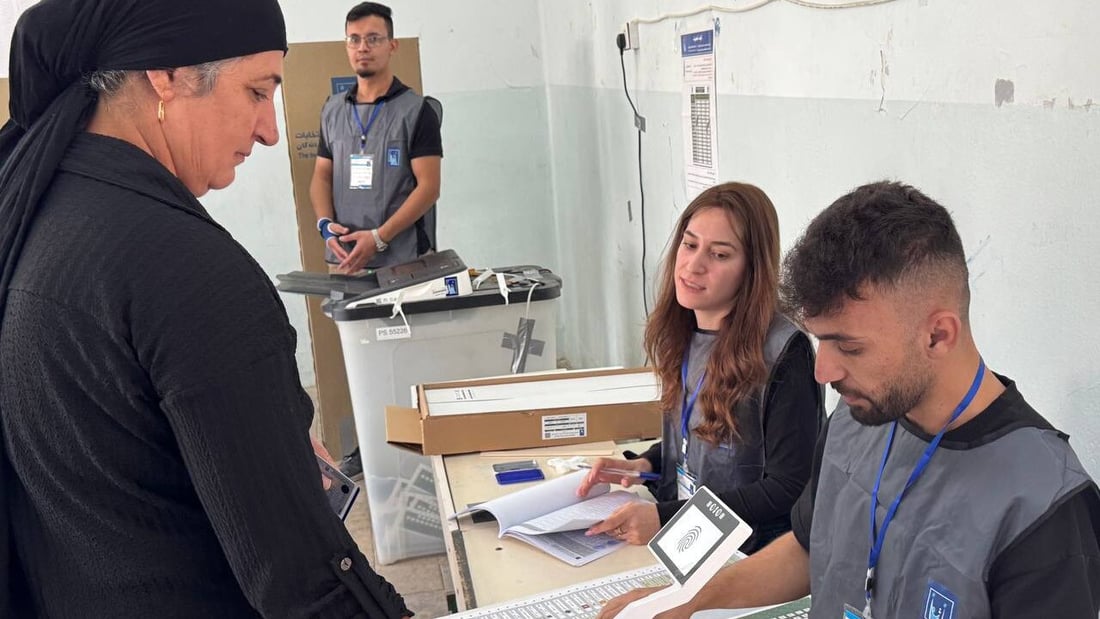
Election workers assist a voter at a polling station during Iraq’s November 11 parliamentary elections.
IHEC reviews complaints as Iraq prepares for next step in election certification process
BAGHDAD — Iraq’s Independent High Electoral Commission said Thursday it continues to review formal complaints related to polling-day conduct in the Nov. 11 parliamentary elections, as part of the standard process leading to final certification by the Federal Supreme Court.
Preliminary results released Wednesday night confirmed Prime Minister Mohammed Shia al-Sudani’s Reconstruction and Development Coalition as the leading bloc, winning more than 1.3 million votes nationwide. The commission said these results remain preliminary and cannot yet be appealed until the complaint stage concludes and formal ratification procedures begin.
Turnout reached 56.11%, with 12,009,453 Iraqis casting ballots across general, special, and displaced-persons voting, according to the commission.
Deputy spokesperson Nebras Abu Souda said the timing of the final results depends on how many complaints are filed and on the judiciary’s subsequent handling of appeals against certified results. “The final results depend on the number of appeals and their nature, whether technical or legal, as many appeals require recounting, and here the judicial body intervenes to decide these cases,” she told the state channel.
Abu Souda said IHEC has begun auditing stations flagged for transmission or counting issues. “More than 100 stations will undergo comprehensive audits,” she said. “Once the results are ready, the judicial body will inform us, after which the Federal Supreme Court will issue the final certification.”
IHEC spokesperson Jumana al-Ghulae said the commission has received 101 complaints — 44 related to the special vote and 57 to the general vote — all under review for classification and resolution.
Preliminary projections place Sudani’s Reconstruction and Development Coalition in first, followed by Mohammed al-Halbousi’s Taqadum Party and Nouri al-Maliki’s State of Law Coalition with 29 seats each. The Kurdistan Democratic Party is projected to win 27 or 28 seats, and Qais al-Khazali’s Al-Sadiqoun Movement is expected to take 27.
Under Iraqi election law, once IHEC resolves all polling complaints and finalizes results, candidates and parties may file appeals before the Judicial Panel for Elections. Only after those appeals are adjudicated does the Federal Supreme Court ratify the outcome.