
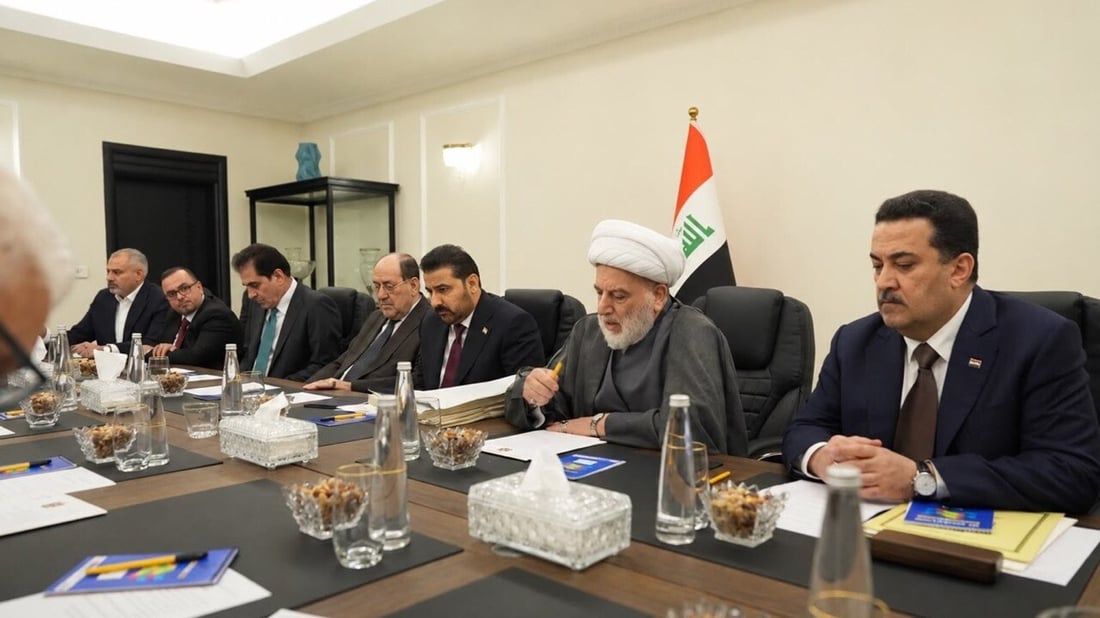
The Coordination Framework leaders during a meeting.
Shiite alliance rejects combat troops for Jurf al-Sakhar, source says
BAGHDAD — Iraq’s ruling Shiite alliance on Monday turned down Prime Minister Ali al-Zaidi’s insistence on sending combat forces into Jurf al-Sakhar, agreeing instead to replace the armed force that holds the area, a source in the alliance told 964media.
Leaders of the alliance, the Coordination Framework, agreed at their Monday evening meeting to swap the force in the northern Babil area for other units of the Popular Mobilization Forces, the source said Tuesday. They told Zaidi the change would take time and could not be rushed or come through clashes between security forces, so that the force could leave and put its affairs in order.
Zaidi insisted on going in with combat forces but met clear opposition from the alliance “to prevent a confrontation and avoid trading oil for blood,” the source said.
The issue must not become a political fight or lead to bloodshed, and only those involved in the smuggling should be punished, not the innocent, the alliance’s leaders said, according to the source. They praised Zaidi for opening the case, thanked him and called on the judiciary to carry out a transparent and fair investigation.
The source denied there had been any dispute. “There were no disagreements of any kind at yesterday’s meeting. The prime minister left after the meeting ended, and what is being said in the media about disagreements and heated exchanges is completely untrue,” the source said. Sources cited by 964’s Kurdish-language service had reported that the meeting ended without agreement after heated exchanges over sending forces toward the area.
The Framework’s official statement after the meeting, held at the office of Humam Hammoudi, head of the Islamic Supreme Council of Iraq, did not mention Jurf al-Sakhar. It said the leaders had discussed the federal budget and the political, economic and security situation. They also hosted a delegation from Sulaymaniyah that included President Nizar Amedi, Patriotic Union of Kurdistan President Bafel Talabani and New Generation Movement leader Shaswar Abdulwahid.
The meeting came hours after government spokesperson Haider al-Aboudi said Zaidi had ordered the armed forces into Jurf al-Sakhar and given the faction there a deadline to leave. He did not say when it expires.
The government has named that faction as Kataib Hezbollah, an Iran-aligned group with brigades in the PMF, the state-sanctioned umbrella of mostly Shiite armed groups formed in 2014 to fight the Islamic State group. “The party involved in the smuggling is the party that holds the ground, and that is Kataib Hezbollah,” Aboudi told Al-Rasheed TV on Sunday.
Kataib Hezbollah accused Zaidi on Sunday of breaking his pledge to it and his office of spreading “fabricated reports,” and on Monday it posted photographs of its armed fighters and a video of rockets being assembled. On Tuesday, Abu Talib al-Saidi, a Kataib Hezbollah official, told a news conference inside Jurf al-Sakhar that the faction did not intend to clash with the armed forces. He said the faction had welcomed Zaidi’s investigating committee and served it lunch, and accused the committee of distorting the facts afterward.
The standoff began on Nov. 9, when a report by the Federal Intelligence and Investigations Agency, an Interior Ministry body, began circulating. Citing satellite images from 2021 to 2026, it alleges that pipelines in Jurf al-Sakhar were holed and the oil carried away in 36,000-liter tanker trucks.
On Saturday, Zaidi relieved nine security and oil officials and referred the accused to the courts after his investigating committee confirmed the smuggling and found refineries in the area, the government said. They included Babil’s police chief, the PMF commander in Babil and the director of the Oil Ministry’s Oil Pipelines Company. Ali Turki announced his resignation as Babil governor on Thursday, two days after publicly rejecting the smuggling allegations.
A judicial committee investigating the case went to Jurf al-Sakhar on Tuesday for an on-site inspection, an official source told the state-run Iraqi News Agency.
The United States designated Kataib Hezbollah a terrorist organization in 2009. Jurf al-Sakhar was officially renamed Jurf al-Nasr in 2014 after Iraqi forces and allied armed groups recaptured it from Isis. It has been closed since then, and many of its displaced residents still cannot return.