
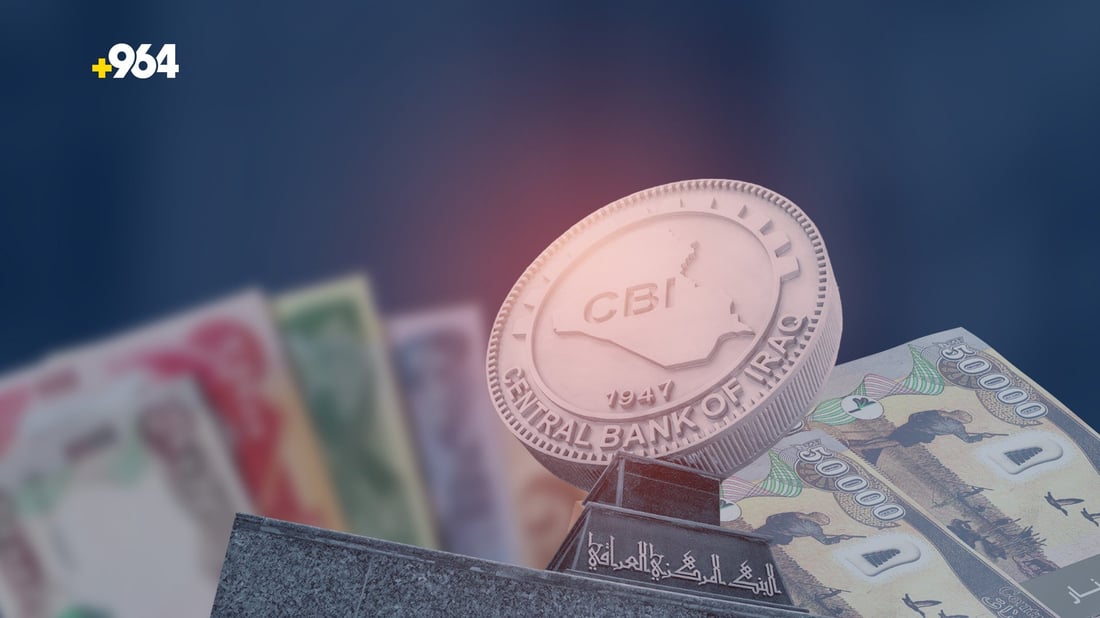
(Graphics: 964media)
Government’s dollar-shipment talk risks new US cutoff, economist warns
BAGHDAD — The government’s public enthusiasm over the arrival of U.S. cash dollar shipments could push Washington to cut them off again and renew pressure on the Central Bank of Iraq’s reserves, economist Ziad al-Hashimi warned Wednesday.
The dollars belong to the Central Bank and are meant only for travelers, not for the government or the markets, Hashimi wrote on Facebook. “The Iraqi government is ‘very enthusiastic’ as it begins receiving cash dollar shipments after their release by the Federal Reserve, as though these dollars were meant for it or it could do with them as it pleases,” he wrote.
“Strange attention has accompanied this process, with statements about the head of government personally following the arrival of the dollar shipments and that this cash will calm the markets, even though these dollars will be held by the Central Bank and under its control, for travel purposes only, and are not meant to reach either the government or the markets,” Hashimi said.
Mahmoud Dagher, an adviser to the Central Bank governor and the bank’s spokesperson, told the state-run Iraqi News Agency on Tuesday that Prime Minister Ali al-Zaidi was personally following the shipments, each carrying about $500 million. “Two aircraft loaded with dollars have arrived, and other shipments will follow in the coming days, according to the prime minister’s statements,” Dagher said.
Zaidi said Friday that Washington would send $1 billion in cash and that the parallel rate would soon fall to 155,000 dinars per $100. He gave no delivery date.
That attention, and Zaidi’s earlier talk of pumping the dollars into the markets, would draw the notice of the U.S. Treasury and the Federal Reserve, Hashimi said. Both had previously frozen cash shipments to stop dollars from reaching the markets and being smuggled to parties under U.S. sanctions, he said.
“The Iraqi government’s behavior and undisciplined statements could push the Treasury and the Federal Reserve to cut off cash dollar supplies again, deprive the Iraqis entitled to these dollars and renew pressure on the Central Bank of Iraq’s dollar reserves,” Hashimi wrote.
The government was focusing on “the psychological aspect by issuing dangerous and exaggerated media messages about the arrival of cash dollars and inflating their importance in an attempt to reassure the markets,” he said. It should instead work to control demand and curb the use of dollars for smuggling and illegal trade, he said.
“Despite the start of the cash dollars’ arrival, their positive effects on exchange rates may not last, and the government’s exaggerations will have no lasting effect as long as there is large real demand chasing every dollar offered in the markets,” Hashimi wrote.
Dagher defended the approach on Saturday, telling state television that Iraq pays for most imports through bank transfers and letters of credit. Cash makes up no more than 10% of transactions and goes to travelers, students abroad and a few other purposes, he said. Zaidi’s mention of more cash dollar shipments came from experience and knowledge of the Iraqi market, which reacts strongly to the supply of cash dollars, Dagher said.
Iraq’s oil revenue is held in an account at the Federal Reserve Bank of New York, from which the Central Bank receives periodic shipments of U.S. banknotes.
The U.S. State Department said in April that dollar shipments to Iraq “were temporarily paused,” after The Wall Street Journal reported that the Treasury had blocked a cargo-plane delivery of about $500 million to press Baghdad to rein in Iran-aligned armed groups. Government spokesperson Haider al-Aboudi said in July that deliveries of U.S. currency had resumed.
The dollar edged down on the parallel market on Wednesday, selling for 168,250 dinars per $100 in Baghdad, about 11% above the official rate of 152,000.
Since Oct. 7, the Central Bank buys dollars from the Finance Ministry at 1,500 dinars, sells to banks at 1,510 and sets the public rate at 1,520, up from 1,300, 1,310 and 1,320. Keeping the old exchange rate would have left future governments with problems “that would be impossible to resolve,” Zaidi told Al-Iraqiya TV on Friday.
Zaidi told the parliament speaker and committee chairs on Oct. 8 that devaluation was necessary to keep paying salaries without more borrowing. Hashimi said the next day that Zaidi had sidestepped the causes of the financial crisis, accusing the government of taking the easiest option at citizens’ expense rather than tackling waste, corruption and an overstaffed public sector.