
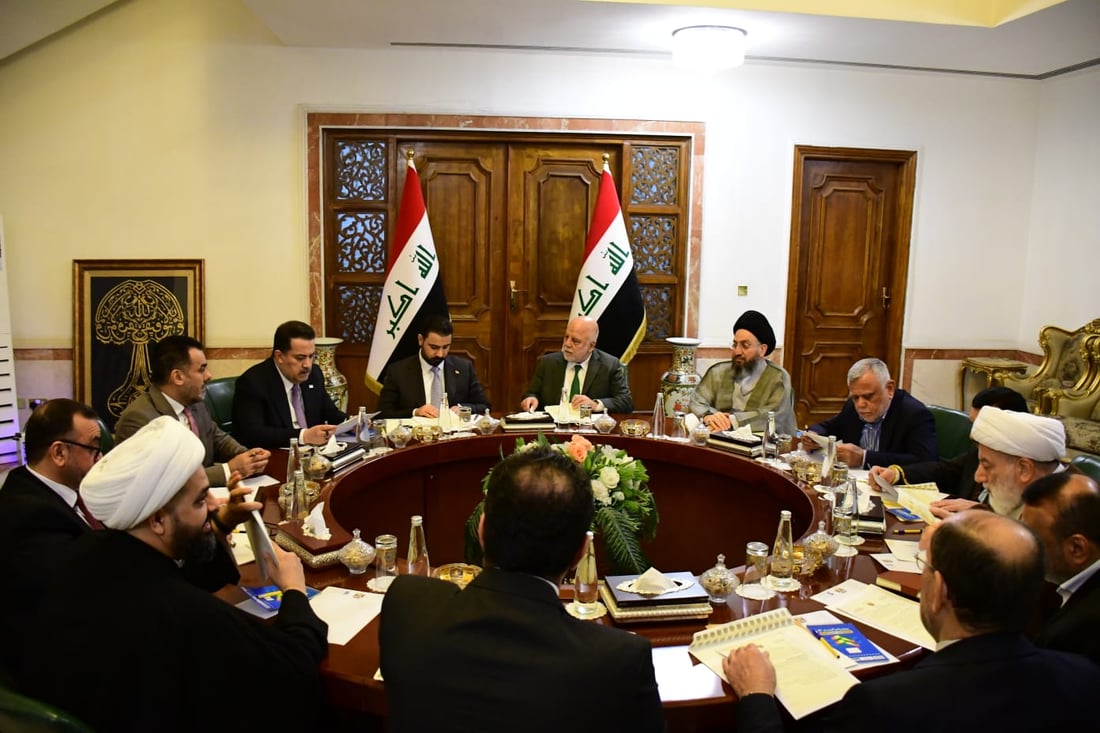
FILES: Leaders of Iraq’s Coordination Framework meet in Baghdad.
Media Monitor
Sudani ally claims an ‘American veto’ is blocking cabinet appointments
BAGHDAD — A senior figure in Mohammed Shia al-Sudani’s Reconstruction and Development Coalition said an American veto is keeping factions and parties linked to them out of ministerial posts, and that Washington has warned Iraq of sanctions if it fails to implement agreements on bringing weapons under state control.
“The Coordination Framework is Shiite and defends the Shiite cause, but there are unusual and unseen divisions within it,” Adnan al-Danbous said in a televised interview. “We find disagreements over positions, and sometimes there is an American veto preventing factions or parties linked to factions from reaching positions, otherwise sanctions are coming.” On the weapons file he said: “I believe the idea of sanctions exists and is real.”
Talks between Coordination Framework leaders and the factions refusing to disarm remain difficult, he said. “I believe the atmosphere is still difficult and needs more time.” He predicted trouble ahead: “In my estimation, I believe there will be an earthquake in the region in the coming months, because what is happening now is a prelude to an issue that will not end peacefully.”
Danbous said the factions would return to attacks if fighting resumed. “The slogan of the resistance is the unity of the fronts. If fighting resumes, the resistance will resume its operations, and that is not a matter for debate.” Direct exchanges between the United States and Iran resumed on Aug. 30, and coalition aircraft shot down 10 drones over Erbil on Sept. 2.
He tied the divisions to the empty ministries. “The divisions are differences that have not yet reached the point of conflict,” he said. “The first vote on the Cabinet took place three months ago, and we have still not voted on the defense or interior ministries.” Nine of 23 ministries have been unfilled since parliament approved 14 ministers on May 14, nearly four months ago, rejecting nominees for interior, higher education, planning, culture, and reconstruction and housing, and postponing votes on defence, labour, migration and displacement, and youth and sports. Prime Minister Ali al-Zaidi told the Framework on Sept. 1 that talks would finish that week with a vote to follow.
A Harakat al-Nujaba official said last night that the Framework has softened its position, no longer asking that weapons be restricted to the state but that they be regulated.