
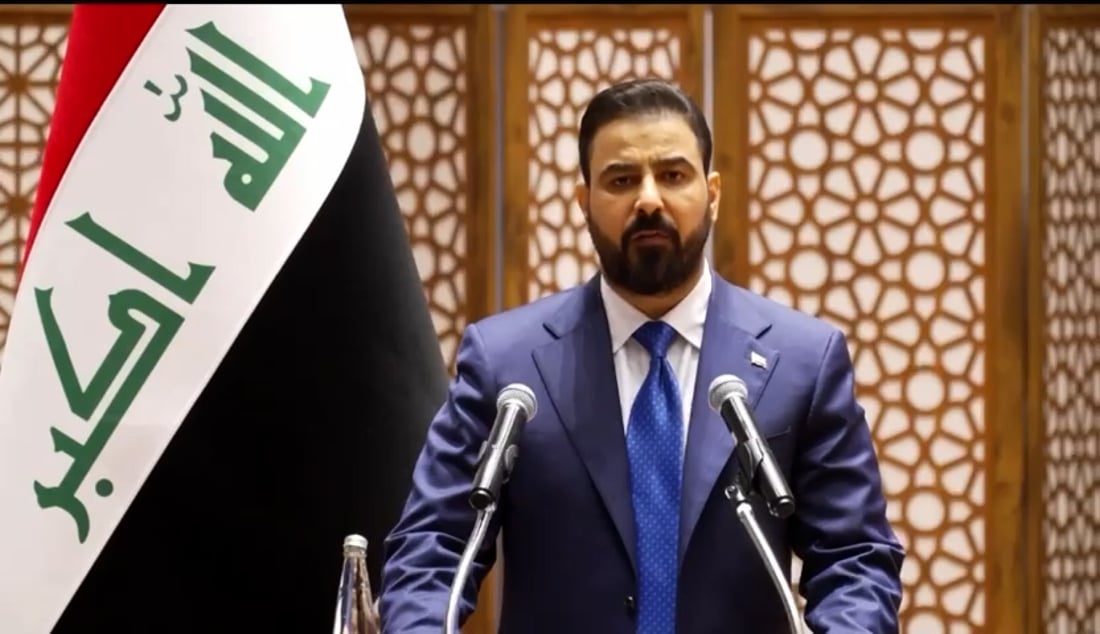
Zaidi says no foreign power is behind his government’s measures
BAGHDAD — Prime Minister Ali al-Zaidi’s office said on Wednesday that his government acts on its own will and at no foreign party’s urging, a day after his orders on the Kurdistan Region’s border crossings and oil drew Kurdish objections.
The measures the government takes inside Iraq’s internationally recognized borders rest solely on its constitutional powers and legal responsibilities and “do not come in response to encouragement, dictation or direction from any foreign party,” the office said in a statement. It did not name the orders or say what had prompted the statement.
“The Iraqi government does not draw the legitimacy of its decisions from the positions or leanings of states, and does not wait for encouragement from anyone to exercise its constitutional and sovereign responsibilities,” the statement said. It closed: “Our decision is Iraqi, our will is national, our reference is the constitution and the law, and Iraq’s supreme interest is the standard that governs our positions and measures.”
The statement came hours after the Baghdad daily Al-Mada reported that politicians and analysts it spoke to saw Jurf al-Sakhar as a U.S. target tied to cutting off money flowing to Iran. On their reading, Washington had achieved part of its aim by opening the file on the area, the paper reported.
U.S. President Donald Trump called Zaidi “a strong guy” on Nov. 20, when reporters asked whether he could bring armed groups under state control. U.S. envoy Tom Barrack wrote on X after meeting Zaidi in Baghdad on Nov. 5 that Iraq under him was choosing “sovereignty over dependency.” Three days later, Barrack called Zaidi’s cancellation of Mosul airport leases held by companies linked to armed factions “sovereignty in action.”
Later on Wednesday, Iraq’s Federal Supreme Court gave a ruling interpreting the constitution, which Zaidi had requested. It ruled that securing Iraq’s borders is a federal power, including borders in territory the Region administers, and that federal authorities may supervise and control the agencies at every border crossing in the Region.
In Erbil, Judge Abdul-Jabbar Aziz Hassan, head of the Kurdistan Region’s Judicial Council, said the recent remarks against the Region by the spokesperson for the commander-in-chief of the armed forces were “a cause for alarm and concern.” Iraq’s constitution clearly sets out how the Region and the federal state relate and how rights and powers are divided between them, he said in a statement.
Disputes must be settled “on the basis of the constitution and the law and respect for dialogue and agreements, not harsh language and force, which serves no side and puts Iraq’s calm and stability at risk,” Hassan said. He urged the federal government to keep seeking constitutional solutions, saying any other step outside the constitution and the law would not deliver justice and would harm all of Iraq.
The KRG cabinet called the orders a violation of the constitution after it met on Wednesday under Kurdistan Region Prime Minister Masrour Barzani. Earlier in the day, the Supreme Judicial Council urged Baghdad and Erbil and the country’s political parties to abide by the 2005 constitution.
Parliament Speaker Haibat al-Halbousi urged Baghdad and Erbil to avoid harsh language and to take their disputes to the Federal Supreme Court, saying no one was above the constitution, 964’s Kurdish-language service reported overnight. The head of parliament’s border crossings committee said most of the Region’s unofficial crossings were on the border with Iran and had to be brought under control, the service reported.
A session of the federal Council of Ministers on Tuesday night ended without Zaidi’s orders on the Region being discussed, the service reported. It also reported that the U.S. State Department had said Zaidi had done in Jurf al-Sakhar what his predecessors had not. 964media could not find the State Department’s remarks, and Zaidi’s office did not refer to them.
Zaidi issued the orders on Tuesday after an inquiry into suspected oil smuggling at the state-owned North Oil Company, the Kirkuk-based company that runs oil fields across northern Iraq. He ordered the federal government to take over every border crossing in the Region, barred the Kurdistan Regional Government from approving crude or fuel exports without the federal Oil Ministry and told the ministry to manage federal oil fields under the KRG’s security control in Diyala, Kirkuk, Salah al-Din and Nineveh governorates.
He also removed Lt. Gen. Omar al-Waeli as head of the Border Ports Authority and dismissed Kirkuk’s operations commander and police chief. By Tuesday night, Zaidi had named Lt. Gen. Mohammed al-Zubaidi to the Kirkuk Operations Command. A security source told 964media that Maj. Gen. Hassan Kadhim Obaid, the police chief of Muthanna governorate, had been assigned to the Border Ports Authority.
Kurdish leader Masoud Barzani said the Region would not submit to unconstitutional decisions, though he said it would help stop smuggling by legal and constitutional means. Kurdistan Region President Nechirvan Barzani rejected what he called military language toward the Region, and the Kurdistan Democratic Party and the Patriotic Union of Kurdistan called any violation of the Region’s rights a red line.
The government’s campaign against oil smuggling began this month in Jurf al-Sakhar, the northern Babil area held since 2014 by Kataib Hezbollah, an Iran-aligned armed faction that denies smuggling oil.