
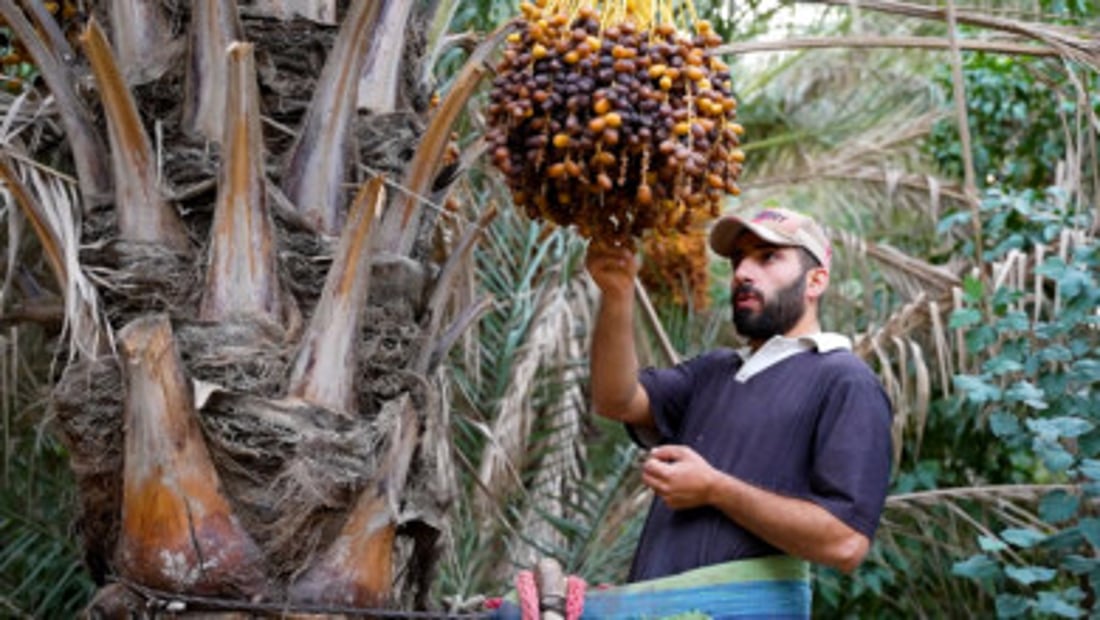
Rawa’s date harvest spans seasons with varieties ripening at different times
ANBAR — The date harvest season in Rawa, western of Anbar governorate, begins in early August with early-ripening varieties, including Barban, while other varieties such as Umm Al-Balaliz, Khadrawi, Mejhool and Barhi mature later, with some harvested through early November.
Orchard owner Hammam Jumaa Al-Rawi told 964media that Rawa produces several date varieties with different ripening periods, influenced by weather conditions and the agricultural characteristics of the area near the Euphrates River.
“Rawa is distinguished by its variety of dates and their different ripening times. We have early varieties that begin ripening in early August, particularly Barban and Khiyara, which are among the first to mature in the western region,” Al-Rawi said.
He explained that other varieties require more time to mature, extending the harvest season into autumn. “Other varieties ripen later, including Umm Al-Balaliz, Khadrawi, Mejhool and Barhi. Harvesting some of them may begin in mid-October and continue until early November,” he said. “Our date season does not end all at once. It varies depending on the variety and its ripening conditions.”
Al-Rawi said changes in temperature and humidity can affect when dates reach maturity, “Climate changes affect ripening times, particularly lower temperatures and changes in humidity levels,” he said. “Farmers therefore need to continuously monitor their palm trees and the stages of fruit growth and ripening until the appropriate harvesting time.”
Among Rawa’s date varieties, Al-Rawi identified Ashrasi as particularly popular among residents and consumers.
He said the variety is sought after in local markets because of its taste, texture and size, “One of Rawa’s distinctive varieties is Ashrasi, which holds a special place among residents and is considered one of the desirable and popular types in markets because of its taste, texture and size,” he said.
“I believe Rawa’s natural environment and agricultural conditions, particularly the proximity of its orchards to the Euphrates River, give this variety characteristics that distinguish it from other dates,” he added.
Beyond their agricultural value, Al-Rawi said palm trees have long been part of the social and family life of Rawa residents, “In Rawa, the palm tree is not merely a tree we plant to obtain fruit. It is part of the region’s history and the lives of its people,” he said.
He explained that palm trees have been associated with family homes and orchards for generations, and that older residents in particular continue to care for them.
“Palm trees grow inside homes, and older people are especially keen to care for them because they see them as cherished trees carrying memories of their parents and grandparents and representing part of their agricultural and social heritage,” Al-Rawi said.
Elsewhere in Anbar, the news is not pleasing. Date palm yields in Hit, in western Anbar, have fallen from about 100 kilograms per tree last season to 70 kilograms this year after storms, strong winds and rain damaged the crop, farmers and traders told 964media last week. Prices have dropped as well. Khastawi used to sell for 600,000 to 650,000 dinars (about $360 to $380) a metric ton, but buyers are now unwilling to pay 500,000 dinars (about $300), and prices sometimes fall below that, Suleiman said.
Farmers elsewhere cherish other varieties too. Date farmers in Karbala’s Hussainiya area are sticking with the Zahdi variety even though it sells for a fraction of the price of Barhi, because it survives harsh weather, keeps for up to a year without refrigeration and sells abroad from Asia to North Africa. Zahdi sells for less than 1,000 dinars (about 60 cents) a kilogram, against around 2,500 dinars (about $1.50) or more for Barhi, but farmers say lower storage costs and less spoilage make it the safer crop.
There are hundreds of date verities across Iraq. More than 150 date varieties, most of them native Iraqi cultivars, went on display at Duluiyah’s ninth date festival in late September, where farmers showed off the town’s large Barhi and introduced new varieties grown through tissue culture.