
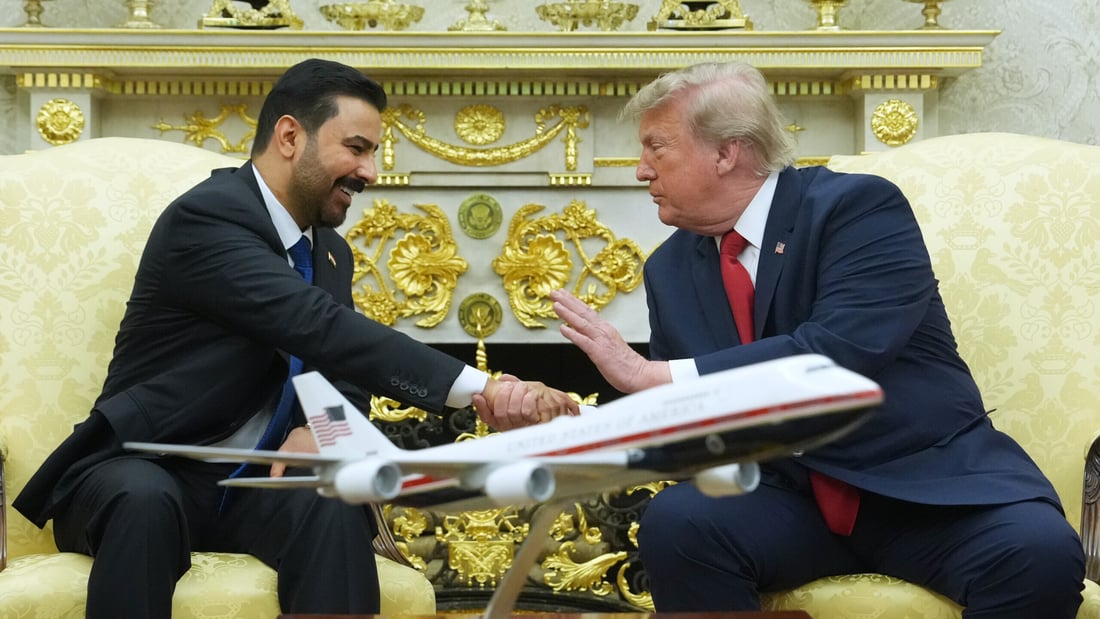
President Donald Trump meets with Iraq's Prime Minister Ali al-Zaidi in the Oval Office of the White House, Tuesday, July 14, 2026, in Washington. (AP Photo/Julia Demaree Nikhinson)
Iraq drafts tighter contract rules after US Treasury requests, sources say
BAGHDAD — A Planning Ministry committee is drafting new rules for government contracting after the U.S. Treasury asked Baghdad to tighten oversight of existing and future contracts, to stop state money reaching companies and entities under Iran-related sanctions, sources told 964media.
The Treasury asked Iraqi authorities to set up a mechanism to review government contracts, both those already signed and those to come, a source familiar with financial cooperation between Baghdad and Washington said. U.S. scrutiny covers the work and supplies specified in contracts, the materials and equipment imported, the entities supplying them and the ultimate beneficiaries of payments. A main aim is to stop sanctioned companies from benefiting from Iraqi contracts, directly or through intermediaries and subcontractors, the source said. The Treasury wants every line item identified, including the type, quantity, price and specifications of materials and equipment, rather than relying on a contract’s total value and general description, a Planning Ministry source said.
The proposed measures include requiring Prime Minister Ali al-Zaidi’s government to disclose companies’ real owners and the ultimate beneficiaries of state funds, barring sanctioned entities and their affiliates from contracts, examining imports and supply contract terms, and linking dollar payments to international transfers, extending existing oversight of dollar transactions and Iraqi banks, the sources said.
Talks with the World Bank and within the government have also covered how to vet companies that contract with the state, including their actual ownership and financial relationships, the Planning Ministry source said. Companies would have to disclose who owns or controls them, as well as subcontractors and intermediaries, and those in violation would be excluded. The talks also covered checking that contract details, invoices, actual suppliers and payment recipients match, and expanding information-sharing between contracting authorities, banks and the Central Bank. The ministry is separately building a unified electronic platform for tender announcements and contracts, with training for contracting staff in procurement management, risk assessment and contract data analysis, the sources said.
The U.S. Treasury has expanded sanctions in recent months on financial and commercial networks it accuses of using contracts, businesses and intermediaries to support Iran-linked entities or evade U.S. restrictions. In earlier sanctions announcements, it has cited the use of subcontractors to divert money from Iraqi government contracts and the steering of projects to other companies in return for illicit proceeds. Since 2023, the United States has barred at least two dozen Iraqi banks from dollar transactions.
Parliament’s Planning Committee and the ministry’s committee have requested documents on several government contracts suspected of corruption and waste, which are being reviewed with the Federal Commission of Integrity and the Board of Audit, said Abdulhamza al-Khafaji, a member of the committee. Government contracts account for about 80% of the causes of major corruption cases in Iraq, he said, through inflated project values and quantities, manipulated prices for materials, equipment and services, contracts awarded above their real cost, and payment items that do not match the work done.