
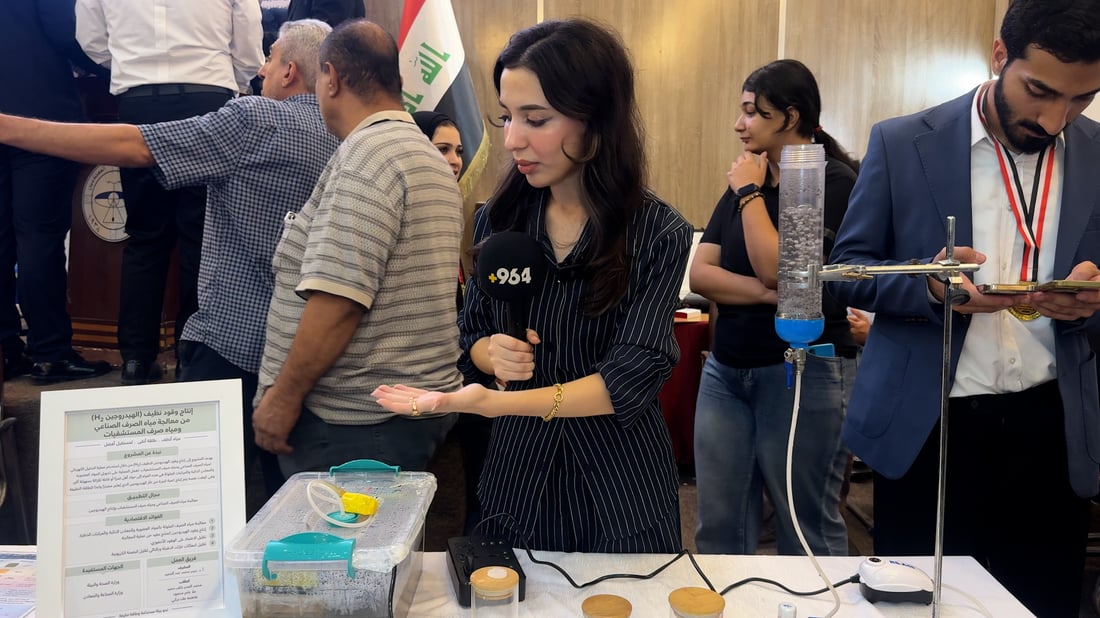
A student presents a wastewater treatment and hydrogen production project at an engineering exhibition in Baghdad. Photo by 964media.
Funding barriers persist
Paralysis rehabilitation robot among 170 student projects shown in Baghdad
BAGHDAD — A robot designed to help people with lower-body paralysis walk again was among more than 170 engineering projects shown by students and graduates in Baghdad, where organisers said most university inventions never get past the prototype.
Yousef Mohammed, a medical devices engineering graduate from Turath University, built a rehabilitation robot that uses an electronic system and a mobile app to train people with lower-body paralysis to walk. “The miniature version cost about 2.5 million dinars and took six months, while the full model needs funding of no less than 14 million dinars, which is an obstacle to completing it,” he said. That is about $1,630 and $9,150.
The exhibition at the Iraqi Engineers Association on Nidal Street brought together 11 universities, colleges and institutions, among them Baghdad, Nahrain, Mustansiriyah, Kufa and Diyala universities and the Hussein Shrine’s institutions. Academics, business figures and World Bank representatives attended. It was the first, and was meant both to encourage young engineers and to test “the readiness of official institutions to absorb these projects and turn them into practical applications,” said Wissam al-Khazali, the association’s deputy president. “There is a flaw in the state’s approach that needs to be corrected to support innovations,” he said. “Universities produce hundreds of projects every year that end up in storage without development or application, wasting effort and creativity.” The association plans to send summaries of selected projects to the cabinet and ministries.
Safa Farouq, a postgraduate at the University of Baghdad, presented a system that produces hydrogen from industrial and hospital wastewater by electrolysis and another that treats polluted water using a moving bed biofilm reactor, in which microorganisms growing on small carriers break down pollutants. The treatment system is already running at two hospitals serving about 40 beds, and she put the cost of installing it at 35 to 40 million dinars, about $23,000 to $26,000.
Mustafa Hamid, from Warith al-Anbiyaa University, built a carbon-reinforced drone he says reaches 120 km/h for 300,000 dinars, about $200, in a month, and asked the Interior Ministry to consider developing it with sensors and 4K cameras for surveillance.
Hamid al-Uqabi, head of the International Federation of Businessmen in Iraq, said financing problems and obstacles for investors kept graduation projects from reaching production, calling for closer links between the public and private sectors and protection for locally made products. “Iraq needs to restore programs that support young people and graduation projects and move them from merely seeking a university degree to actual implementation,” he said.