
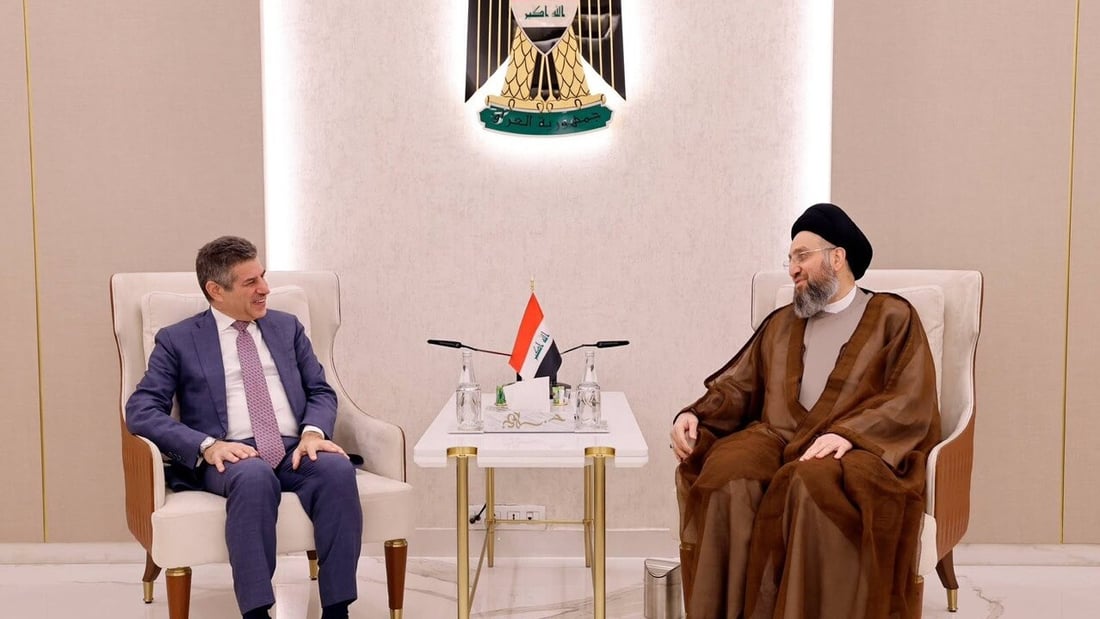
Ammar Al-Hakim, head of Iraq’s National State Forces Alliance, meets U.S. Chargé d’Affaires Steven Fagin in Baghdad.
Hakim tells US envoy the weapons file runs on Iraqi timelines
BAGHDAD — Ammar al-Hakim told the U.S. chargé d’affaires that weapons outside state control must be dealt with on Iraqi mechanisms and Iraqi timelines, days after the envoy said Washington supports an Iraq where militias are not armed outside government authority.
Addressing the issue was “a constitutional requirement and a national interest,” the head of the National State Forces Alliance said in the meeting with Steven Fagin, stressing “the importance of dealing with this issue from the standpoint of the Iraqi national interest, according to Iraqi mechanisms and timelines.” He praised “all efforts that contributed to liberating the land and restoring the state.”
On the economy he called for diversifying Iraq’s economy and its oil export routes and raising production in line with the country’s resources, population and the damage caused by regional events and the fight against terrorism. He also urged “ending escalation in the region and replacing it with dialogue and understanding.”
It is the fifth senior Iraqi figure Fagin has met since returning this month, after Foreign Minister Fuad Hussein, Prime Minister Ali al-Zaidi, Supreme Judicial Council president Faiq Zaidan and KDP leader Masoud Barzani. The weapons file featured in every readout, with different accounts of who controls it: Zaidan told him the programme would run under a plan adopted by the Coordination Framework rather than the government, while Fagin told Barzani that the United States supports an Iraq in which militia forces are not armed outside formal state authority.
Iraqi officials have been separating the coalition’s Sept. 30 departure from the weapons process itself, without agreeing on what the date changes. Security adviser Qasim al-Araji said on Friday there is no fixed timeframe for completing it, having earlier said the date marks the start of understandings rather than a handover deadline. Sabah al-Numan, spokesperson for the commander-in-chief, said on Saturday that the end of the mission would remove the justification for armed activity outside state authority.
Hakim has backed restricting weapons to state institutions before, saying in June that Iraq’s political forces had agreed on the principle as part of strengthening the state.