
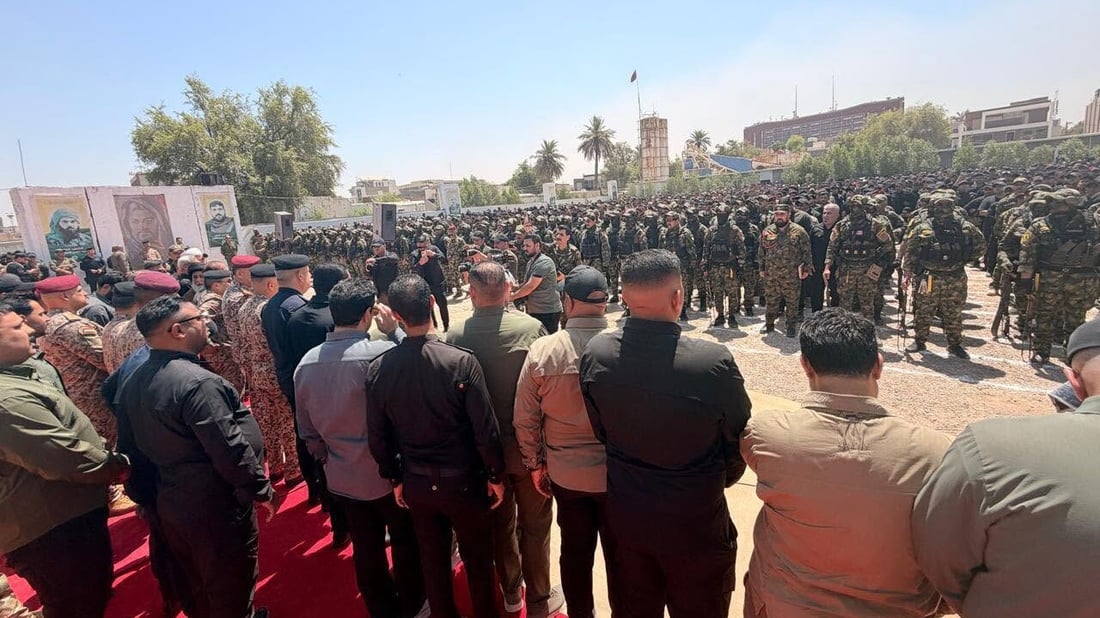
FILES: Members of the Imam Ali Battalions attend a ceremony as the group submits personnel and weapons records for Iraq’s state integration program.
Zaidi to raise weapons initiative with Trump, alliance spox says
BAGHDAD — Prime Minister Ali al-Zaidi will raise Iraq’s weapons-restriction initiative in talks with U.S. President Donald Trump in Washington, carrying an inventory of weapons and personnel from armed factions that have agreed to join the process, according to Khadamat Alliance spokesperson Hossam al-Rubaie.
In an interview on Alawla TV, Rubaie said Zaidi would present Trump with “data and a realistic inventory” of weapons and personnel linked to the factions that agreed to the initiative. He said the inventory would let the government regulate the status of factions that had surrendered weapons, including those that took part publicly and those that joined without being named.
“Two large factions joined the three factions that announced their involvement in the initiative to restrict weapons,” Rubaie said. “These two parties had rejected surrendering their weapons, but they agreed to join the initiative and hand over their weapons without an announcement.” He did not identify the two factions, and 964media could not independently verify the claim.
Zaidi traveled to Washington on Monday at the head of a high-level delegation for his first official foreign trip since taking office. Government spokesperson Haider al-Aboudi said Sunday the visit “focuses on economic cooperation.”
Zaidi’s government is pursuing a plan to place weapons under state control, a policy dividing the Iran-aligned factions. Asaib Ahl al-Haq, Saraya al-Salam and the Imam Ali Battalions have moved to comply, while Kataib Hezbollah, Harakat al-Nujaba and Kataib Sayyid al-Shuhada have rejected disarmament, arguing their weapons remain necessary as long as U.S. forces are in Iraq.
Rubaie described the initiative as an effort to bring armed groups under a legal and security structure while acknowledging their past role. “The initiative to restrict weapons can be described as an initiative of recognition because it includes brothers who fought, made sacrifices and have a clear history,” he said, calling for a “real security framework, legally organized” for members of the groups known as resistance factions.
He said the security agenda for the visit had two parts: continued cooperation against the Islamic State group and the restriction of weapons to the state. “The danger of ISIS still exists, and its cells are still present,” Rubaie said. Although Iraq declared military victory over the Islamic State in December 2017, the group continues to operate through sleeper cells, particularly in remote and desert areas.
Rubaie argued that placing weapons under state control would not weaken the country’s internal structure and could instead strengthen state institutions.
Earlier Monday, the coalition known as the Islamic Resistance in Iraq rejected Zaidi’s visit, issuing a nine-point statement that warned the government against signing agreements during the trip and called for an end to the U.S. military presence in Iraq. Former Prime Minister Mustafa al-Kadhimi earlier this week expressed support for Zaidi’s efforts to strengthen state authority.