
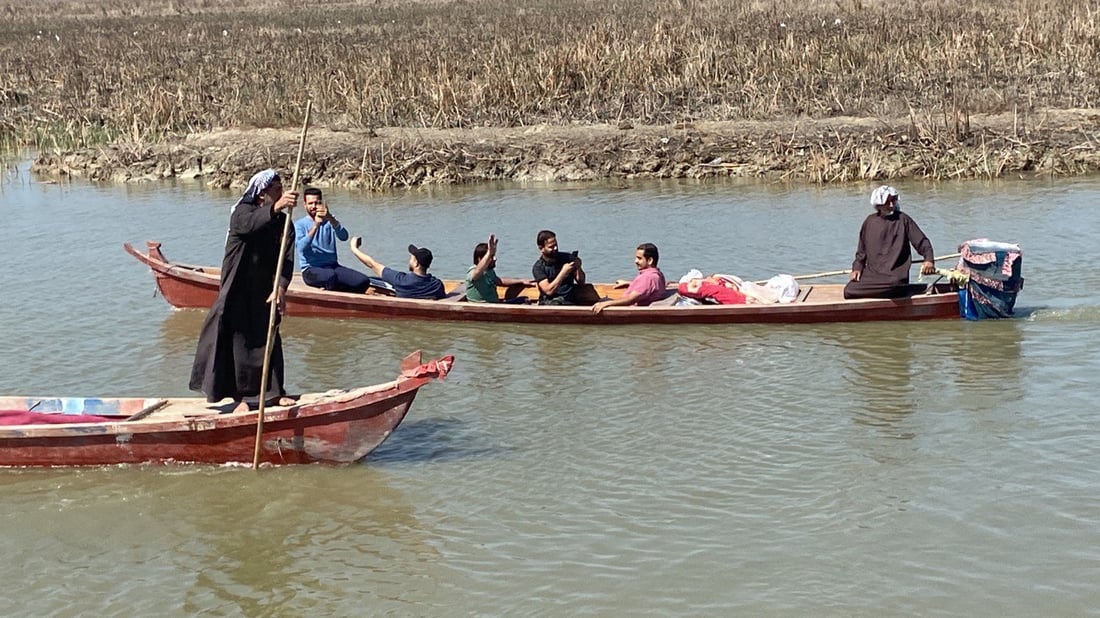
Men travel by traditional wooden boats through the marshes in southern Iraq. (Photo: 964media)
Iraq’s water reserves recover to 34 billion cubic meters after historic lows
BAGHDAD — Iraq’s water reserves have risen to 34 billion cubic meters after falling to 5 billion at the end of 2025, Water Resources Minister Muthanna al-Tamimi said Sunday, crediting heavy rainfall while warning that the country must conserve its supplies.
“The water situation at the end of 2025 and the beginning of 2026 was very difficult, as Iraq had only 5 billion cubic meters of water, the lowest level of water storage the country has witnessed since 1933,” he told the state-run Iraqi News Agency. “Storage increased thanks to abundant rainfall to reach 34 billion cubic meters.”
Iraq has been facing a worsening water crisis linked to rising temperatures, prolonged drought, declining and less predictable rainfall, desertification and reduced river flows. Climate change is increasing pressure on water supplies, agriculture and rural livelihoods, particularly in central and southern Iraq, where scarcity and soil salinity have hit farming and livestock.
Tamimi said the current level “still remains less than half of what it was in 2021,” when storage reached 60 billion cubic meters, stressing the importance of cooperation to maintain good storage levels and ensure a successful agricultural season.
In Iraq, the agricultural season refers to the government’s annual cropping plan, which determines what crops can be grown, where and on how much land, based on available water. It is prepared jointly by the ministries of Agriculture and Water Resources and approved by the Cabinet.
Tamimi said the ministry is monitoring the plan through field visits and coordination with local authorities to address obstacles, and that governorates must adhere to their allocated water shares and coordinate to ensure each receives its entitlement. He said the government launched this season’s plan only after coordinating with the Agriculture Ministry, with the goal of helping farmers who “were deprived of many summer seasons during the past years.” He called on farmers to adhere to water allocations, expand the use of modern irrigation and commit to the requirements for a successful season.
Tamimi said Iraq is among the countries most affected by climate change and that the water sector had gone without sufficient government attention for years. He said many of Iraq’s water projects are outdated and that upstream countries had urged Iraq to adopt a new water policy reflecting climate challenges.
Iraq depends on the Tigris and Euphrates for most of its freshwater, but both rivers originate outside its borders. Turkish dams on the two rivers reduce downstream flows into Iraq, and Iran has built dams and diverted several tributaries that feed the Tigris. Iraqi officials say these upstream projects, combined with drought, rising temperatures and declining rainfall, have sharply reduced inflows and contributed to recurring shortages.
Increased rainfall and water releases have brought partial improvements to Iraq’s marshlands this year, but current levels remain insufficient for full environmental recovery, Environment Minister Srwa Abdulwahid said in May. She announced plans for a public awareness campaign promoting responsible water use and “abandoning a culture of waste,” and described modern irrigation and efficient water management as “the optimal solution” for water scarcity and climate change.