
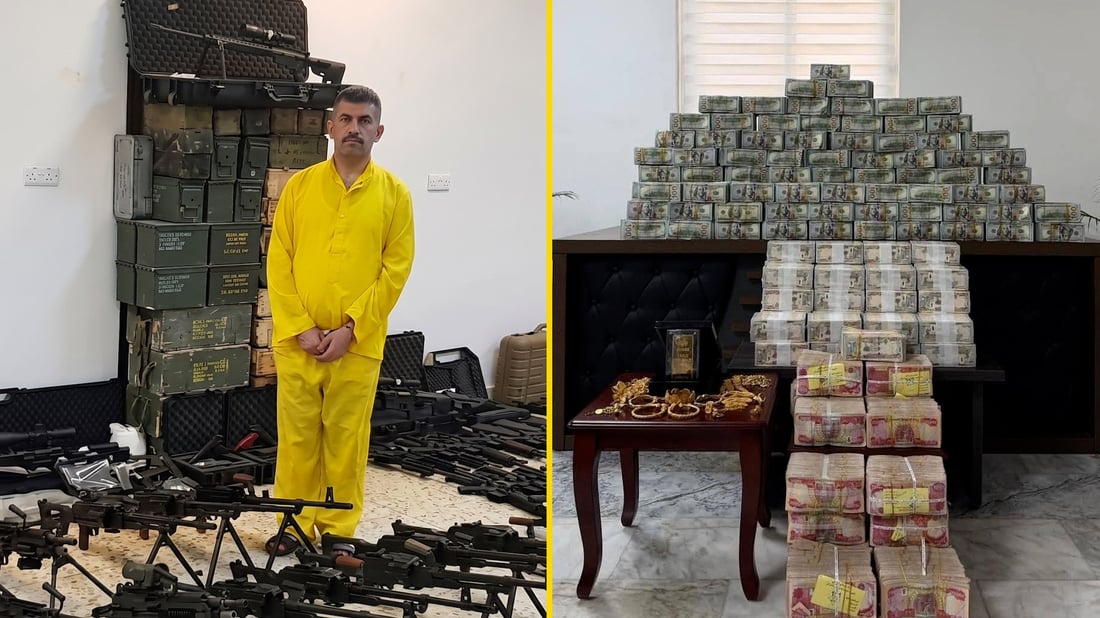
FILES: Adnan al-Jumaili under arrest, seized weapons, cash, and gold jewelry.
Iraqi court orders seizure of assets worth $52 million in oil ministry corruption case
BAGHDAD — An Iraqi court has ordered the seizure of commercial properties, flour mills and transport trucks worth an estimated 69 billion dinars (about $52 million at the official rate) in the latest development in the corruption investigation involving detained Deputy Oil Minister for Refining Affairs Adnan al-Jumaili.
The Nineveh Integrity Investigation Court on Monday ordered the seizure of nine commercial properties and three flour mills in Mosul, along with seven transport trucks, as part of an investigation into alleged money laundering and financial corruption involving Jumaili and other suspects, according to the Supreme Judicial Council.
The court said the commercial properties, in central Mosul, are valued at about 45 billion dinars ($34 million) and the three mills at about 24 billion dinars ($18 million), with each truck worth about $200,000. Investigators found the assets had been registered in the names of workers employed by the suspects “to disguise and conceal their illicit origin,” the court said.
Because the mills and properties remain operational and generate income, the court appointed judicial custodians to manage them, preserve the assets and collect revenues while proceedings continue. The judiciary said investigations and efforts to apprehend fugitive suspects were ongoing, describing the seizures as part of broader efforts to recover proceeds of corruption.
Monday’s announcement came hours after Iraq’s Central Anti-Corruption Criminal Court announced the recovery of 375 kilograms of gold connected to the investigation. The judiciary said 358 kilograms were recovered in the Jumaili case through coordination with authorities in the Kurdistan Region, and 17 kilograms in a separate operation. The gold, transferred to the Central Bank of Iraq and shown in bars at the handover, would be worth roughly $49 million at current international prices.
On July 9, investigators said they had recovered an additional 14 billion dinars (about $11 million) hidden in a stormwater drainage pit, which the investigating judge said came from irregularities in projects linked to Jumaili and other suspects. Earlier searches uncovered more than $121 million in cash that authorities said had been stored in plastic water bottles buried at Jumaili’s home in Tikrit.
The investigating judge said the case began in October 2025 after the Central Criminal Court for Combating Corruption received reports that political candidates had spent unusually large sums on parliamentary election campaigns by exploiting state resources with the support of influential figures in the previous government. Investigators spent months gathering evidence because of the case’s complexity, and after Jumaili’s arrest concluded the inquiry had expanded beyond a single official.
The judiciary has not publicly detailed the specific charges against every suspect but has described the investigation as involving alleged financial corruption, money laundering and abuse of public resources.
Jumaili was arrested in May as investigators pursued allegations related to refinery projects and government contracts. Initial searches seized about $10 million, 3 billion dinars, roughly 40 properties, gold and weapons across Baghdad, Salah al-Din and Erbil governorates. The inquiry later expanded into a wider campaign, and in late June authorities announced the arrest of 47 political figures and officials, including sitting members of parliament whose immunity had been lifted.
The Supreme Judicial Council has warned against attempts to exploit the investigation. Earlier this month the investigating judge cautioned business owners against people falsely claiming they could remove names from case files in exchange for money, urging anyone approached to report it.
The seizures follow the council’s announcement Friday that it is working with Prime Minister Ali al-Zaidi to build a legal framework that would prioritize recovering misappropriated state funds while allowing reduced legal measures for suspects who voluntarily return the money. The announcements also came as al-Zaidi traveled to Washington for meetings with U.S. officials.