
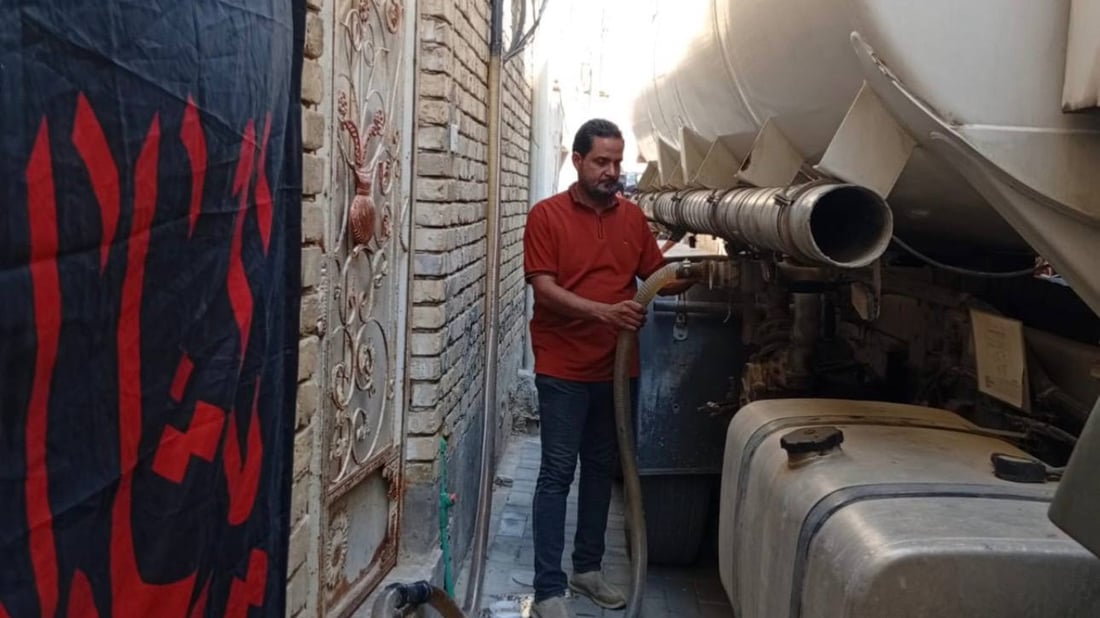
Filling a household water tank from a tanker truck in Zubair, Basra. (Photo: 964media)
Water shortages persist in Basra’s Zubair as replacement pipeline nears completion
BASRA — Water shortages continue to affect the Zubair district of Basra after reduced flows through the Badaa Canal cut supplies to the Basra Unified Water Project, with a replacement pipeline expected to be completed within two months, local officials said.
Zubair District Commissioner Abbas Maher told 964media that reduced water releases reaching the R-Zero project through the Badaa Canal are “the main reason” for the crisis, attributing the decline to the canal’s age and several breaks over the past month.
“The district currently receives about 1,000 cubic meters per hour,” Maher said, with the rest distributed to other areas of Basra. He said Zubair needs between 3,500 and 4,000 cubic meters per hour to supply the Shuaiba and Khutwa water projects and pipelines serving residential neighborhoods.
Maher said the reduced supply has forced authorities to run pumping stations for four hours at a time, followed by a four-hour pause to refill storage basins.
“The water reaches areas close to the pipelines, while more distant neighborhoods continue to suffer near-total interruptions,” he said.
Authorities are continuing emergency deliveries by tanker truck while work proceeds on a pipeline to replace the Badaa Canal. Maher said the project is 75% complete and expected to be finished within two months, which he said will increase flows and improve supplies to the district.
Zubair and parts of central Basra have faced shortages since July 1 after a sudden collapse in the Badaa Canal, the main source supplying treatment plants in North Rumaila.
Zubair Water Directorate Director Alaa al-Asadi told 964media the district is facing “a real shortage of treated water” and said an emergency plan remains in place to supply more than 20 areas with tanker trucks operating morning and evening.
“The available quantities are still below actual demand,” al-Asadi said. “Priority in distribution goes to established residential areas before agricultural districts and outlying neighborhoods.”
He said the emergency plan will remain in effect until repairs to the Badaa Canal are completed and water supplies return to normal.