
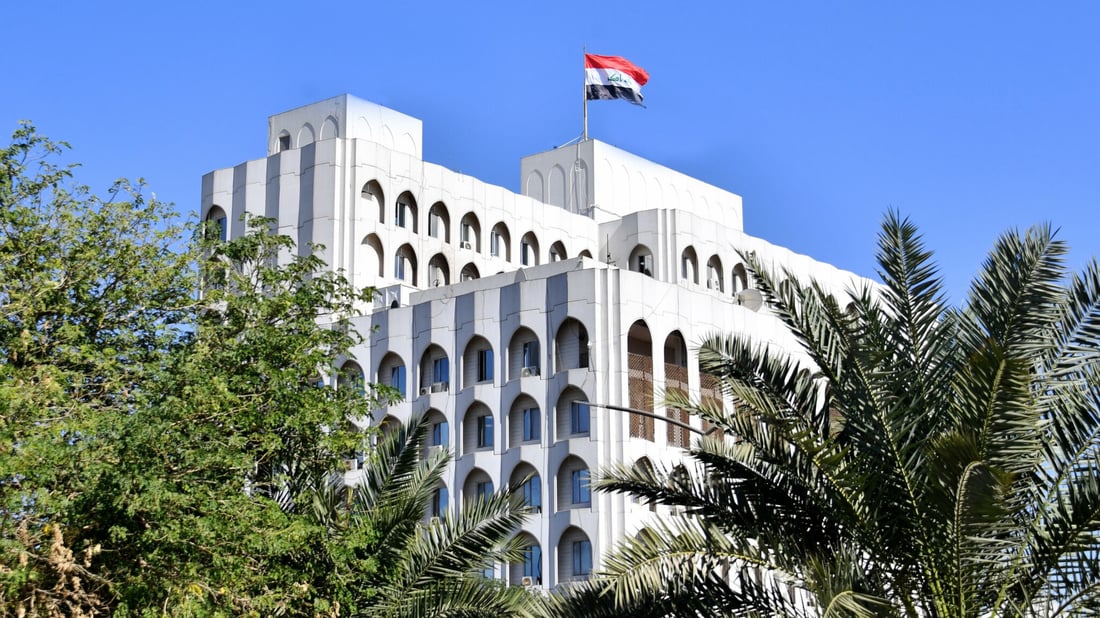
The Iraqi Foreign Ministry building in Baghdad
Iraq welcomes US-Iran agreement to end military operations
BAGHDAD — Iraq welcomed a memorandum of understanding between the United States and Iran to end military operations, the Foreign Ministry said Monday, voicing support for diplomatic efforts to resolve regional disputes.
The ministry congratulated both countries on the agreement, saying it hoped the step would strengthen regional security and stability and open “new horizons for understanding and cooperation.” “The principled and consistent position of Iraq has been, and remains, based on rejecting war and adopting dialogue and peaceful means as the only way to settle differences,” it said.
The ministry said Iraq had closely followed the negotiations leading to the memorandum and praised the mediation roles of Pakistan and Qatar. “We extend our congratulations to the governments of the Islamic Republic of Pakistan and the State of Qatar for their efforts in mediation and support for the negotiation process, leading to the end of military operations,” it said, adding that Iraq’s own experience with regional conflict reinforced its belief in the need to prevent escalation. It expressed hope the agreement would lead to a permanent end to the conflict and said Iraq would continue strengthening relations with countries affected by the crisis.
Kurdistan Region President Nechirvan Barzani welcomed the agreement on Sunday, expressing hope that all parties would work toward its implementation to support regional stability and prosperity.
The statements followed the announcement of a framework agreement between Washington and Tehran that includes an end to military operations, a commitment to further negotiations and the reopening of the Strait of Hormuz. Announced via mediator Pakistan, the arrangement is expected to ease military tensions and open a period for talks on Iran’s nuclear program and related issues, with a signing ceremony to follow.
Iraq was deeply affected by the conflict. It relies on Iranian gas for more than 30% of its electricity generation, but imports collapsed after strikes on Iran’s South Pars gas field in March. Oil production also fell sharply as the closure of the Strait of Hormuz cut off southern export routes, reducing associated gas output. Exports fell from nearly 100 million barrels in February to 18.6 million in March, while revenues dropped from more than $6.8 billion to around $1.95 billion. Because oil accounts for the vast majority of government income, the disruption rapidly translated into pressure on public finances.