
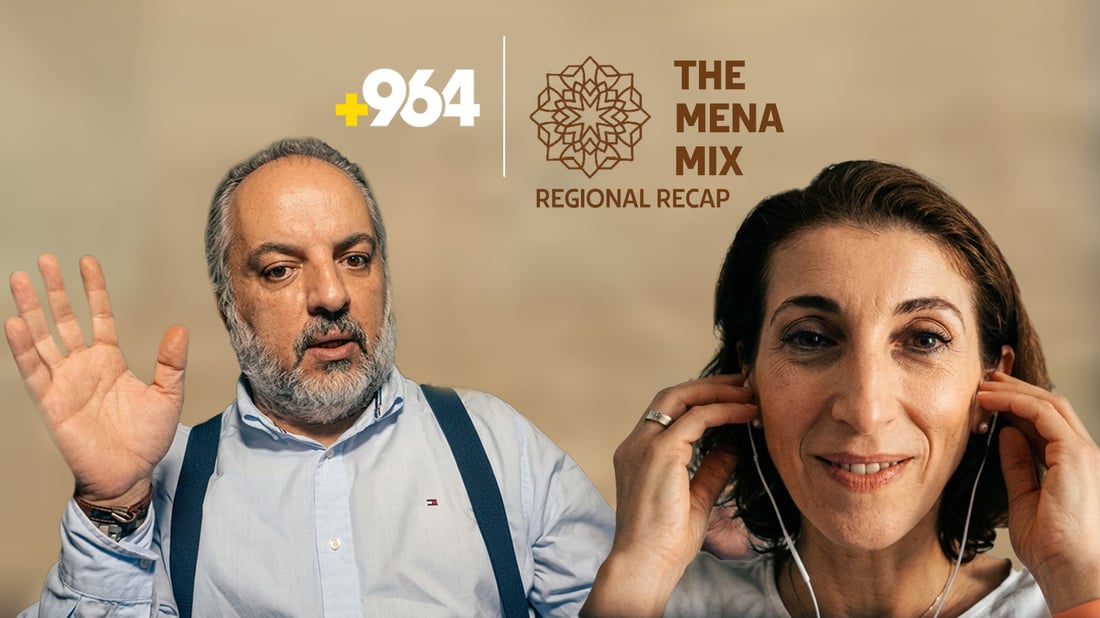
Hiwa Osman, left, speaks with IMEO associate fellow Kalina Boagach on the MENA Mix Regional Recap Podcast.
Media Monitor
Decades-old Gulf security model is breaking down, 964media’s Hiwa Osman says
BAGHDAD — The Middle East is entering a new strategic era in which long-held assumptions about Gulf security, U.S. influence, Iraq’s political balance and energy exports are being rewritten, 964media director general Hiwa Osman said in a wide-ranging interview on the “IMEO MENA Mix: Regional Recap” Podcast.
Speaking with host Kahina Bouagache, Osman said the latest Iran-Israel-U.S. confrontation has shown that the security architecture protecting Gulf states for more than four decades is no longer reliable. He described a phase of “managed escalation and managed deterrence at the same time,” with Iran, Israel and the United States each at an equilibrium point because none can afford all-out war.
Gulf security long rested on three foundations, he said: a steady flow of oil and gas, a strong American presence offering protection, and the containment of Iran. None holds today. “We have an American presence, but it doesn’t seem to be very useful. In fact, it’s a liability,” Osman said, adding that Iran is no longer contained. With the Gulf now a hub for finance, technology, artificial intelligence and logistics, he said, far more than oil is exposed in a regional crisis, pushing Gulf governments to weigh broader partnerships, including with China.
On Iraq, Osman argued that Baghdad failed to hold the neutral line its leaders publicly advocated, ending up viewing each superpower through the other’s eyes once the fighting began. That contradiction, he said, fed months of post-election paralysis until the judiciary stepped in. He credited Supreme Judicial Council President Faiq Zaidan with a central mediating role, citing people close to him, because he kept working relationships with rival camps.
Osman called armed groups under the Popular Mobilization Forces umbrella Iraq’s main structural challenge, saying many factions sided with Iran and struck beyond Iraq’s borders, including nearly 700 drone and missile attacks on the Kurdistan Region during the conflict. Washington’s main leverage over Baghdad, he argued, is financial rather than military, since Iraq depends on U.S. dollar transfers from oil revenues. Politicians, he said, can no longer be “Americans in the bank and Iranians on Twitter,” posturing about the resistance while needing U.S. approval to keep the funding flowing. “Back in 2003, it took Bush 150,000 U.S. troops to remove Saddam Hussein. Now it’s with one tweet.”
He said the funeral ceremonies planned in Iraq for Iran’s late Supreme Leader Ali Khamenei on July 8 will be read as a political test of Iranian influence more than a religious event, with turnout aimed as a message to Washington: “You think you have Iraq, but you think you have their minds? We have their hearts.”
On oil, Osman said nearly all Iraqi exports have run through the Strait of Hormuz since 2003, making any disruption a direct economic threat, and that Baghdad is again weighing routes through Turkey, Syria, Jordan’s Aqaba port and Saudi Arabia’s Yanbu terminal. But alternatives need security, political arrangements and capacity, not just money, he cautioned, calling a $3 to $4 billion pipeline near-impossible given state bureaucracy. He also doubted Gulf states would trust Iraq to carry extra exports while armed groups keep attacking their neighbors.
On Syria, Osman said rebuilding after Bashar al-Assad’s fall cannot be reduced to folding armed factions into the national army. The Kurdish question, he argued, is settled through constitutional and citizenship rights and cultural and linguistic equality, not military reintegration, with the Druze, Alawites and Kurds all represented in the political system. Decisions on minorities, he added, should stay Syrian rather than be dictated by Turkey. “This is the key challenge for Damascus today.”