
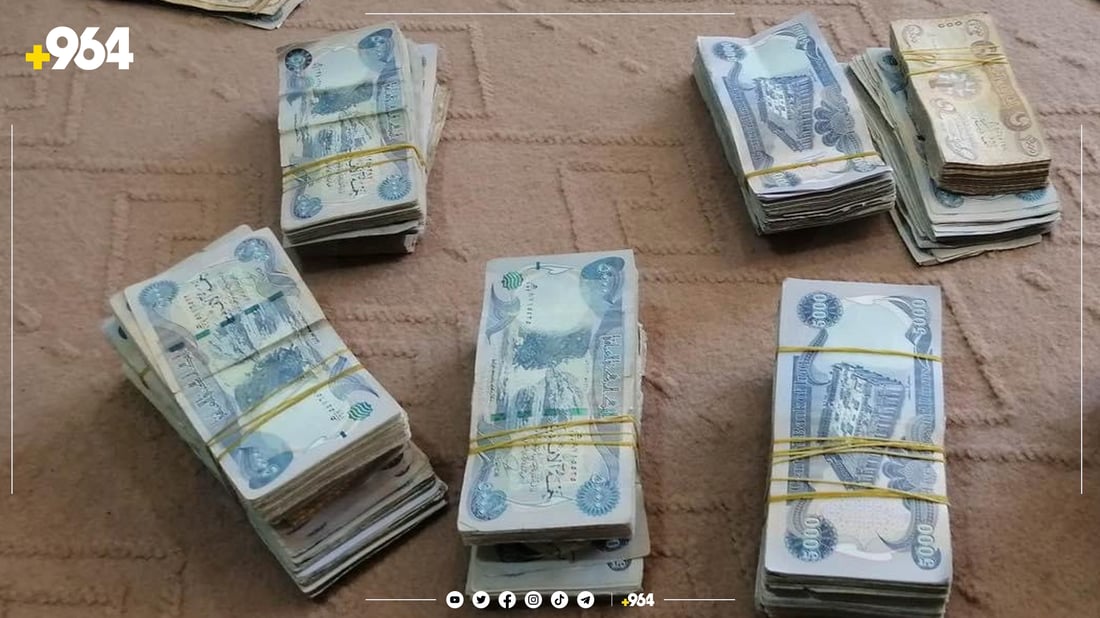
Bundles of Iraqi dinar banknotes displayed.
Fiscal crisis
Reserves are not a salary fund, Iraqi economist says
BAGHDAD — The Central Bank’s foreign reserves cannot be treated as money available to pay public salaries or cover a deficit, economist Manar al-Obaidi said Wednesday, rejecting a claim by a member of parliament’s Finance Committee that Iraq’s reserves would cover 10 months of wages.
Mansour al-Baaiji said Tuesday that Iraq holds 109 trillion dinars in reserves, about $83 billion, enough for 10 months of salaries alongside gold holdings and revenues, and that pay was fully secured. Dividing reserves by monthly salary spending produces that figure, Obaidi wrote on Facebook, but “it remains an economically and institutionally misleading comparison.”
“Foreign reserves are not a financial allocation within the budget, nor are they a free balance at the disposal of the treasury,” he said. “They are external assets held and managed by the Central Bank to achieve monetary policy objectives” — price and exchange-rate stability, financing imports and external payments, and confidence in the dinar. Reserve adequacy is normally measured in months of import cover, or against issued currency and external obligations, “not by the number of months for which salaries can be paid.”
He said reserves rise when the Central Bank buys the foreign currency generated by oil exports from the Finance Ministry and credits the government in dinars, and fall when it sells dollars to banks for imports, which also drains dinars from the banking system. “The Central Bank’s sale of dollars does not lead to the creation of a new balance for the Ministry of Finance,” he said. What gives the government dinars is converting its dollar oil revenue or drawing on balances it has already accumulated — a mechanism under strain as export earnings fall while demand for dollars continues.
A deficit is a separate matter, and does not oblige the government to borrow from the Central Bank, he said, listing existing balances, treasury bills and bonds, external borrowing, reordered spending and deferred obligations as alternatives. Article 26 of the Central Bank of Iraq Law, titled “Prohibition on lending to the Government,” bars direct or indirect credit to the government, while the bank may buy government securities on the secondary market. The prohibition has been circumvented before: during the 2020 oil price collapse the government used indirect mechanisms to draw on Central Bank funds, and Foreign Minister Fuad Hussein said in June that the state had issued 25 trillion dinars to cover its expenditure.
“Reserves exist to protect the value of the dinar and the purchasing power of salaries, not to themselves be turned into salaries,” Obaidi said. “If they are depleted to finance current spending, the state may be able to pay salaries nominally for a limited period, but in return it would risk weakening their real value and threatening the stability of the currency and the economy.”
The government confirmed in late July that Iraq is in a crisis and that salaries would no longer follow their previous schedule. July pay went out in stages from July 28, with security personnel and Popular Mobilization Forces members covered before civilian ministries, and university staff protested in Basra and Kirkuk last week over pay running up to 50 days late. Iraq exported 32.1 million barrels of crude and condensates in May and June for about $2.34 billion, roughly $1.17 billion a month, against pre-war exports of about 3.3 million barrels a day.