
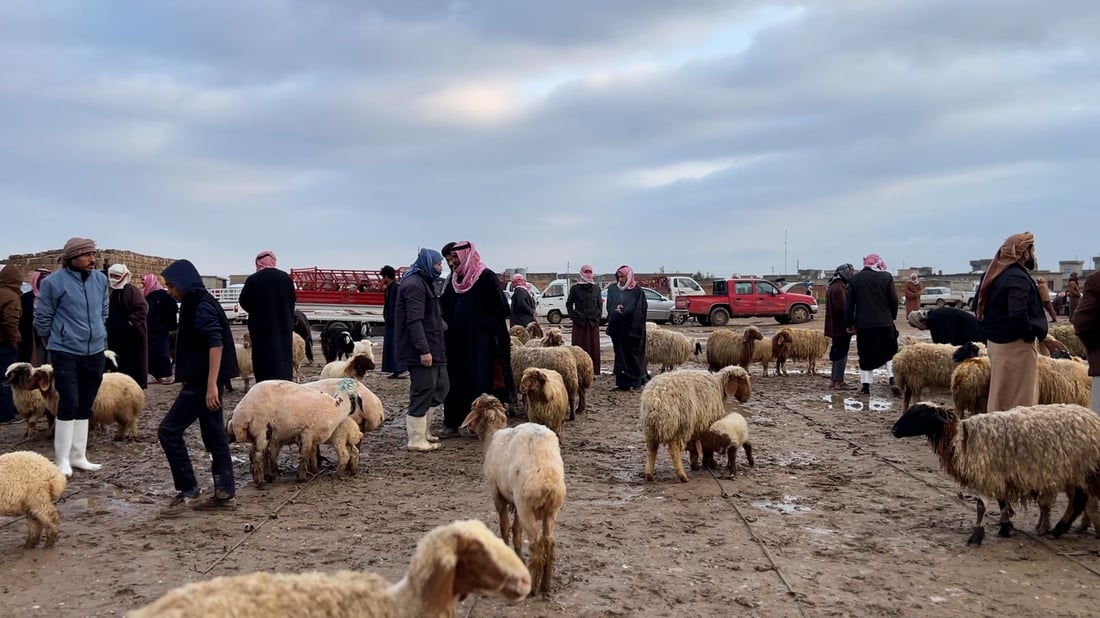
Traders and herders gather at the weekly livestock market in Tel Abta, west of Nineveh governorate, where sheep graze on natural pastures following recent rainfall. Photo by 964media
Rains breathe new life into western Nineveh livestock markets
NINEVEH — Recent rainfall has revitalized livestock markets in western Nineveh, turning pastures green and allowing herders to abandon feed supplements in favor of natural grazing — a shift traders say is driving up demand for locally raised sheep ahead of the season.
Tel Abta’s weekly Saturday market draws traders, customers and butchers from across the Jazeera region, and has seen renewed activity following the rains. Breeders say the Iraqi Naemi sheep is among the most sought-after, prized for its lean, well-proportioned build and meat quality. “The Syrian is rougher with a larger build, and the Hamdani has a larger tail,” said breeder Mizar Hayawi.
Traders say livestock raised on natural pasture produces noticeably better meat than commercially raised animals fed on protein supplements and processed feed. “Imported sheep are fed on fodder and proteins,” said trader Jajan Mishaan. Young herder Abdulrahman Mohammed said sheep are identified by color and markings — “Absa” for black-faced, “Shaala” for yellowish, “Daraa” for black-chested, “Rakhma” for reddish and “Baqma” for black-mouthed — and that age can be read from the teeth.
Current market prices have ewes with newborn lambs ranging from 500,000 to 700,000 dinars ($322 to $452), weaned lambs aged three months or more at 400,000 to 700,000 dinars ($258 to $452), young male camels at around 1.5 million dinars ($968) and female camels before breeding at around 2 million dinars ($1,290), with camel prices rising during Eid al-Adha.
Traders called for infrastructure improvements to the market, including paving or graveling the ground and reducing fees, which currently stand at 10,000 dinars (about $6.45) per pair of sheep.