
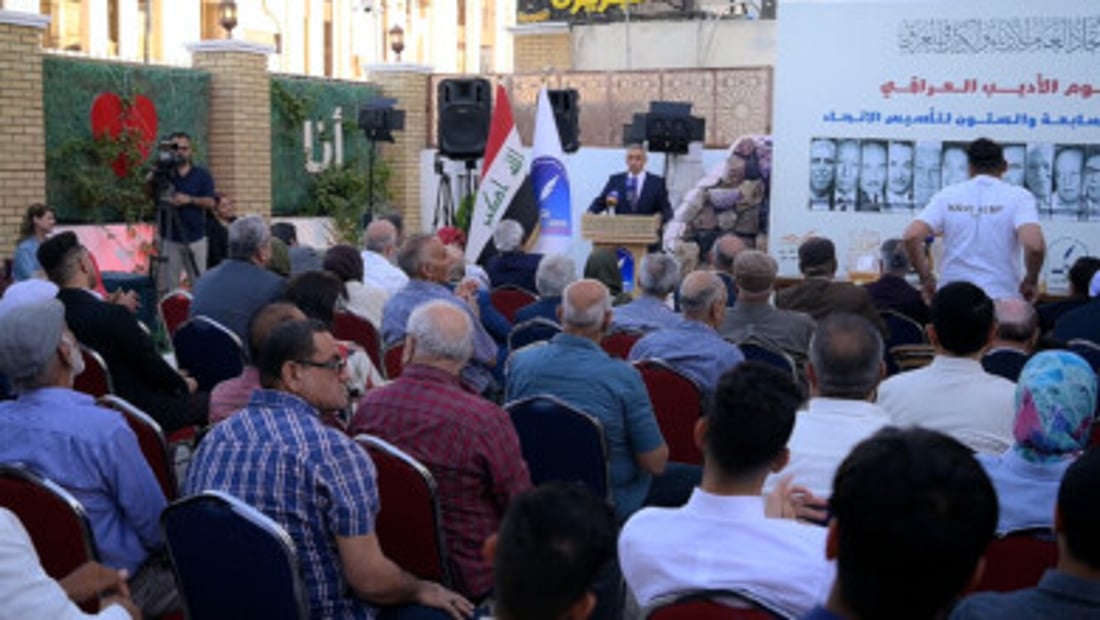
Iraqi writers’ union marks 67th anniversary with celebration of Jawahiri and Sayyab
BAGHDAD — The Union of Iraqi Writers celebrated the 67th anniversary of its founding on Thursday at its Baghdad headquarters on Andalus Square — known among intellectuals as the House of Jawahiri — with poets, novelists and cultural figures gathering to commemorate the generation that established the union in 1959.
The union was founded on May 7, 1959, in the months following the revolution that ended the Hashemite monarchy, with Mohammed Mahdi al-Jawahiri elected its first president by acclamation at the inaugural session. The building carries a large portrait of him in its central courtyard and a lecture hall decorated with images of prominent Iraqi poets.
“This day is a milestone in Iraqi culture, because the writer is an important part of society and represents the conscience of the people through literary texts, criticism and intellectual writings,” said Munther Abdul Hur, secretary for cultural affairs at the union.
Speakers focused on two figures regarded as the defining voices of modern Iraqi literature. The first was Jawahiri himself, born in Najaf in 1899 into a family of religious scholars, who became one of the most celebrated neoclassical poets in the Arab world. His poetry engaged with successive Iraqi regimes — the monarchy, the republic and the Ba’ath — earning him repeated exile. He left Iraq for the last time in 1979, settling between Damascus and Prague, and died in Damascus in 1997 at the age of 98.
Khayaal Mohammed, daughter of the poet, said members of the union represent an extension of his literary and national legacy. “His works, heritage and love for the homeland are still alive. History bears witness to his national, revolutionary and emancipatory positions,” she said, adding that both poets’ homes have become cultural landmarks in Iraq.
The second figure honored was Badr Shakir al-Sayyab, born in 1926 in the village of Jaykur near Basra. Alongside fellow Iraqi poet Nazik al-Mala’ika, Sayyab launched the free verse movement in Arabic poetry in the late 1940s, breaking from classical meters and drawing on Mesopotamian mythology and the influence of T.S. Eliot. His 1960 collection “Rain Song” is widely regarded as one of the landmark works of modern Arabic poetry. He died in Kuwait in 1964 at the age of 38.
“There is no substitute for them. This celebration of Iraqi Writer’s Day is essentially a celebration of Jawahiri and Sayyab,” said poet Yahya al-Samawi. Novelist Aryan Saber said the two poets “drew the roadmap” for later generations. “We are trying in turn to draw the path for future generations after us,” he said.