
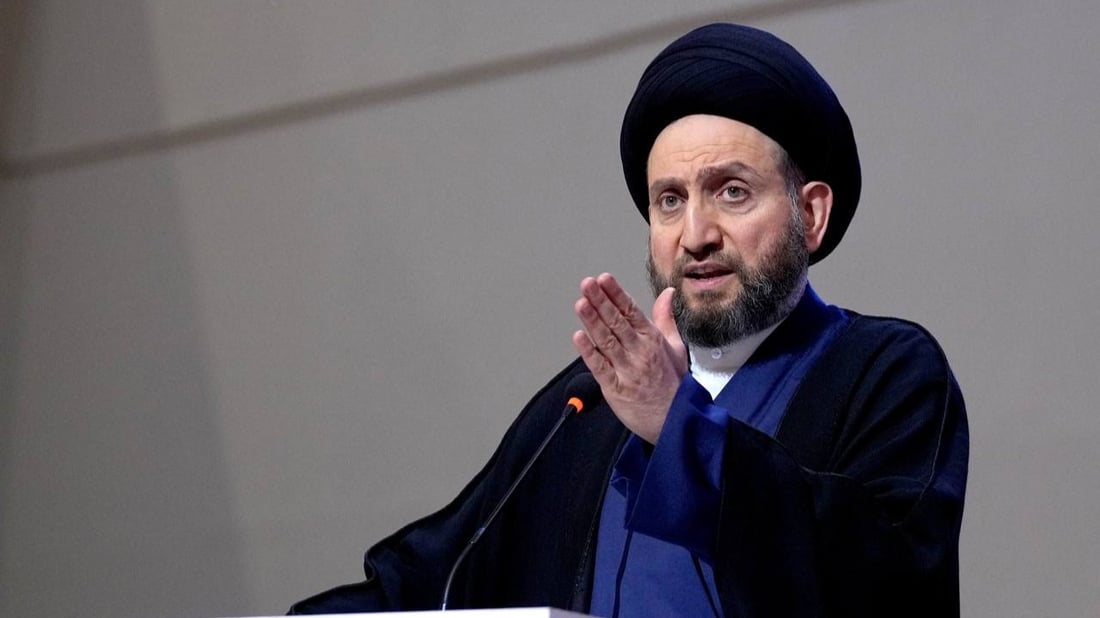
Ammar Al-Hakim, head of the Hikma Movement
Media Monitor
Hakim backs corruption drive but urges dialogue on weapons
BAGHDAD — Ammar al-Hakim urged the government on Saturday to press on with its anti-corruption campaign and go after “the big cases,” while arguing that the separate effort to bring weapons under state control should be settled by dialogue rather than confrontation.
Speaking at a meeting of the Hikma Movement’s advisory body, Hakim said “understanding and dialogue are the best way to resolve this issue,” and stressed respecting the circumstances of armed factions that “made sacrifices and gave martyrs in fighting terrorism and liberating the land.” He also called for the cabinet to be completed and the process accelerated “so that we have a complete government that can move forward with implementing its program.”
On the economy, Hakim said the region is in “exceptional circumstances” because of the conflict between the United States and Iran, and that Iraq’s economy has been affected. He said Iraqi oil exports had stopped and called for export routes to be diversified, along with the country’s income sources across agriculture, industry, tourism, investment and technology. Exports have fallen sharply rather than halted: Iraq shipped 32.1 million barrels of crude and condensates in May and June for about $2.34 billion, roughly 526,000 barrels a day against about 3.3 million before the war, and the Oil Ministry said this month that tankers were again crossing the Strait of Hormuz.
He backed the government’s efforts to build relations in the region and internationally, and called for e-governance and digitalisation to improve transparency and protect public funds.
Investigations have widened since the arrest of former Deputy Oil Minister Adnan al-Jumaili in May. A court has ordered the arrest of former Labor Minister Ahmed al-Asadi, Baghdad’s Karkh Court of Appeal has asked parliament to lift the immunity of lawmaker Nazem al-Asadi over contracts awarded to a company the court says the two founded together, and security forces arrested National Masses Party leader Ahmed al-Jubouri last week.
Prime Minister Ali al-Zaidi told Coordination Framework leaders last week that completing his government is close, three months after parliament approved him with five ministries rejected and four left unvoted. He has set Sept. 30, when the U.S.-led coalition mission ends, as the date for bringing all weapons under state control. Saraya al-Salam, Asaib Ahl al-Haq and the Imam Ali Battalions have moved to comply; Kataib Hezbollah, Harakat al-Nujaba and Kataib Sayyid al-Shuhada have refused.