
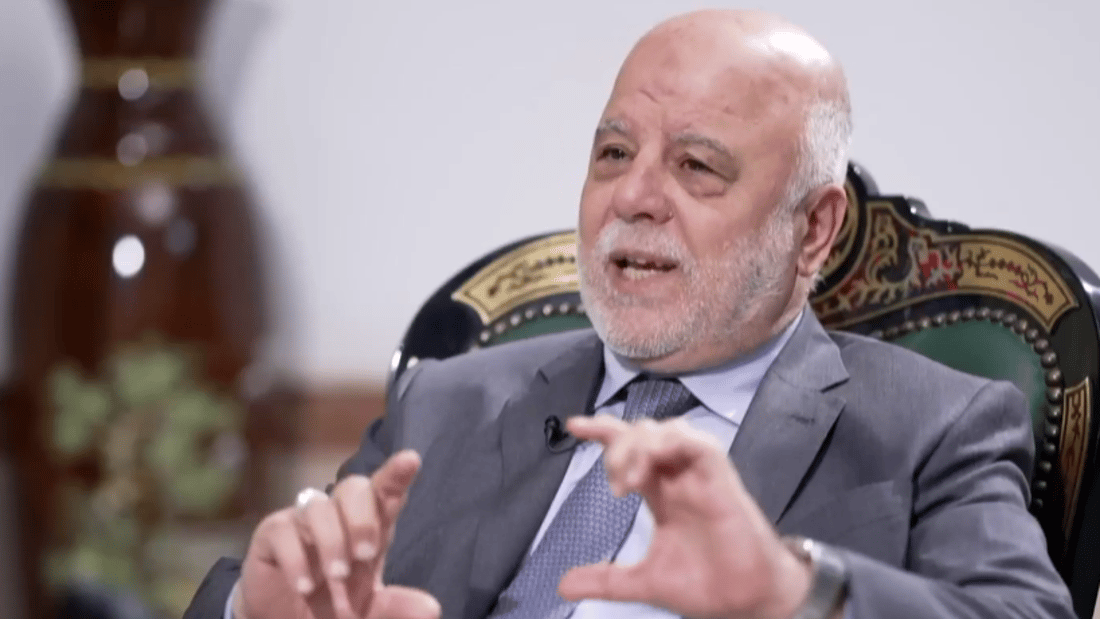
Al-Nasr Coalition leader Haider Al-Abadi
Media Monitor
Abadi advises Zaidi to avoid direct confrontation with armed factions
BAGHDAD — Former Prime Minister Haider al-Abadi advised Prime Minister-designate Ali al-Zaidi against entering into direct confrontation with armed factions or the Popular Mobilization Forces, urging him instead to rely on political dialogue and diplomatic mechanisms to address the issue of weapons outside state control.
Salam al-Zubaidi, spokesperson for Abadi’s Al-Nasr Coalition, said Abadi delivered the advice during a meeting with Zaidi, warning him that directly confronting armed groups would be counterproductive. “Do not open a direct line of confrontation with the factions or the Popular Mobilization Forces, and limiting weapons should be within diplomatic mechanisms and political methods to solve this issue,” Zubaidi quoted Abadi as saying.
Abadi framed the factions as part of Iraq’s state structure, saying they “are part of the Iraqi state and part of the jihad and liberation of Iraq,” and argued they should be contained and integrated into state institutions rather than confronted. He also advised Zaidi to work through Coordination Framework partners who have influence over the factions to reach understandings on weapons.
On the role of Iran, Abadi linked some factions’ resistance to disarmament to their dependence on Iranian support. “Some factions, especially the faction of Akram al-Kaabi and Kataib Hezbollah, are considered an extension of Iran, and if Iranian support is removed from them, the situation will change,” Zubaidi quoted him as saying. He said Zaidi should raise the issue directly with Tehran.
The U.S. State Department’s Rewards for Justice program has announced rewards of up to $10 million each for information on three faction leaders in recent weeks: Harakat al-Nujaba founder Akram al-Kaabi, Kataib Hezbollah leader Ahmad al-Hamidawi and Kataib Sayyid al-Shuhada secretary-general Abu Ala al-Walaei.
Since the regional war began in late February, Iran-aligned factions under the Islamic Resistance in Iraq umbrella have carried out repeated drone, rocket and missile attacks on U.S. military and diplomatic targets in Baghdad and the Kurdistan Region. The United States has simultaneously struck PMF-linked positions across multiple governorates, killing dozens of fighters.