
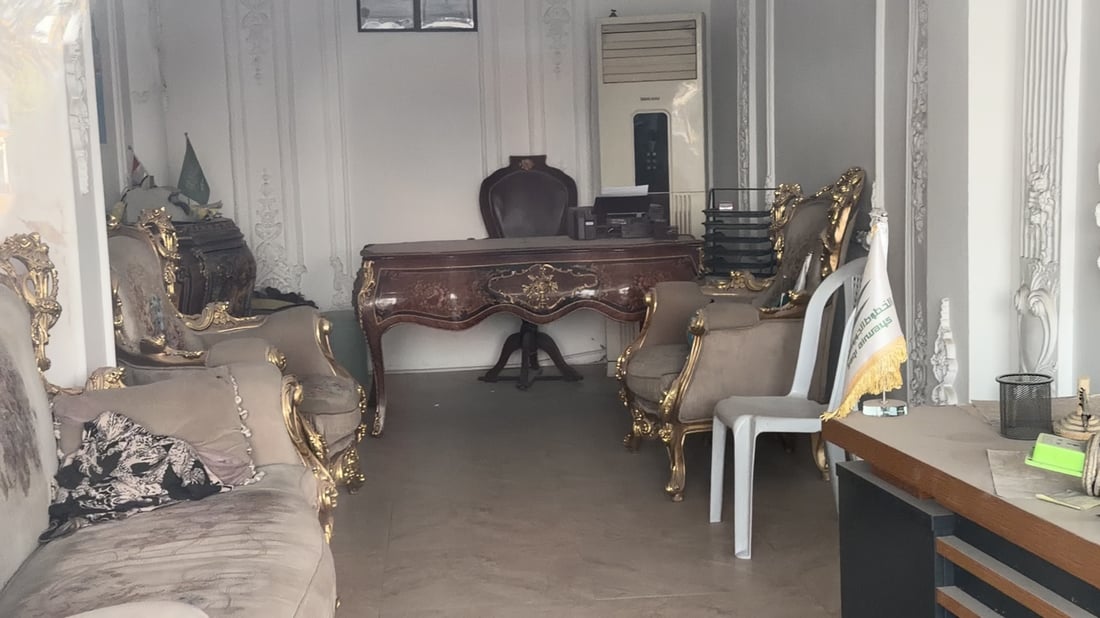
The interior of a travel company office in Baghdad. Photo: 964media
Fake Umrah companies take passports and cash, then vanish
BAGHDAD — Ali al-Aboudi gave a travel agency three passports and $1,000 for an Umrah trip. Days later the office was shut. It took him seven months to get a letter allowing him to replace the passports.
Fraudulent travel companies are advertising Umrah packages for as little as $300 on social media, then closing their offices after collecting money and passports, say victims, licensed operators and a government official.
Aboudi handed a company three passports and $1,000 before it shut down days later. “I spent seven months between the police and the court before I obtained only a letter to replace the lost passports,” he said, adding that dozens of people were deceived the same way. “The advertisements on social media and the attractive prices were the reason we fell into the trap.”
Some travelers reached Saudi Arabia before discovering the problem. Sara Khalid said her family and other pilgrims paid in full, and some arrived to find no bookings or accommodation. “They found themselves in the street after the company disappeared, and the shock was great,” she said. Assaf Ghazi said his family gave passports and money to a company advertising discounted packages before its owners disappeared. “These cases have become recurrent, so we filed a complaint to recover our rights,” he said.
The advertised prices are below the market. Recent Iraqi listings put overland Umrah packages at about 575,000 to 650,000 dinars (roughly $375 to $425) and air travel at 750,000 to 1.15 million dinars ($490 to $750), varying by hotel, trip length and meals.
Hassan Fahd al-Kinani, spokesperson for the High Commission for Hajj and Umrah, said one owner of a fraudulent company had been arrested in coordination with the Interior Ministry. “There is no such thing as commercial Hajj, and all licensed Umrah companies are published on the commission’s official website,” he said. “Any company outside these lists falls outside the commission’s responsibility and will be pursued legally in coordination with the relevant authorities.”
Licensed operators say the schemes have damaged confidence in established firms. Ahmed Akram Salman, director of Diyar al-Iraq and al-Burooj, said fraudulent businesses exploit the system of sub-agencies. “The solution lies in tightening the procedures for granting licenses and requiring agents to provide guarantees and undergo checks before approvals are issued, because reputable companies are the first to suffer,” he said. Nazim al-Badrani, owner of Manar al-Duha, said heavily promoted low-cost offers encourage people to deal with unknown firms, and that “it is difficult to pursue these offices unless formal complaints are filed against them.”
Hameed al-Mashaykhi, owner of al-Siqaya, said some operators set up temporary offices after limited experience, collect payments and disappear. Company manager Saif Hameed said fraudsters postpone departures while taking money from as many customers as possible before closing. “A legitimate company holds proper approvals that can be easily verified,” he said.