
Op-ed
A nation divided
When Jonathan Randal’s book about the Kurds was translated into Arabic, its publishers gave it a new title: “A Nation Divided”.
Randal himself had called it “After Such Knowledge, What Forgiveness?”, but the Arabic edition chose its own framing, and that editorial choice was what stung.
The phrase felt harsh at the time, condescending toward a people emerging from a century of disappointment, fragmentation and war. Many read it as a reductive verdict on a nation still searching for its place among states. I was among them.
But the more I look at the Kurdish political scene today, the more I find myself returning to that title, and the less I find to argue with.
Not because the Kurds lack a cause, or history, or sacrifice, or political weight, but because they remain unable to answer a question more dangerous than any external pressure: can they act as one when the moment demands it?
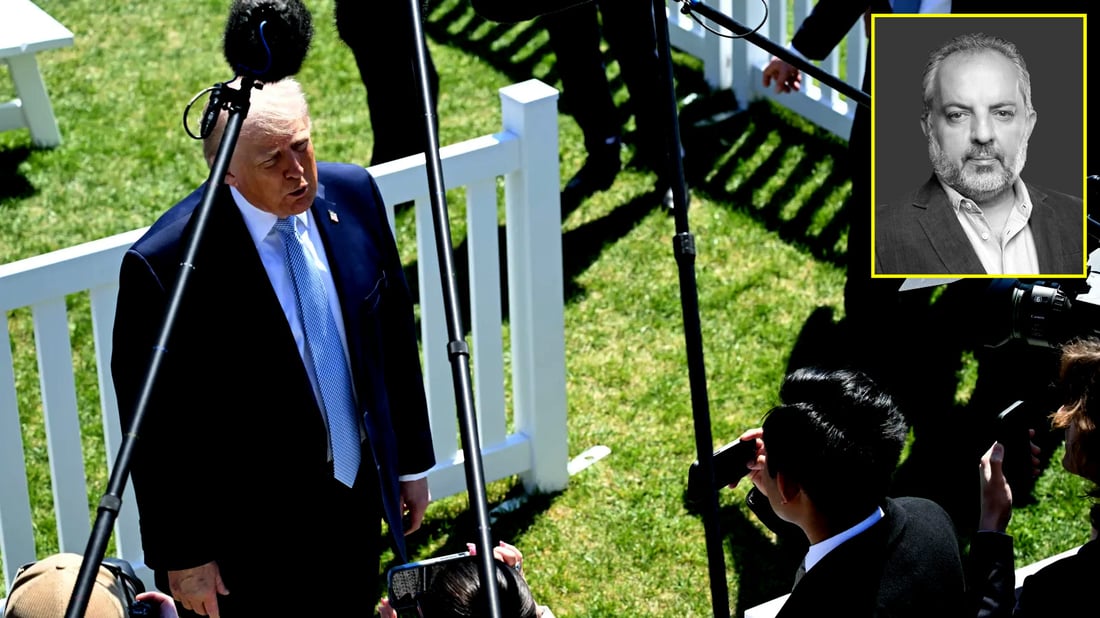
When Donald Trump recently claimed that weapons had been moved to Iran through the Kurds, the response was telling. The denial came swiftly, but it did not come as one voice. Each of the two main Kurdish parties absolved itself and gestured toward the other, in the familiar mixture of denial and indirect accusation tied to an old rivalry that never really leaves the scene. That is where the real problem lies.
For years, the dominant explanation for the Kurdish dilemma in the region was simple: major powers use them, then abandon them. It is not entirely wrong, but it is no longer enough. The issue today is not only what is done to the Kurds, but whether they can function as a single actor in regional and international equations. And this division no longer appears to be the exception. It has become the rule.
We see it in the formation of the Kurdistan Regional Government, where a process that began with elections more than a year ago has turned into open-ended bargaining with no clear end.
We see it in Baghdad, where there is no unified Kurdish representation, only fragmented actors negotiating in different directions. We saw it in the selection of Iraq’s president, a position once treated as a historic Kurdish prerogative before becoming the subject of internal Kurdish rivalry.
And we see it now in perhaps the simplest possible test: responding to an external accusation. Even in a moment like that, the question was not how to confront the narrative. It became how to use it against one another.
This helps explain a scene that has come to repeat itself. An Iraqi prime minister-designate visits Erbil, then Sulaymaniyah, then returns to Baghdad. What he carries back is not a Kurdish position, but several Kurdish positions. In a political system built on careful balances between regions, parties and sects, so many competing voices cannot be meaningfully negotiated with.
In politics, it is not only the weak who are marginalized. Those without a unified stance are sidelined too.
The question then becomes a different one. Do the Kurds present themselves as a side others can deal with coherently? Regional and international powers do not search for justice as much as they search for clarity. They look for a partner that knows what it wants and can commit to it.
In the Kurdish case, there is often more than one position, more than one interpretation and more than one direction at the same time.
Division is no longer always a conscious choice. It has become a structure of its own. A structure in which every external crisis turns into an internal dispute, and every political opportunity becomes a competition over who gets to claim it.
Yet perhaps the deeper question is not only about Kurdish division itself. In the history of this region, internal conflicts are rarely allowed to end decisively in favor of one side. Not always because that side cannot prevail, but because the surrounding environment does not treat decisive outcomes as desirable. Division, despite its cost, remains manageable. A conclusive resolution creates a new reality that is harder to control.
So conflicts are neither resolved nor pushed toward resolution. They are managed: an unstable balance that keeps everyone dependent and prevents any one actor from becoming an coherent center of decision-making.
In that context, division is no longer merely an internal outcome. It becomes part of a wider equation. One that does not call for unity, does not ask for resolution, but simply demands stasis.
That is why, whenever a decisive moment arrives, in war, in negotiation, or in something as simple as an accusation, the question is never what will we do. It becomes who will speak for us. And that is the question the Kurds still cannot answer.
In today’s regional and international landscape, it is not only those without power who are excluded. Those without unity of decision are sidelined too. The greatest obstacle facing the Kurds today is therefore not external. It lies in their ability to be Kurds first, before they are parties.
And perhaps that is also why, when Trump spoke of the Kurds as a single actor, he was not describing an existing reality. He was making use of its absence.
He knew the response would not come in one voice, but in scattered ones, and that none of them alone would be enough to dismantle the narrative he reached for to justify the failure of his attempt to open a Kurdish front inside Iran.
Hiwa Osman is the director general of 964media