
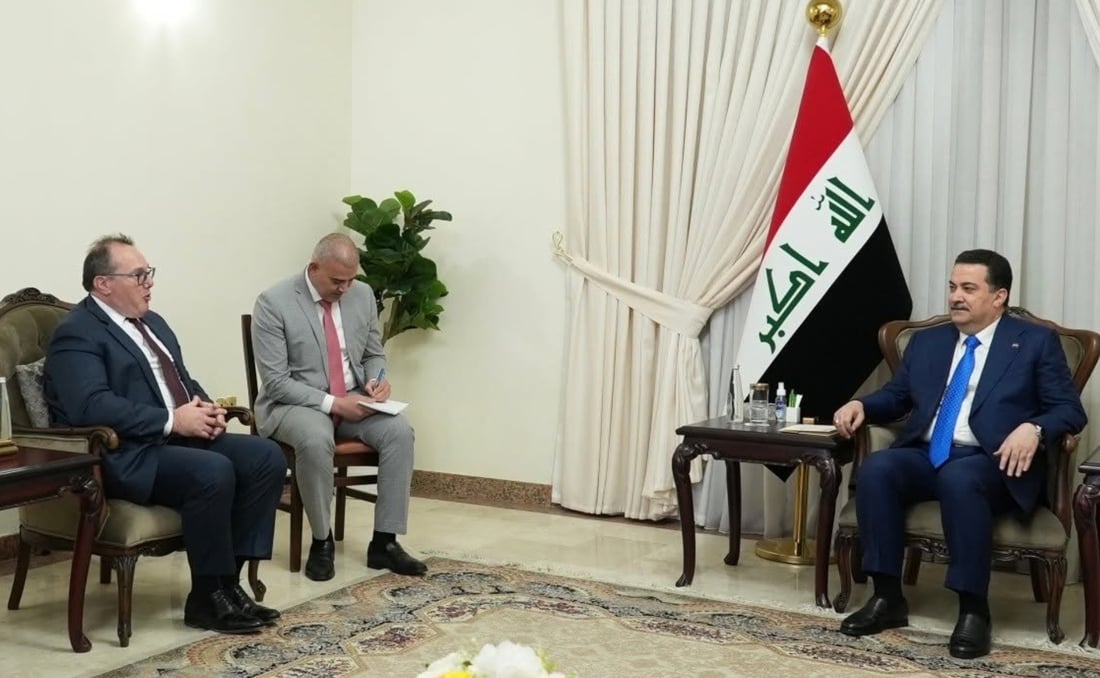
Sudani: Coordination Framework backs PM to implement weapons restriction plan
BAGHDAD — Mohammed Shia al-Sudani, head of the Reconstruction and Development Coalition, said the Coordination Framework has authorized Prime Minister Ali al-Zaidi to move forward with implementing the government program on restricting weapons to state control, following a meeting with U.S. Embassy Chargé d’Affaires Joshua Harris.
Sudani said “the Reconstruction and Development Coalition and the rest of the Coordination Framework forces authorized the prime minister to implement what was stated in the government program regarding restricting weapons to the hands of the state,” stressing continued support for “the plan in place to facilitate the implementation of this path, in a way that enhances the authority of the state and preserves security and stability.”
He also stressed the need to legislate laws regulating the rights of the PMF and its members “in a way that guarantees preserving their sacrifices and strengthens their presence within the legal and institutional frameworks of the state.”
On bilateral relations, Sudani said Iraq seeks to develop ties with the United States in economic development, energy, investment and infrastructure, describing Iraq as moving “seriously toward providing a safe and attractive investment environment.” He added that Iraq aims to achieve independence in the gas and energy sectors through local production and diversified oil export outlets, and called for shifting the U.S.-Iraq military relationship toward bilateral cooperation rather than the international coalition formula.
Harris expressed U.S. appreciation for efforts to restrict weapons to the state and reaffirmed Washington’s readiness to support Iraq’s energy sector and proceed with projects tied to bilateral memorandums of understanding signed by U.S. companies.
Iraq formally began integrating Saraya al-Salam into the state security structure at a ceremony in Samarra last Thursday, following Muqtada al-Sadr’s May 27 announcement that the group would come under state authority. The precise command structure for compliant factions has not been publicly detailed, with official statements using broad terms such as “integration” and “restructuring” without specifying whether fighters will be absorbed individually into army units or remain as intact formations.
Harakat al-Nujaba, Kataib Hezbollah and Kataib Sayyid al-Shuhada have rejected disarmament, describing their weapons as “a trust and a duty.” The U.S. State Department’s Rewards for Justice program has offered up to $10 million each for information on Harakat al-Nujaba’s Akram al-Kaabi, Kataib Hezbollah leader Ahmad al-Hamidawi and Kataib Sayyid al-Shuhada secretary-general Abu Ala al-Walaei.
Since the regional war began in late February, Iran-aligned factions under the Islamic Resistance in Iraq umbrella have carried out repeated drone, rocket and missile attacks on U.S. military and diplomatic targets in Baghdad and the Kurdistan Region, while the United States has struck PMF-linked positions across multiple governorates, killing dozens of fighters.