
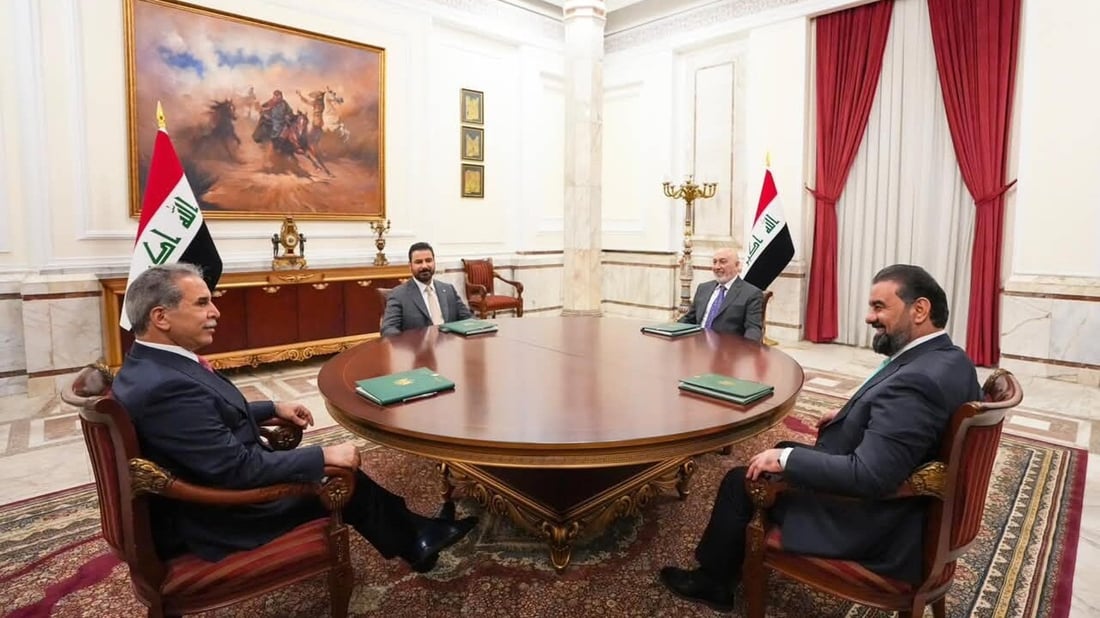
Iraq's four presidencies during a meeting on Wednesday, June 11, 2026.
Iraq’s top leaders back weapons restriction, urge swift completion of cabinet
BAGHDAD — Iraq’s president, prime minister, parliament speaker and judiciary chief met Wednesday at Baghdad Palace to stress support for restricting weapons to state control and to call for the swift completion of Prime Minister Ali al-Zaidi’s cabinet.
President Nizar Amedi hosted the meeting, attended by al-Zaidi, Parliament Speaker Haibat al-Halbousi and Supreme Judicial Council President Faiq Zaidan. The leaders discussed political, security and economic developments as well as regional issues.
The four presidencies affirmed their commitment to “the principle of restricting weapons to the state as a fundamental pillar of the rule of law and the consolidation of state authority,” praising groups that have moved to sever ties with the Popular Mobilization Forces in accordance with the constitution and the law. They also affirmed that “security and military decisions must be exclusively in the hands of the Iraqi state, its constitutional institutions and under the command of the commander-in-chief of the armed forces.”
The leaders stressed the “necessity of expediting the completion of the cabinet at the earliest opportunity,” saying the move would raise the efficiency of government performance and strengthen executive institutions’ ability to implement the ministerial program. Nine of the government’s 23 ministries remain unapproved after political parties failed to reach consensus during the May 14 confidence session. Al-Zaidi took the constitutional oath on May 16.
The meeting comes as Iraq formally began integrating Saraya al-Salam into the state security structure at a ceremony in Samarra last Thursday, following Muqtada al-Sadr’s May 27 announcement that the group would come under state authority. The precise command structure for compliant factions has not been publicly detailed, with official statements using broad terms such as “integration” and “restructuring” without specifying whether fighters will be absorbed individually into army units or remain as intact formations.
Harakat al-Nujaba, Kataib Hezbollah and Kataib Sayyid al-Shuhada have rejected disarmament, describing their weapons as “a trust and a duty.” The U.S. State Department’s Rewards for Justice program has offered up to $10 million each for information on Harakat al-Nujaba’s Akram al-Kaabi, Kataib Hezbollah leader Ahmad al-Hamidawi and Kataib Sayyid al-Shuhada secretary-general Abu Ala al-Walaei.
Since the regional war began in late February, Iran-aligned factions under the Islamic Resistance in Iraq umbrella have carried out repeated drone, rocket and missile attacks on U.S. military and diplomatic targets in Baghdad and the Kurdistan Region, while the United States has struck PMF-linked positions across multiple governorates, killing dozens of fighters.